
The Tripod of Meditation
Meditation is a journey into Nirvichara (silence). It’s a journey of the self, throughout the self, to the self. Meditation is one of the organs of Yoga. It is the final tool or key for the entire journey of yoga. Yoga is more about Meditation. The physical practice is the vehicle for meditation and meditation is a vehicle for Yoga or Samadhi. There are no types of Meditation, just the pathways or techniques for meditation. There are thousands of techniques for meditation. Among the eight limbs of Patanjali Yoga, the first five limbs, already described, are external (bahiranga) and the remaining three are internal (antaranga). The internal ones are: dharana, dhyana, and Samadhi. These three constitute the tripod of meditation yoga.
1. Dharana
To fix the Chitta (mind) to a particular location is called Dharana. This word has been derived from the Sanskrit verb root dhr, which means ‘hold’. The place to which the Chitta is bound may be internal or external. When it is internal, it may be a chakra inside the body like the ajna-chakra (the spot between the two eyebrows) or some tissue, organ, or limb of the body. When it is external, it may be the image of a deity, a crystal, a colored or a black or a white spot, or any other external object. Maharsi Patanjali has defined dharana in one of his aphorisms.
2. Dhyanam
Having fixed the chitta to a particular location, the yogi’s mind remains busy with a single thought which continues to be one alone and which becomes continuous and uninterrupted. The single thought may be likened to the continuous flow of oil when poured from one container to another. Maharsi Patanjali has defined dhyana, as has been outlined here.
The word dhyana has been derived from the Sanskrit verb root dhyai, which means ‘to think’ to contemplate, to meditate on, to call to mind’.
Some Yoga Schools use the term bhavatta dhyana (transcendental dhyana). Such a use does not conform to the usage in classical yoga, however. There is a thought in dhyana, although single and continuously flowing. If dhyana transcends thought, it is not Dhyana at all (It is Samadhi). Of course, ‘meditation’ is a word that is not equivalent to ‘dhyana’. Meditation may be transcendental, but not dhyana.
Patanjali has used the word pratyaya in his aphorism. It contextually means ‘conception, notion or idea’. What flows in dhyana is one idea.
3. Samadhi
The word Samadhi has two prefixes, namely, sam and. It is derived from the Sanskrit verb –root dha. It means ‘to place, to put, to hold or to fix together’ and may mean ‘joining or combining with’. Here we introduce the word dhyeya. What is meditated on is dhyeya. It is the idea or notion on which dhyana is done. It is the object on which one meditates. Patanjali’s definition of Samadhi is stated here: When the contemplation shines forth in consciousness as the intended object on which one meditates.
We may discuss the topic of Samadhi in two stages, the initial and the final. The initial ones are with seed (sabija) or with support (salambana) whereas the final ones are without seed (nirbija) or support (niralambana). Samapatti is the Samadhi with seed. The word means ‘to be like that’. According to Patanjali’s definition, the rajas and tamas whirls of mind being dwindled, and the citta being crystal clear, with reference either to the knower or to the process of knowing or to the object-to-be-known. The citta attains samapatti by acquiring the form of one of these three, being tinged by one of these three.
The dhyeya (the object meditated upon) is gross in the deliberative (savitarka) and super-deliberative ( nirvitarka) samapattis whereas it is subtle in the reflective (savicara) and super-reflective (nirvicara) samapattis. The subtle dhyeya is one of the five tanmatras.
In the savitarka samapatti, distinctions among the world (sabda), intended-object (artha) and the idea (jnana) are maintained and the citta becomes one with each of them. While in the nirvitarka samapatti, the yogi’s citta gets rid of the word and the idea and becomes identified with the intended object.
In the savicara samapatti, the place (desa), time (kala), and cause (nimitta) of the subtle dhyeya are distinguished and the yogi’s cittas become one with each of them. In the nirvicara, samapatti, the yogi’s citta makes no distinctions of the place, time, and cause of the subtle dhyeya and becomes one with the subtle dhyeya only.
All four types of samapatti, described here, are with seed (sabija). Patanjali names them as sabija Samadhi. The savitarka and savicara types of Samadhi are savikalpa whereas the nirvitarka and nirvicara types of Samadhi are nirvikalpa. The sabija Samadhi is otherwise known as samprajnata Samadhi and the nirbija Samadhi as asamprajnata Samadhi. In the latter, the citta rests in the purusa.
In the nirvitarka and nirvicara samadhis which are devoid of vikalpas (distinctive deliberations and reflections), the dhyeya is gross and subtle, respectively. It is the dhyeya that serves as the support. In this meditational state, the whirls of mind (cittavrtti) do not completely cease to be. And hence this Samadhi is sabija. There is some sort of cittavrtti since there is awareness of the yogi on his identification with the dhyeya. The emerging cittavrtti is the seed (bija) that still remains.
By the efficient and prolonged practice of nirvikalpa Samadhi, the refined intellect (prajna) of the yogi realizes the Truth Maharsi Patanjali uses the term rtambhara prajna which also generates samskaras, albeit begin in nature. As usual, these samskaras are also imprinted on the karmasaya, the reservoir of an instrument (antahkarana) of the subtle body. The samskaras produced by the ttambhara prajna antagonize and uproot the other types of samskaras that already lie in the karmasaya. The other types of samskaras are rooted in the five klesas (avidya, asmita, raga, dvesa, abhinivesa). Thus the klesamula samskaras are erased and their place is occupied by the rtambhara prajna samskaras.
Through sustained practice of the higher type of Samadhi, the yogi develops vairagya ( freedom from worldly passion; the freedom from all worldly desires) and anasakti (non-attachment). This results in the complete erasure of all traces of the rtambhara –prajna samskaras. Thus the citta has either seeds or roots of vrttis( whirls). This Samadhi is nirbija ( seedless). This is the culminating state of yoga, in which the yogi’s purusa ( self) is detached from prakriti (the primordial nature) and attains kaivalya ( the liberated state of isolation).
Samyama
The yogic processes of dharana, dhyana, and Samadhi, done together at a time, are known as samyana. This samyana is very important in yoga. In most cases, it is samyana that a yogi practices instead of dharana, dhyana, or Samadhi, practiced separately.
If you want to learn about meditation in detail, Join us at Himalayan Yoga Academy in our Meditation Courses in Nepal. We offer various courses like yoga teacher training in Nepal, singing bowl courses, reiki training, Ayurveda Training, and many more. Also, we provide a special meditation package (42 Hours) which will provide you insight into details of the pathways of meditation, meditation techniques, and many more.
Kirtan and The Power of Devotion
We present an article on Kirtan and the power of Devotion. Chanting is a rhythmical repetition of a prayer, sound, or word that can express devotion, gratitude, peace, and compassion. By chanting, it connects us symbolically and physically to nature and all other living beings. Bhakti Yoga is defined as a path of devotion. It is the practice of concentrating one`s mind, emotions, and senses on the Divine. The ideas and practices of Bhakti Yoga originated throughout India from the 12th to 18th century. Bhakti marga is a part of religious practice in Vaishnavism, Shaivism, and Shaktism. The motive of bhakti-yoga practitioners is to attain oneness with the divine and to utilize the energy through faithful devotion.
Bhakti yoga means ultimate surrender to the divine. Its goal is to revive that state of pure consciousness and enter into the divine world. Bhakti is a very deep, pure, beautiful, and intense emotion of love of the devotee for the divine. Bhakti yoga is also about the union with universal energy or universe. It includes all religions by not specifying one particular object of devotion. It is a celebration of universal consciousness and the Divine in everything. Kirtan, the act of praising or chanting words, names, or mantras, is done in bhakti-yoga to enhance an individual’s practice.
Although this practice is the simple one but the spiritual process of chanting leads us to connect within ourselves and the Divine.
Throughout the chanting, you consciously immerse yourself in the flow and atmosphere of prayer and slowly move into its meditative state. Chanting is widely practiced to cope with negative and stressful emotions. By chanting we express our emotions into our external voice. Kirtan is a devotional practice like chanting the name and glories of God. It includes levels of music, singing, and rhythm to reach across infinite space-digging into the heart’s deepest well and the universe by permeating vibrations. Kirtan is vessel that can hold love, union, longing, separation, lust, despair, mourning, and anger. The heartbeat and vibrations increase when chanting. The sound strongly resonates with the human body. The sound is absorbed by every cell and organ of our human body not only ears.
Chanting reminded us of our humanity as chanting in a group allows for all voices to become one. Each individual has a different story but through chanting, we can become a unified voice and be reminded of our humanity. Kirtan doesn’t differentiate any boundaries. Kirtan is an offering, a gift to the great one who has given us everything, and to whom we can give nothing in return but our loving remembrance.
Here are some points that you should know if you are new to chanting and kirtan
Chanting Has Multiple Meanings
Mantra is often chanted to bring peace to the mind and it releases positive energy. Chanting mantras is an ancient practice that calms your mind and soul. It brings a greater concentration to the present moment and lessens our attention to the continuous stream of thoughts.
Mantras connect us with the present and make us to fall in love with the present.
Mantras have the unifying power that can’t be denied. As it allows the words and feelings to become unique to you. Chanting mantras could be a powerful way to connect with the divine. Repeating the words or phrases is to engage in Kirtan. It may have various meanings to various people.
It’s Okay to Feel Uncomfortable Singing in a Group
You may feel uncomfortable either singing in a group or singing alone. It’s normal to be in a discomfort zone as you’re not the only one being discomforted. Slowly you will be used to and get out of the discomfort zone and then you can experience something beyond your being.
When chanting its only you. You influence it as it influences you. So it need a active participation from both sides.
Practice Chanting Like You Practice Asana
You need to find someone you feel comfortable with, to guide chanting. Like when you first started your asana practice, you likely had to find the right teacher.
To learn asana you practice it completely with effort so make sure you also drown in the feelings and words while chanting. They should be simple enough for you to repeat over and over again. There is a saying practice makes man perfect so the more you chant more you can chant perfectly.
You don’t have to get the words right
Sanskrit is a sacred and most ancient language that has a specific meaning in each syllable. It is an entirely different language with various sounds and phrases. Many of us are familiar with Western practices so they don`t know much about Sanskrit. So in the beginning it’s hard to chant Sanskrit words but it`s better to know that you are not alone in this discomfort. Just go easy on yourself, slowly you will be used to it.
If you don’t pronounce well, chant much slower and slower until you do. Your wrong pronunciation won’t hinder you from your ability to connect with its devotional teachings. The words mean something unique to you. It is your body that needs the vibration. So practice and repeat the words releasing the positive vibration.
You Don’t have to Understand What You’re saying
The main motive is to focus on how you feel when you chant. It’s fine if you don’t know the words you are saying. Kirtan simply means forgetting about yourself and surrendering to the divine or something great so just feel the words and vibration all over the body and connect with the divine and inner self.
Final Tips for Kirtan and the Power of Devotion
Kirtan and chanting is more about surrender. It is an best way to heal through vibrations, sounds and breathing. When chanting mantra, every mantra has its own properties, vibrations and uses. So it is Important to select the right mantra
You don’t have to know everything about what you are chanting. You just have to feel the words and vibrations. It is a deeply personal experience that manages to connect you with everyone else in the room. It is personal and global simultaneously.
It’s not necessary to stress or feel discomfort just chant with all your heart. Be open and free. Discover more of what is possible and access that which already resides within you. You can do much more than you think and you can do much more than you know.
Tadasana
Mountain pose, called Tadasana in Sanskrit, is a classic pose that acts as the foundation of all standing yoga poses. This is one of the wonderful asanas providing a great advantage with ever-increasing movement. The sequence lends itself to learning Pranayama, mudra, and bandha as they can be applied in ever-increasing layers of deepening concentration once the sequence is memorized. It offers a wonderful opportunity to practice the poet Kabir’s words-
“Entering into your own body and have a solid place for your feet.”
It is a lovely sequence to watch, as it resembles the ideal common also to the Chinese meditation in movement form of Tai Chi Chan, which undoubtedly reached there from India via Tibet. Some believe they may share common roots. Indeed when Krishnamacharya studied with his teacher of seven years, Ram Mohan Brahmachari, they lived in the Lake Manasarovar region of Tibet.
Although Krishnamacharya`s student BKS Iyengar calls tadasana mountain pose, the master rendered tad as “Palm Tree” done on the tip toes with arms overhead in an outward fingerlock.”
“When the supreme truth is realized, the mind goes away. Who knows where, and who knows how vasana or mental conditioning, karma, and also joy and despair disappear.
The Yogi is then seen to be in a state of continuous and unbroken meditation, firmly established in adamantine meditation or samadhi, like a mountain.”
In contrast, Krishnamacharya rendered tad as a “straight tree” My teacher, Paul Copeland, said that the master’s use of English with him was colorful, descriptive, and very full of imagery. He often referred to this “straight tree” as a palm tree moving to the gentle breezes of the ocean. The Palm Tree is a common tree native to the coastal regions of India and the tropics. It is a long slender tree that manages to survive despite its sparse root system.
In a standing position, our bodies are like palms, in which we have a small support base relative to our larger upper body. In moving through this Vinyasa, we mimic the gentle swaying motions that this tree makes in response to the wind currents. The Palm Tree is an excellent form in which to learn smoothness in the Vinyasa format of flowing movement and breath symmetry. With Practice, the student can learn pacing, conservation of breath, spinal flexibility, and most importantly, concentration.
Krishnamacharya’s completed Tadasana posture is a balancing pose done with the arms outstretched overhead, fingers in outward finger lock that draws the abdomen into a mild Uddiyana bandha, chin down in Jalandhara bandha, feet together with the heels lifted.
The first components of movement free the shoulders, wrists, and upper back. The middle sequence works the mid and lower back as well as the hips and inner thighs. And the final sequence of movements goes to the extremes of hips, shoulder, and spinal flexion and extension. This sequence is of fundamental importance in preparing you for full forward and back bending.
Of foremost importance in doing this Vinyasa is to maintain an awareness of breath so that it is continuous throughout the sequence. Only when breath is held is there the likelihood of strain and pain. Breath is the warning sign that can protect us from harm. This sequence is especially beneficial in learning the limits of natural range of motions. Thus it forms the basis of all other standing postures.
The importance of this initial position, Samasthiti “standing stable” with the feet apart, is that it points to the core of our being. It is the path to the central essence of being human. Just standing steady in your inner being. When in that place, there is another presence that one begins to notice. That Presence signals that you are never alone.
“Sri Bhagavan explained that God means Samasthiti- that is all that is, plus the Be-ing- in the same way as ‘~O’ means the individual plus the Being and world means the variety plus Be-ing. The Be-ing is in all cases real.” This is the central teaching of Yoga as non-dualism. There are very few expressions of this highest level of Yoga. Among them is the story of a sage and his son.
Seed and Tree story Svetaketu and Uddalaka
The Chhandogya Upanishad (part VI, chapter XI, 1-3) is a dialog of the teaching of the sage Uddalaka and his son Svetaketu. “If my dear, someone were to strike at the root of this large tree it would bleed but live. If he were to strike at the middle, it would bleed but live. And if we were to strike at the top, it would bleed but live. Pervaded by the living self, that tree stands firm, drinking in again and again its nourishment and rejoicing. But if life leaves one of its branches, that branch withers; if it leaves a second, that branch withers, if it leaves a third, that branch withers. If it leaves the whole tree the whole tree withers. In exactly the same manner, my dear said, “Know this: this body dies, bereft of the living self, but the living Self dies not. Now, that which is the subtle essence- in it all that exists has its self. That is the truth. That is the Self. Thou art That, Svetaketu.”
“The world is not other than the mind is not other than the Heart; that is the whole truth.” So the Heart comprises all. This is what is taught to Svetaketu by the illustration of the seed of a fig tree.
Contemplation (Dharana)
“Be strong then, and enter into your own body;
There you have a solid place for your feet.
Think about it carefully!
Don’t go off somewhere else!
Kabir says this:
Just throw away all thoughts of imaginary things,
and stand firm in that which you are.”
Direct your auditory attention to your breath sounds and your visual attention directly in front of you. One exception for Visual gaze is during spinal twists in which you will look as far as possible at eye level. The other exception is during beck bends when your gaze is upon a spot directly above you.
Precautions
Anyone with low back pain, or sciatica, or in the last trimester of pregnancy should modify the forward bend (steps 11-13) and bend their knees (step 16). If this is still too strenuous (for instance, for those with acute sciatic pain), keep your torso at a 45-degree angle instead of parallel to the floor. Read the instructions carefully before practicing this sequence.
Instructions of Tadasana (Palm Tree)
- Starting position- stand erect with your feet slightly apart and your arms relaxed at your sides. Close your eyes and contemplate the image of a palm tree swaying naturally from the motion of a breeze. Allow your body’s natural, gentle rocking motions to occur spontaneously. Contemplate the stillness underlying the motion. This is called Samasthiti, standing steady. Open your eyes and continue to breathe deeply.
- INHALING as your arms sweep outward and upward while looking up to an upward namaste. EXHALING, look down as you interlace your fingers and turn your palms into an outward finger lock.
- INHALE as you lift your heels to balance on your toes, coming into Palm Tree Pose (Tadasana). Exhale, lowering your heels. Inhale and stretch up from your waist with your feet planted.
- EXHALE, while maintaining the length in your sides, bend to your right. Press your hips to the left while your arms reach to the right.
- Inhale as you return to the erect centered position.
EXHALE, bending to your left side. Let your hips move to the right as your arms move to the left. INHALE as you return to the center.
- EXHALE, twisting your torso to the right, squeezing your thighs to maintain a straight line from hands to the feet. Tilt your head up to look to the back of your hands.
- INHALE, returning to center, head and eyes level. EXHALE, twisting to the left, tilt your head upward, stretching your arms outward. INHALE, returning to center
- EXHALE, lower your arms palms down to shoulder height. Then INHALE, rotate the shoulders outward so your palms turn up.
- EXHALE, twist to the left, gaze at your thumb, while maintaining a straight line across your arms. INHALE, returning to center position. EXHALE and twist to the right, looking at your thumb.
- INHALE, return to center while bringing your hands overhead in an outward finger lock.
- EXHALE, pressing your pelvis backward to elongate your spine as you come to Half Forward Bend (Ardha uttanasana).
- INHALE, open your arms straight out from your shoulders, with your palms down.
- EXHALE, sweep your palms together aligned to your back in an outward Palm Salute.
- INHALE, initiate an upward movement from your hands returning to standing with your arms overhead shoulder width apart.
- EXHALE, reaching forward from your chest as you extend your hips backward into a full forward bend. Place your fingertips along the line of your toes, bending your knees if necessary. INHALE, stretching your head and chest forward elongating your spine.
- EXHALE lower your head toward your shins and press your palms toward the floor coming to a full forward bend (Uttanasana). While keeping fingertips fixed to the floor, repeat inhaling up and exhaling downward twice more, progressively bringing your forehead closer to your shins.
- INHALE reaching outward to pull yourself up, returning to erect standing arms overhead.
- EXHALE, spreading your arms outward and behind your back then interlace your fingers while pulling your shoulders and go into a lifted backbend looking overhead.
- INHALE, squeeze your shoulders and go into a lifted backbend looking overhead.
- EXHALE bending forward while pulling your arms away from your back. An option is to stay in the pose for three full breaths, while allowing gravity to deepen your stretch.
- INHALE returning to standing erect.
- EXHALE round your shoulders forward to bring your palms together behind your back into a reverse Namaste.
- INHALE pulling your shoulders together to flatten your hands, expand your chest to look upward.
- EXHALE twisting to the left, squeezing your shoulder blades, while bringing your head level.
Inhale returning to center.
Exhale reverse twist to the right side.
Inhale returning to center.
- Exhale lifting your chest and firm your buttocks as you backbend and look upward.
Inhale returning to center.
- Exhale coming into a gentle forward bend dropping your head.
- Inhale return to center standing position.
Exhale lower your arms to sides, while stretching out your fingers.
Inhale bring your palms to Namaste gesture at your heart. Stand in a comfortable, stable position and observe the benefits of the sequence. Take six full breaths, and then lie down to rest for one to two minutes in Savasana.
Notes to polish your practice
Concentrate on developing this Vinyasa gradually by first memorizing the sequence. It is suggested that you memorize it in segments until the entire sequence can become a flow. The next step is to deepen your pranayama extending the length of the breath with every motion. I recommend that you break down the series learning a few lines at a time. You may want to learn only half the series, ending at pose 14 instead of the entire series. Once you can repeat half the series from memory then you can continue to learn the remainder of the Vinyasa.
Two poses awkward posture is reverse Namaste. As an aid in reversing your hands, round your upper back and turn your elbows forward as you rotate then as option is to grasp your forearms behind your back with your hands gradually moving closer to your elbows. This will help to keep your chest expanded and develop your upper back strength.
Benefits of Tadasana ( Palm Tree )
This Tadasana Vinyasa is a beautiful and graceful sequence composed by Krishnamacharya for Paul Copeland, MD to research the physiological benefits of Yoga practices. I find its practice continuing to deepen as I have persisted with it for 30 years. It is simple yet elegant; when done repeatedly with breath symmetry, it balances Vata dosha, promoting regularity of breath and a calm mind.
Many Vata conditions benefit from this practice. Some include CFIDS- chronic fatigue immune dysfunctions syndrome, body aches, joint pain, and even chronic conditions of the skeletal system like arthritis, and spondylitis (a condition in which the bones fuse sometimes with scoliosis and or kyphosis or hunchback).
There is a story about the fourth-century Coptic Christian monk, Apa Bane, founder of one of the first Christian desert monasteries south of Cairo, Egypt. His name means “Father Palm Tree” Possibly the saint received this epithet after entering the monastery because of his Kyphotic appearance which reminded them of a palm tree resisting a desert storm. He lived as an ascetic, ate only in a standing position in his dark cell, and slept leaning with his chest supported by a wall erected for this purpose.
Perhaps he had difficulty rising after sitting or lying and therefore adopted the habit of eating and sleeping in a standing position. In any case, we can assume that the saint did not recognize his stiffness as a disease but assumed it was a fate put upon him by God, which contributed to his unique way of asceticism”. The skeleton of a person with his condition does indeed resemble the lines of growth of the palm tree.
When done first thing in the morning, it is a gentle way to warm up spine and prepare for more difficult for more difficult practices. With practice, you can learn to decompress every segment of the spinal column with this sequence. The movements are coupled with lateral flexion, which can promote increased circulation to the spinal disc. It is an ideal sequence for adolescents as it can facilitate erect posture and optimize height. The practice increases the postures of self-esteem. Who can say which comes first the posture or the esteem? It also lessens the tendency for mild scoliosis curvatures to become greater during developmental years.
It can stand alone and be a wonderful way to harmonize breath and motions. I particularly enjoyed doing it for three or up to ten repetitions as a way of deepening my breath and beginning to connect to the primal field of the life force Uddalaka speaks of. When done for more repetition . one can begin to deepen and lengthen the Pranayama and add steadiness of eye gaze, Drishti.
Ayurvedic Care of Children
Himalayan Yoga Academy is delighted to present an essential article on the Ayurvedic Care of Children. Ayurveda considers that the proper care of children is the foundation of health both for a person and for a culture. The best way to judge a person’s health is to see how they grew up as a child- the diet, exercise, and way of life that they followed. The best way to judge the health of a culture is to see the health of its children and how it raises children. By this standard modern culture is in trouble. Our children are raised on artificial food, mass media impressions that are often distorted, and spend too much time alone or without proper parental supervision.
One of classical Ayurveda’s eight main branches is pediatrics. Disease propensity in life is created by the lack of understanding and care for the unique constitution of the child. An ancient Vedic verse states, “The One God has entered into the mind, born at first, he plays within the child.” This Divine Child is worshipped in India as the infant Krishna. This was a way of bringing out both care and understanding in the parents. Krishna, though a Divine incarnation, was portrayed as a young boy stealing butter so that parents would recognize the divinity even behind childhood pranks and treat children with the proper care.
It is important to determine the Ayurvedic constitution of your child. An ayurvedic diet and lifestyle should be prescribed accordingly. The same diet is not good for all children, any more than the sane education is. Without understanding the unique nature of an individual- and that of the child may be different from that of the parent- we are likely to impose a restrictive or inappropriate pattern upon them. This makes it difficult for them to discover who they are and what their real needs may be. We can also examine childhood as a whole from the Ayurvedic perspective.
The Stage of Childhood
The stages or seasons of human life have their own particular nature and needs. The age of childhood, being the formative age, is the most important. It is more uniform in different people, races, and cultures, as children are children wherever we find them.
Childhood is the stage of life in which kapha, the biological water humor, predominates. Water is the formative element, the origin of life, and is responsible for growth and development. As children are producing new tissues, new water as it were, they will also produce more mucus as a by-product. More mucus indicates poor digestion, which allows phlegm to accumulate rather than new tissue to be built up.
Kapha For this reason, children mainly have diseases of excess mucus and suffer most from disorders involving the lungs, ranging from the common cold to bronchitis and pneumonia. These are Kapha diseases in Ayurveda. Though children may be individuals of any of the three doshas, the state of childhood will keep Kapha at a higher concentration. Therefore, with all children, we must be careful to keep the level of mucus in the system from becoming too high.
Dietary Considerations For Children
Generally, children should have an even diet, avoiding too many sweets, strong spices, overly sour food, or too much salt. A diet of whole grains and complex carbohydrates promotes a calm and harmonious child. It is easy to pervert the taste of the child and such a condition can take years to correct. Tasty foods, used as a substitute for parental love and care, warp the child’s sense of affection.
Yet, children need foods that are building and most of these increase kapha. We cannot simply treat children by putting them on a water-decreasing or mucus-reducing diet because this will not afford them adequate nutrition for growth. In this regard, dairy products and sugar are good for children if taken in the right way. According to the sages of ancient India, milk is an ideal food for children when taken properly and balanced with the right spices.
Dairy Products and Children
For proper growth in children, strongly nourishing foods are needed, including adequate amounts of protein. After mother’s milk, the natural food of infants is cow’s milk, which can be taken as a major food for most young children. The main exceptions are those whose culture has not used dairy; they may not genetically possess the enzymes to digest it.
For vegetarians, it is helpful to add dairy products to the diet to improve nutrition. Dairy products are good meat substitutes and are equally as strong as meat without the negative effects and bad karma of taking an animal’s life.
However, dairy products are mucus-forming. This is true not only of milk but also of cheese and yogurt to an even greater degree. Though good foods for children’s growth, they are apt to aggravate children’s diseases. To counter potential side effects, they should be prepared properly and taken in the right food combinations.
Most dairy products, particularly milk, do not combine well with other foods. Milk combines poorly with bread, sour fruit, beans, nuts, fish, or meat. It is usually best taken alone or as a meal in itself. It does combine well with whole grains, however, and sweet fruit like bananas. Yogurt does not combine well with milk, sour fruit, or nuts, though it combines better with vegetables and can be taken with meals.
Pasteurized milk is a kind of precooked food. It is devitalized and therefore more mucus forming. The best way to take milk is to use raw milk, heat it to the boiling point, which renders it more digestible, and then add mucus-decreasing spices. Such are cardamom, cinnamon, ginger, and cloves. Cardamom is perhaps the best. A pinch to a ¼ teaspoon of such spices per cup of warm milk, along with a little honey or raw sugar, not only tastes good but also makes the milk more digestible. To take cold pasteurized milk along with a meal of bread or meats makes a toxic combination.
Warm milk is a mild sedative to promote sleep. Its calming effect is increased by preparing it with a little nutmeg, about ¼ teaspoon per cup. Milk is a mild laxative and good for constipation in children. However, it should be avoided in conditions of diarrhea or loose stool.
The mucus-forming properties of cheese can be reduced by taking it with spices like cumin, mustard, or cayenne pepper. Cheese is the most mucus-forming of dairy products and should not be used in excess.
Yogurt, according to the tradition of Indian use for thousands of years, is best taken with meals, mixed with fresh cucumber and spices like cumin, coriander, cilantro, or cayenne pepper. It is heavy, hard to digest, and somewhat constipating (making it good for treating diarrhea in children). When taken properly, it is not a good food for weight reduction, despite what is advertised.
Buttermilk forms the least mucus of all dairy products. The natural forms of buttermilk, with minimal salt added, are preferable.
Supplement dairy products with whole grains like wheat or brown rice, nourishing fruits like bananas or papayas, and complex carbohydrates like potatoes to provide adequate nutrients for growth.
Sugar and Children
We need a certain amount of sugar for adequate growth because sugars build the body. White sugar, however, is not good, as it is a refined, dead, or tamasic food, and leaches the minerals out of the body. Jaggery (Gur) is the best form of cane sugar. It is made from crude syrup and it is rich in vitamins and minerals. Other raw or barely malt and unrefined sugar.
Honey is a very concentrated sugar. It is best used in small amounts as a sweetener or as a medicine. It is excellent with herbs, particularly tonics or expectorants because it is a good flavoring agent and enhances their effects. But as a food and in cooking (except when the baking temperature is not high), it is harder to digest than sugar and similarly can overstimulate the pancreas.
Sugar, even in the form of fruit juices, doesn’t combine well with most foods and causes gas and fermentation. Whenever gas or indigestion exists it is better to avoid sugar in any form until the problem is taken care of.
Ayurveda recommends a certain amount of raw sugars for children, particularly with whole grains or milk. Many such Ayurvedic herbal confections exist using sugar, honey, ghee, nuts, and tonic herbs. These are good for the debilitated also.
Oils and Children
Proper oils in the diet, like ghee, sesame, or olive, are important, as are nuts like almond, walnut, and pecan for nourishing the brain and nerves. But as oily foods cause mucus, make sure not to give them if the child is suffering from congestion. According to Ayurveda, the best oils for the diet are ghee and sesame oil. Ghee can be taken as a cooking oil or used like butter. It is easier to digest than butter and has less mucus forming.
Oils are also useful in massage (though this is tropic in itself). Giving a warm sesame oil massage to a child calms the nervous system, helps promote sleep, and nourishes the skin. Above all, it increases the child’s feeling of being nurtured and cared for.
Spices for Children
Many spices are good for children and help regulate their metabolism. Hot spices, however, such as cayenne, hot chilies, and black pepper should be used with care. They are drying and can irritate the stomach. The stomach must gradually learn to produce more mucus secretions to deal with them. Warm, mildly sweet spices are preferable such as ginger, cinnamon, cardamom, coriander, and fennel. Other mild but not sweet spices are turmeric, cumin, and basil.
For keeping the system clear of mucus and for improving mental function and sensory activity, herbs and spices such as basil, thyme, sage, hyssop, and mint are good. Spices for relieving colic, gas, and distention are fennel, cardamom, cumin, and dill. These help store griping, ease the flow of energy and regulate peristalsis in the colon.
Herbs for Children
Children can benefit from various herbal supplements. In Ayurveda, special tonics for children are prepared and different companies have their proprietary medicines, these not only have good nutritive properties but also help regulate growth hormones. Equivalent-type remedies can be made with herbs available here. For improving the growth of bone, teeth, and hair, use comfrey, Solomon’s seal, marshmallow, American ginseng licorice, and sesame seeds. They are best taken in warm milk, with approximately a teaspoon of the powder of the herb.
Good Ayurvedic tonic herbs for children include Ashwagandha, shatavari, amalaka, and bala. Formulas include Ashwagandha compound and the Energy Tonic (no.2). For improving intelligence in children, the calamus, is excellent when taken in small amounts (½ teaspoon) in milk with honey. Gotu Kola improves the mind, cleanses the body, and calms the emotions. Gotu kola is particularly good for children who are hyperactive from excess sugar consumption and poor liver function. The medicated ghee of these two herbs is excellent.
Ayurvedic herbal jellies such as Chyavan prash or Brahma Rasayana are excellent growth foods for children. As such jellies are tasty it is easy to get children and no strong therapies should be used. For example, cayenne, a very hot herb, and goldenseal, a very cold herb, should not be used frequently or in large quantities. Herbs that are very tonifying like ginseng, should be used with discretion. The dosage of herbs is less for children. Infants do well with small amounts, a pinch to a quarter teaspoon of herbs in teas or milk. Children ages five to ten can take a quarter to half the adult dosage.
Spiritual Therapies for Children
It is also important to teach yoga to children at an early age. Their bodies are suppler and postures learned while young can be easily retained throughout life. While meditation is difficult for children, we should at least encourage them to sit silently or to participate in chanting and rituals.
We should open them to the world of nature with walks, hikes, or retreats, that meditation can be worked into. Myths, stories, and animal forms of the Divine, such as Hanuman, the monkey god in the Ramayana, or important for communicating to the subconscious mind of the child. The natural creative imagination power of the child should be allowed to flower and be attempted to the symbols of the cosmic mind.
Balancing Vriksasana
This sequence is named for the Balancing Vriksasana (Tree pose). It is also known as Bhagirathasana, named for the sage whose devotional sincerity to Shiva resulted in the heavenly river Ganga being manifested on Earth. This Posture promotes a feeling of equanimity and serenity. Its practice is described in the medieval Tantra Hatha text the Gheranda Samhita in chapter II, sutra 36.
The qualities of a tree are used in several places in yogic teachings. Patanjali’s eightfold path is more literally rendered as “eight limbs”; symbolically a tree with eight limbs, that must each be cultivated for the fulfillment of the promised experiences he describes leading to illumination.
By the sustained practice of all the component limbs of Yoga, the impurities dwindle, and wisdom’s radiant light shines forth.
A tree’s image is used metaphorically as the fullness, the continuity of human experience. By denying any of the states of life, the life force is diminished and fulfillment is lost.
“What is seen as birth, death, pain, pleasure, form, and formlessness are all limbs of one being. There is no division among them, even as there is no division in the several parts of one tree.”
Another balancing pose of the Vinyasa is the Dancer King Posture (Natarajasana) which symbolizes Shiva as witness consciousness. It is named after Nataraja, the Cosmic Lord or the Lord of the Dance of the time. The Dancer King is the subject of the statue of Shiva dancing on the back of a dwarf, where Shiva symbolizes the ignorance of our true self. By focusing on the witness consciousness, while remaining fully engaged in the daily routine of everyday life.
Contemplation ( Dharana)
A regular practice of balancing postures can enhance our humility. Naturally, we will fall. No one can maintain balance forever. So it is important to learn how to fall with grace and even with a sense of laughter and playfulness.
During a mid-life crisis I nurtured myself by taking time away from teaching yoga to live amongst, the redwood forests of Northern California. While there am empathic. My yoga teacher nurtured me back to spiritual health through numerous acts of kindness. On one of our many walks together in the forest, he showed me an enormous redwood tree that had fallen during a winter storm about two years prior.
The tree’s root ball was remarkably shallow being only about three feet deep yet it was easily 50’ in diameter. The trunk was nearly 30 in diameter, the length of the tree having shattered into five major sections upon impact when it fell and its 270 length (its former height ) was gracing the fern–covered forest floor. Its age was estimated to be over 2000 years. I was awestruck. How remarkable is the strength of this majestic being and how awesome is its return to earth? The circle of life was never revealed to me as completely as in the presence of this being, whose relatives are the largest living beings.
The story of Queen Julia
Queen Julia loved her subjects so much that she was constantly attending to their affairs and seeking to uplift the quality of their lives. She was so busy with their lives that she rarely had time for herself. Inevitably, yet quite predictably, this lifestyle created a profound sickness due to increasing stress. She was forced to go into solitude to recover. Her attendant recommended she go to visit the summer palace that her predecessor had built in the major climate prevalent in the south of the country.
The journey was a delight for the countryside was truly exquisite. Seeing such an abundance of nature’s greenery, Julia remarked how much she felt nourished simply by being immersed in the colors and aromas of nature. During her journey, Queen Julia heard of a famous woman saint named Mira who was said to be “Wise beyond measure”. The queen decided to seek her out for counsel as to how she might better serve her subjects and herself simultaneously.
Upon their meeting, Mira saw deeply into the burden Queen Julia was carrying. Mira invited Queen Julia to go for a walk in the forest to greet her subjects. Mira explained to the Queen that all of nature was her domain and that love and suddenly Mira grabbed the trunk of one of the greatest trees Queen Julia had ever seen. At first, Mira seemed entranced as an exquisite glow radiated from her and her smile turned into a saintly expression of love. Then she began to scream, “The tree has got me and won’t let me go!
Queen Julia was shocked. “How can a tree grab and hold you? Have you gone mad?”
Mira replied with a look of delight. “How then can your subjects hold onto you? Can you not cast them off as easily as I relax my grip on this magnificent tree?” Saying so she released her embrace of the tree and she fell upon the lush forest floor laughing hysterically. The queen’s illness faded away soon after due to her sharing in the lifestyle and loving company of the saintly Mitra.
Precautions
While none of the poses are strenuous or harmful, they are challenging to your sense of equilibrium. If this is a concern, consider doing the series near a wall or chair. This way, you’ll have more reliable support if needed.
Instructions
- Start by standing in the samasthiti pose with your feet hips wide and hands at your sides. Take several deep breaths, centering your attention and focusing on enhancing your sense of poise. Continue standing until you notice a natural tendency to sway and your body’s tendency to make continuous adjustments as it maintains the center. Then gently extend yourself taller, lengthening through your spine, neck, and skull. Experience how a tree would reach the warmth and radiance of the sunlight.
- On an Inhale, bring your palms together into Namaste (Palm Salute gesture) at your heart. Continue to elongate your spine while taking three comfortable breaths. To steady your balance, gaze at a fixed point and feel the solidity of the earth.
- Exhale and bend your right knee bring it straight forward as high as possible, then externally rotate your hip without twisting your pelvis to rest your foot on your inner thigh. Remain steady for three breaths, then on an
- Inhale extend your arms straight up overhead, keeping palms together in Namaste. Stay steady for three breaths.
- Exhale as you lower your arms to your sides, returning your leg to the ground.
- Repeat steps 2-5 with your left leg lifted.
- Exhale lowering your hands to bring your right foot into the upper groin with your knee to the side. Place your heel on the thick gracilis tendon that attaches to your pubic bone.
- Inhale extend your arms straight up. Hold the balancing tree pose (Vriksasana) for three breaths, maintaining your balance by keeping your inner and outer thighs firm, Then on an
- Exhale sweep your hands out and down, simultaneously bringing your knee forward then downward returning to standing steady pose. Repeat (6-9), balancing on your right leg.
- 10. Inhale extending your spine and chest to full capacity then as you Exhale bend your right knee bringing your foot , behind your hip, Grasp the top of your ankle with your right hand.
11. Inhale extend your left arm forward and upward, gently pulling your arms away from each other. Steady your balance for three breaths.
12. Inhale lift your chest fully lengthening your spine as you pull your foot away from your hips coming into the Dancer Pose (Natarajasana). Equalize the pull of your foot backward to the expansion of your chest forward.
13. Inhale comes to standing erect with your knees together, heel pulled toward your hip, while lifting your left arm straight up.
14. Exhale using both hands pull your heel firmly toward your buttocks with thighs together.
15. Inhale while opening your chest, then Exhale and release your leg returning to Standing Steady Position. Repeat (10-15), balancing on your right leg, with your left leg lifted.
16. Inhale as you bring your arms overhead, with your palms facing each other.
17. Exhale lowering your hips into a partial squat position squeezing your thighs together.
18. Inhale lengthening your spine then Exhale into a deeper squat, then Inhale bringing yourself into a vertical line.
19. Exhale as you balance on your toes with your thighs parallel to the floor. Inhale sitting tall then hold the pose steadily for three breaths.
20. Inhale forming Namaste to your heart bringing yourself into the full Squat Pose, Utkatasana. Exhale fully then as you.
21. Inhale come to be standing as you extend your arms overhead.
22. Exhale as you bring your hands to your heart in Namaste to finish the Vinayasa. Take several deep, full breaths while feeling the benefits of the series.
Notes to polish your practice
The eyes are very important for maintaining balance. Fixed gaze (Tratak), described in chapter five on Yoga Purification Practices, is to be maintained without an attempt to see details in the objects you are observing. Maintain a relaxed gaze. By fixing your gaze on an unmoving object, the process of concentration begins automatically. Your breath will become smooth, regular and slow, There may be a tendency to hold your breath, yet by staying alert, the rhythm will establish itself.
Work to keep your hips and pelvis level and square to the front throughout the Vinyasa. This will allow the muscles of your inner and outer thighs to adapt to the changing pressures of gravity and maintain a balanced posture. Feel the stability of the pose not only at your foot and ankle but also in the firm position of your pelvis girdle.
Many people tend to do the Balancing Tree posture with their bent thighs straight out to the side. Since normal range of motion of the hips in abduction is only 45 degrees, this 90-degree motion is impossible without twisting your pelvis. This places the hips uneven from side to side and gives a twist in the spinal column.
Benefits of Palm Tree
The balancing tree builds on the Palm Tree sequence. While the Palm Tree develops rhythm in breath and motion, the balancing tree develops concentration and poise. Because it requires us to focus our mind and stay with our breath while poised on one leg, this sequence deepens our inner work. Balancing poses are said to impart stability and greater self-esteem.
Physical balance can lead to a stronger, more determined mental and psychological stance. The quality of maintaining your balance in life without strain or wavering can be enhanced through the practice of this vinyasa. You will notice that when you are having trying times in life, the balancing poses are likely to be more difficult. However, practice during these times often makes the difference in life seem less stressful as it may produce insights into those situations.
Because the arm positions in the Vinyasa lift your chest and diaphragm, enabling the diaphragm to move more powerfully, the sequence is ideal for anyone with respiratory limitations or shallow breathing that often accompanies depression.
The variations of hip height in squatting are excellent for strained ligaments of the knee, though if your knee strain is obvious, be sure to keep your feet a more comfortable distance apart. Usually increasing your width from six to twelve inches apart will promote comfort while increasing stamina. The squat pose also enhances the opening and strengthening of the diaphragm, bringing Vitality into breathing. It requires a lift of the rib cage and separates the rib. In the full squat position, the ankles are stretched intensively, and so balance may be precarious. If there is a balancing problem, move your feet even wider apart. Keep the inner arch of your foot lifted to help support your ankle.
Utkatasana, or the Squat pose, resembles the position of a chair in the half vertical (position 22). The full version is done by balancing on tiptoes, so it is very awkward and is sometimes called “the hazardous pose” or ” the uneven pose “. Utkatasana is mentioned in the Gheranda Samhita in Chapter 2, Sutra 23, with just a brief description. The squat posture tones the adductor muscles of the inner thigh. In addition, the bending of the knees strengthens the quadriceps muscles that stabilize and straighten knee joints.
Many of the benefits of Yoga can only be speculated since it is nearly impossible to do an accurate physiological study of its benefits. For instance, attempts at balance will develop our capacity to adapt thus certainly strengthening our immune system, the master adapter. But how much this time may benefit us is probably impossible to measure. We can feel the results of Yoga as the “improved sense of well-being” more than that I shall leave to the Yoga scientists to uncover. They have discovered many of the mysterious ways in which Yoga could or has benefited our various physiological systems.
Practice of the balancing Tree Vinyasa strengthens the joints of the legs and hips and removes strains caused by over -exertion or exercise done with improper alignment . This is an ideal sequence to practice before running or swimming . It tends to balance Vata dosha while sedating an over active Pitta Dosha.
Lord Vishnu The Protector of Universe
Lord Vishnu- Brief Introduction
Lord Vishnu is one of the supreme deities of Hinduism who creates, protects, and transforms the universe. Major deities include Vishnu, Shiva, Brahma, Lakshmi, Parvati, Krishna and Sarawati. The gods of the Hindu faith represent different forms of Brahman. Hinduism has the greatest number of gods and goddesses in any religion in the world known today. The Hindu trinity, also known as tridev, consists of Brahma the Creator, Vishnu the Preserver, and Shiva the Destroyer. The three have a unique sacred duty to the universe and due to this duty, the universe functions. Vaishanism is the sect within Hinduism that worships Vishnu. Viashnavites regard him to be eternal and the strongest and supreme god. Vishnu is associated with most of the good in the world and acts as a balance to Shiva acting as a Destroyer. He is also viewed as a guardian of humans, often being depicted as a hero.
The appearance of Lord Vishnu
Vishnu is represented by a human body, often with blue-colored skin and four arms. He is depicted as a four-armed male form: The four arms indicate his all-powerful and all-pervasive nature. Four arms represent the fulfillment of manifestations in all spheres of life. They symbolize domains over four directions of space and thus the absolute power overall universe.
Each of the hands holds something that is a dear or integral part of the lord that reflects something about him. First, he holds a conch shell that symbolizes the sound “OM” the sacred word that supposedly was spoken to create the world. Secondly, he also carries a chakra or a type of disc that emphasizes mindfulness and lotus flower to symbolize freedom and beauty of life. Finally, and quite different than other symbols, Vishnu carries a mace which acts to symbolize strength.
His eyes are shaped like the lotus petals filled with love and compassion. On his forehead is the Tilak, which is shaped like a alphabet U shaped, the color of his clothes are yellow/golden (Pitambara), wears tasteful Gold Jewelry, a Gold crown on his head, which sometimes has a peacock feather attached to it, as mark of Lord Vishnu Avatar. He is always residing in his bed that lies in the eternal cosmic sea and is made with the body of Seshnaag.
Seshnaag the hundreds and thousands of headed snakes which are the greatest devotees of the Lord make the bed with their body so that the lord could sleep and rest on it. He is always seen with the Goddess Lakshmi (the wife of Lord Vishnu) at the side in most of his depictions. The lord also takes many reincarnations as humans or animals further altering his appearance and form. However, the Chatur Vuja form is also the form, that is used in idols, pictures, paintings, recognizing and imagining Lord Vishnu.
Garud Vehicle of Lord Vishnu
In Hindu Mythology , all the Gods and Goddesses has one or multiple animal companion who represents them or reside on their back. Garuda, is a bird –like being that carries Lord Vishnu in his back. Garuda is usually portrayed as being a strong man; having a golden, glowing body; with a white face, red wings, and an eagle’s beak. He is adorned with the crown in his head. Garuda’s strength and power are unparalleled. He is the sworn enemy of the snakes. He has powerful beak, with two sets of powerful wings. It is said that lord Vishnu resides at his back of mighty Garuda when travelling from one place to another.
Goddesses Lakshmi
Goddess Lakshmi is the wife of Lord Vishnu. She is known as the goddess of wealth, power prosperity abundance, beauty, and purity. She is beautifully portrayed as the beautiful woman with the four arms, standing on the lotus; the lotus symbolizes knowledge, self–realization, and liberation. The goddess is often represented by, her husband Vishnu, the god who maintains human life filled with peace and justice. This symbolism implies wealth and prosperity are coupled with the maintenance of life, justice and peace.
Creation of the Universe
Lord Vishnu is often portrayed as a charming man who can enchant everyone with his magic and charm. Lord Vishnu existed before time and everything as per the mythology, he will be here when everything in existence succumbs to time and new life and the universe will rise in its place.
When lord Vishnu awakens from Yoga Nindra, the Universe begins. Before the creation, Lord Vishnu is in eternal sleep. But, when the time of the birth of creation comes, the Lord Vishnu orders Devi yoga maya who is residing in his eyes and making him sleep to let him open his eyes. When the Lord Awakens, then the birth of creation starts. A lotus emerges from the navel of the Lord from which Lord Brahma comes out and begins to create the universe as we know it.
In the beginning, there was just the vast space. Then the supreme Lord Brahma started the wheel of creation. First, he created the elements, then it started combining to form the non-living aspects of the universe. Slowly, one after another, planets, celestial bodies, and other things started to come in existence. Then, it was the turn to create life. Then Lord Brahma one after another everything in the existence was created.
Character of Lord Vishnu
He is one among the Hindu trinities Gods. He is known as the preserver and Guardian of the mankind. Various stories in Hindu Mythology describe Lord Vishnu’s characters. The stories from the beginning of time, before the beginning of time. And at the end of time all point towards the Lord being of a very flexible nature. It is the nature and character of Lord Vishnu that separates him from other two trinities.
Mythology talks about his two faces; on the one hand, he is known as the quiet, pleasant and gentle. But his second face is dangerous where he is shown in a comfortable posture on kalswarup seshnag (king of snakes).
He is the one to preserve Dharma at any cost. He known when to use brute force, when to use the cunning trick and when to use its unparalleled charm.
His main goal is to protect and run the universe while preserving Dharma and the righteous people. He does everything to accomplish his duty. He appears on the earth in various incarnations to fight demons and to maintain cosmic harmony. His tricks and charm destroyed many evildoers who avoided the path of dharma and were protected by the boons granted by the Gods. When Lord made his move to restore Dharma, be it demons, rakhsyas, or even God, no one can stop him from completing his duty. He is the inner cause and power by which things exist.
Dharma and Adharma
As described in Hindu Scriptures, the concept of Dharma and Adharma is as old as the creation of itself. When a living being, deity, consciousness, and elements choose the right way; spiritual path, and lives, fulfill its duty to the universe it follows its Dharma. Even the non-living has its own Dharma.
The Dharma of the sun is to give us life and light to the earth, the Dharma of water is to satisfy our thirst, Dharma of rock is to be strong likewise Dharma of Humans is to follow righteous paths and truth as shown by God. If one does not follow the right path, fight, or spread hatred, greed, hate, and pain to others then, it is called Adharma. When Adharma comes to a peak then, Lord Vishnu restores Dharma to its rightful place.
Dashavatar of Vishnu
As per as Hindu Mythology , there are Four Yug’s. After the fourth one, the cycle repeats. In all these four Yug’s when Adharma reaches its peak and righteous people will marginalized then Lord Vishnu will incarnate in the earth to protect the good ones, destroy the evil ones to maintain the Dharma in the universe. In this period the lord will take the 10 incarnations which is collectively known as Dashavatars. These avatars are taken from the beginning of yug to end of the fourth one.
The ten avatars in a chronological order in which lord Vishnu incarnated are : Matsya, Kurma, Varaha, Narshima, Vamana, Parashuram, Ram ,Krishna, Buddha, and Kalki. All of them are incarnated on this earth with a special duty to fulfill; to protect or destroy. They appeared for the special purpose , completed the duty, and returned leaving the earth. Matsya was the first incarnations of the Lord while kalki at the end of the kaliyuga will be the last.
Among the ten avatars, six are in human form and other four are in animal form. Matsya is a fish, kurma is a turtle, Varaha is a wild boar, Narshima is the half lion and half human beast, while Parashuram , Ram, Krishna, Buddha and kalki are the human avatars.
Ram and Krishna are the most worshipped and prominent forms of Lord Vishnu. Ram was born to Kaushalya and Dasharatha in Ayodhya , the ruler of the kingdom in Kosala. He is considered as the most virtuous hero from Hindu Mythology. The adventures of ram illustrates all the importance and rewards of fulfilling ones pious duty or dharma. When mother Sita, wife of Lord ram was kidnapped by Ravana. He waged a huge war defeating Ravana and many other demons along the way.
Lord Krishna was the eighth avatar of Lord Vishnu who was born at the Dwapar Yug. It is believed that when the Lord Krishna died then the Kaliyug begin. From childhood, Lord Krishna killed many asuras and demons who disturbed the balance of Dharma. Mahabharata takes place in the period of Lord Krishna. He did not officially take part in a war but was the one to guide Pandavas to victory.
Among the incarnations of Lord Vishnu, Parashuram is only the one who is alive today. Parashuram was born in the treat yug and is believed to be still alive. He was the greatest warrior who have been taught art of fighting by Lord Shiva himself. He is known for his anger, rage, which he received form Lord Shiva.
According to the Hindu Mythology, we are in the fourth Yug called Kaliyug which is the last yug in the time cycle. At the end of the Kaliyug when the evil persons , evil behavior comes to the peak , then Lord Vishnu will incarnate in the form of Kalki to save the world.
Forms of Lord Vishnu
To kill a demon Jalandhar, Lord Vishnu changed himself into him and tricked his wife Brinda. Later, the demon was killed by Lord Shiva. Angered by the death of her husband, Brinda cursed Lord Vishnu to be stone, grass, and tree. So, Lord Vishnu is also worshipped as Shaligram (a fossil stone), peepal tree, and (dubo) grass.
Temples of Lord Vishnu
There are many temples of the Lord Vishnu all around the world. Some of them are of Lord Vishnu while others are of his incarnations like Krishna, Ram, Narshimha, etc. Srirangam temple is the biggest temple of Lord Vishnu in the world. Padmanabha temple which is the richest temple in the world is located in the India.
Nepal has also many temples of Lord Vishnu. The giant statues in Budhanilkantha, Krishna mandir of Patan, Muktinath, Ram mandir of Janakpur, Changu Narayan, Sesh Narayan, Ichangu Narayan, are the most popular temples of Lord Vishnu and his incarnations.
Yoga for Kapha
General Considerations
Yoga for Kapha dosha promotes strength, purifies the physical body, and develops stamina, which balances the earth/water quality of Kapha. Attention is focused on the development of muscle strength and stamina by holding postures within specific Vinyasa sequences. The practice has a grounding benefit. At the same time as one develops strength, one must also soften that strength much as earth is softened by water. This allows the muscles to become strong and defined but not hard and the skin to be soft and malleable. A rock-hard physique with too little body fat is the result of overemphasis upon Pitta’s fire, which burns away the watery qualities of permeability and openness.
The yogi’s body while not slender and hard contains all the elements, enveloped in a soft warm skin. Swami Prakashananda is one example. His body was round and soft, similar to the body of woman entering her second trimester of pregnancy. I had seen this in our guru’s body and in his guru’s body as well.
Prakashananda invited me to massage him at the end of each day. I began with his feet, only to find his skin was remarkably soft, Luxurious life cashmere, yet also uniquely warm and luminous. I thought it more a pleasure to me than I imagined it might be to him. As I continued up his body, his legs felt majestically, strong, yet soft, like redwoods covered in moss. When I reached his belly, I discovered the most unusual sensation of all. His belly jiggled not unlike the “bowl full of jelly” image used to describe Santa Clause. Yet there was another attribute that I discovered a vast vision of blue undulating waves of light that resembled the sight of moonlight upon ocean waves. The water element of his body was fully apparent. I had always been told that our body is composed of 70% seawater and here I was experiencing it directly in his yogic body. I have never forgotten this profound revelation.
The amount of time taken to practice a kapha sequence is longer than for Pitta or Vata. Elongation of the body is promoted by the strength to lift upward against the force of gravity bringing attention to Kapha’s home in the chest region. However, a study physique is created not from stretching, but from toning. The level of practice also develops the cardiological and immune system. Kapha’s balance is apparent in very healthy individual`s.
By following Patanjali’s guides with this practice, the chest is softened as Kapha is sent to its root home in the chest cavity, which opens and softens the heart. The exhale should be longer than the inhale and occasionally the breath should be released through the mouth with an audible sigh. This will help to open hidden, repressed emotions and to release sadness, lethargy, and attachments to unfulfilled desires, while promoting courage, hopefulness, faithfulness and humility. Ultimately, it will increase Ojas. On the physical level; Ojas represents health and the strength of the immune system; on the spiritual level, it is imbibing the love of God/Goddess generating the capacity to love and accept all as Divine. A spiritual practice often becomes central to a, evolving Kapha.
More on Yoga For Kapha
For Kapha predominant constitutions-Kapha/ Vata and Kapha/pitta – the priary focus is on purifying the body of excess and weight , so that health is maintained. The deeper level of Kapha practice opens the heart and creates connection to their chosen form of spirit (Ista de-Vata). From this, Kapha evolves into ojas, producing a luster and glow of spiritual health.
Yoga practices for Kapha strengthen the heart and skeletal muscles, develop, a good tone, and promote kindness, compassion and open-mindedness. On a therapeutic level, these practices can decrease symptoms of diabetes, asthma, other respiratory conditions, constipation, and angina. On a psychotherapeutic level, they are used for depressions, attachment, possessiveness, sadness, and for periods of mourning the loss of a loved one.
In order to promote optimal balance of the dual nature of Kapha (earth and water) , it is crucial to realize that purification is essential for the development of both physical and spiritual virtues. Kapha needs a systemic movements of water to cleanse cellular tissues and remove obstructions. This kind of consistent internal cleansing is more important for Kapha doshas than for the other doshas for whom a spring and or fall cleaning is adequate.
Kapha balance promotes both strength and stamina outcome of a healthy immune system. This in turn promotes the development if the subtle tissue called ojas. It is the essence that is the true sign of health, for longevity is born of Ojas. A very diminutive woman from Russian Latvia, Indra devi was nonetheless a powerhouse of energy, love and service to her thousands of worldwide students. I knew her for over 25 years , before her passing in 2002 just three weeks prior to her 103rd birthday. When She exhibited the true signs of ojas in that she lived her motto of ‘send love and light to everyone’.
Exercise in General
Kapha quality needs to establish regular vigorous exercise that is beneficial for the vital organs of the heart and lungs. Kapha as it evolves will also seek the development of spiritual or heart opening practices that generate feelings of love, joy, and connection to community.
Yoga poses
Kapha may have sluggish digestion and metabolism when imbalanced. They should perform practices that affect the region of the abdomen to increase digestive fire. The ideal for them is vigorous exercise done with regular discipline. In the yoga regimen, this should include daily practice of Surya Namaskar . For them, the program should be physically challenging done with effort to develop strong arms, chest, and upper back. The program should include a minimum of 15 minutes of vigorous practice. They may need to work up to this level of fitness if they have not been maintaining a physical discipline.
Poses that are particularly beneficial for them include Shoulderstand (Sarvangasana), Bridge (Setubandhasana), Lion (Simhasana ), fish (matsyasana), peacock (Mayurasana), and warrior (Virabhadrasana). The poses that press the upper back and chest should be held to their maximum with a focus upon developing muscular strength in the lower trapezius and latissimus dorsi muscles.
Kapha-predominant students should hold their Yoga poses longer than Vata or Pitta predominant types. They need to focus their mind and body on actions that purify them and increase stamina. Long stays in postures can promote both a healthy immune system but also open the physical and spiritual heart.
Along with yoga, they need to exercise throughout the day by walking in nature, working in the garden or swimming. Being in a natural environment is particularly beneficial for Kapha dosha. It helps to maintain their connection with the earth and cycles of nature.
Pranayama
To keep excessive mucous to a minimum, regularly practice Kapalbhati. Hearing pranayama such as Bhastrika and Surya Bhedana are recommended. Also, Uddiyana Bandha should be emphasized once they have mastered the basics of pranayama and have consistent practice. This will help to maintain the strength of the diaphragm and heart muscles.
Purification (Shatkarmas)
All the purification practices were created for the Kapha predominant constitutions. Nauli and Agnisar Dhouti are especially helpful in maintaining the metabolism. Water snuffing (Jala neti) helps to keep the sinuses sand upper respiratory tract open. These practices can also assist in minimizing Kaphas tendency towards allergies and excess mucous formation.
Mantra and Meditation
Mantras that have a devotional connotation are the best for Kapha. Going to group chatting events such as kirtans and bhajans are very uplifting for this heart-centered dosha. Once they have challenged and purified their body, their heart is ready to open wide. Safety is an issue that needs to be addressed, for without the feeling of safety and confidence in their teacher and the practices, Kapha will tend to remain guarded.
Sadhana
The main spiritual practice for Kapha is devotional practices of Bhakti Yoga. Both a physical Yoga and a devotional practice are necessary for kapha, as one without the other may make them suffer. Devotion without physical discipline will make Kapha stagnate. Then they are likely to put on excessive weight. Physical exercise without devotion is just simply hard work, leaving Kapha feeling dry. The downside for those who are more drawn to spiritual practices than physical Hatha Yoga is that health declines. My spiritual teacher, Swami Prakashananda, claimed, “Every guru has heart condition arthritis and diabetes.” For us, it make more sense to be healthy and have some devotion rather than have enormous devotion to others and not pay attention to the rigors of health maintenance.
Ayurveda Yoga Therapy For Kapha
In Yoga’s repertoire, we have practices for balancing the kapha qualities thus promoting natural biological functions of the heart, cerebrospinal fluid, lubrication of the joints, mucous membrane, respiration, sensual pleasure, and memory. On the therapeutic level, the practices that restore balance will diminish kapha-aggravated symptoms. Such as congestion, colds, asthma, diabetes, bloating during menstruation, and excessive weight gain. The practices of pranayama and meditation can be adapted to address psychological issues of attachment, coldness, spiritual connection to a higher power, improve memory, and maintain humility to a higher power.
Summary
The focus for treating Kapha is promoting strength and stamina along with cleansing practices to detoxify the system. The practices should be done with regularity and devotion to develop faith and self-confidence. However, they should not be dry and stoic but rather done with joy and laughter. Yoga is done with a focus on the strengthening effects during the changes of season; the focus is on purification practices like water snuffing (Jala Neti) and head shining (Kapalbhati). Poses are held with persistence, and emphasis is on postures that press the chest and challenge upper body strength.
Examples of Kapha practices include the Pavanmukltasana series variation ( described in my Structural Yoga Therapy book) done to develop strength and stamina of each muscular movement; the isolation Poses, long Sun Salute series, back bending postures such as fish and camel, and sequences such as Stick and shoulder stand Vinyasas.
Kaphas need to follow their heart more than any of the other doshas. Whatever makes them connect with their laughter, joy and spontaneity is a spiritual path for them. As Joseph Cambell said in giving spiritual advice to his PBS viewers “Follow your Bliss”. This is excellent advice for our Kapha dosha.
Yoga for Pitta
General Considerations
Yoga for Pitta, in the next phase of practice involves a focus to promote vitality, greater energy, and sufficient heat to balance the water/fire quality of Pitta. In contrast to Vata balancing, there is little attention paid to the breath except to allow it to move freely.
For Pitta, the pacing will tend to be faster because the emphasis here is on a more vigorous practice to generate body heat and occasional perspiration. The pacing of the asana practice needs to be done in such a manner as to retain the Vata balance, yet warm enough to feel Pitta’s heat being retained within the body. This method redirects frustration, anger, and misguided sexuality, which become transformed into creativity and abundant enthusiasm. The Pitta practices will create vitality and luster. It will also increase Tejas, which in its highest form manifests as spiritual discrimination and allows the yogi to see through the ephemeral into the transcendental nature of life.
For Pitta predominant constitutions- Pitta/Vata and Pita/Kapha- attention directed toward the sensations of heat and vitality are crucial. Once heat is generated and brought home to the belly, the student can learn to discern the five specific sub-doshas of Pitta and seek guidance from them. In this manner, Pitta evolves into Tejas.
The yoga practices for balancing Pitta energy promote a good appetite with a strong digestive fire. It also heightens the enjoyment of life and maintains the stability of our vitality. Therapeutically, these practices are used for inflammatory conditions such as ulcers, arthritis, colitis, acne, and sciatica. The psychological applications include becoming free from anger, criticism, judgment, dissatisfaction with life, and jealousy.
Pittas need practices that are stimulating enough to capture their natural need for excitement. Yet the practice should not stimulate competitiveness or over heat them. The need is for warmth and enthusiasm not a burning heat. Kundalini Yoga is not Recommended for this dosha, except under close supervision and while living with other practitioners. Taking plenty of water before and after Yoga is highly recommended.
Exercises in general
The pitta quality is enhanced by cooperation and sharing activities. Pitta quality will especially enjoy partner yoga practices done in a light hearted jovial manner. Pitta predominant people need this more than others. Working out together and going to Yoga class is more important for them than for Vata predominant people who may tend to be loners.
Yoga Poses
Pitta needs yogic practices that maintain their digestive fire and warm personality, yet temper their tendency toward inflammatory conditions. Yoga poses that apply pressure to the navel region and the solar plexus are beneficial. They provide a massage to the area of the liver and spleen. Spinal twists should be practiced with abdominal focused breathing. Pittas can train themselves to observe the heating tendency of these poses and allow the heat to spread over the skin during winter, thus promoting Bhrajaka Pitta. During the summer, the result should restore the Agni to its home in the middle abdomen, balancing Pachaka Pitta.
Back bending poses, including Cobra (bhujangasana), Bow (Dhanurasana), and Locust (Salabhasana), stimulate Pitta when it is deficient or sluggish. These should be practiced in moderation or by going in and out of the poses with mild exertion. Holding of these poses is only recommended for Kapha as they can break up the stagnancy and attachment associated with this doshas excesses.
Full headstand should be avoided for more than one minute, as it increases Sadhaka and Alochaka Pitta, which may result in burning eyes or headache. It should be avoided entirely for those persons experiencing Kundalini experiences as signs of spiritual or psychic awakening. Brief handstands are also encouraged.
Milder poses such as Inverted action ( Viparita Karani Mudra), shoulder stand (Salamba Sarvangasana) and Plow (Halasana) are beneficial in restoring serenity to Pittas when their lifestyle has been too demanding. The classic Hatha Yoga texts Siva Samhita and Gheranda Samhita (see Appendix) speak metaphorically about the balancing of the solar and lunar principles in the human body. In these poses, the moon (cooling) principle in the soft palate region is restored from its tendency to gain heat by dropping its secretions into the navel ( sun or heating) center. The net result of good practice is that these poses cool the mind and body. One must adapt the practice daily in terms of effort, duration and focus of breath to restore the fire element to its capacity to produce lightness in the mind.
Pranayama
When the body/mind becomes too hot, Pitta should practice a cooling type of pranayama called Sitali Pranayama. You will find it described in the pranayama section; this is an ideal form for Pitta and can be practiced during the hot period of the year.
In general, Pittas need to practice steadiness with regard to pacing of all Pranayamas, as speeding up will tend to be aggravating. While a moderate practice of Bhastrika may be of benefit during winter, they should avoid an excessive practice that displaced the digestive fire.
Purification (Shatkarmas)
Agnisar Dhouti is an idela practice for Pitta as it helps to maintain the digestive fire of metabolism (Agni). It can be safely continued for a long period of time, if discernment is maintained to avoid excessive heat or enthusiasm. Nauli is also beneficial for Pittas especially when effort is made to learn the variations of left, right, central and rolling from side to side. For moderate to slender body types this is not difficult to master, though one needs experienced guidance to show the steps to mastering Nauli.
Tratak practice is especially beneficial for Alochaka Pitta. It should be practiced regularly to the point of making the eyes tear. Once this has been achieved, it can be continued until the tears become cool. In those with eyestrain or who wear glasses, Alochaka Pitta may be excessive; this practice will return it to normal levels.
Mantra and Meditation
Pitta will benefit from practicing soothing mantras like Om or the Bija mantras like lam (focusing upon the first chakra) and ran ( focusing upon the third chakra). These mantras have a calming affect and help Pittas to experience fire in its spiritual essence as Divine Light.
Many Pittas predominant students meditate more deeply with open eye practice than closed. In this manner the practice of fixed gazing (Tratak) can be evolved into its deeper form as Sambhavi Mudra. This enhances a feeling of serenity, allowing meditation to move towards an experience of selfless service in honor of the Divine Presence in others.
It is important for Pittas to maintain humility and selfless service is a key to that quality’s evolution. These practices may utilize the aid of a Yantra (spiritual geometric design), by holding their visual awareness still and contemplating the archetypical quality the yantra represents, thus meditative absorption is deepened, which can focus attention to the subtler body of energy and light. This is particularly recommended for those students of Tantra Yoga.
Sadhana
The deal spiritual practice for Pitta is selfless service (karma yoga). Regular readings from the Bhagavad Gita, Paramahansa Yogananda’s Autobiography of a Yogi, or the Book of Job in the Bible can provide inspiration. These writings will enhance Pittas understanding of detachment and sense of self.
Another path well suited for Pitta is Tantra Yoga. The deepest asects of tantra are transformative, honoring the world as the creation of the Divine Mother. Tantric teachings that focus upon the more superficial goals of heightened sensuality, heightened sexuality, opening the chakras and psychic abilities will not satisfy Pitta’s longing for Spirit.
“Recent Western nonacademic interest in the Tantra has tended to blur the important distinction between the tantra-sastra and the Kamasastra. India had a highly developed science of erotica, the kama sastra, where the goal was a cultured, refined lovemaking, a perfectly acceptable fulfillment of one of the four legitimate aims of human existence, that of kama (sensual pleasure). The tantra sastra, in using the secret ritual, did not seek to fulfill kama, but rather to provide a new path for the attainment of moksha (spiritual liberation). It grossly distorts the Tantra to represent it as teaching that sexuality and spirituality are themselves identical.”
The Yoga sutras (III, 38) caution about the development of supernatural powers that can result from realizing the potential of the mind. In the third chapter on siddhis, it states: “These gifts (that come from siddhis) are impediments to being absorbed in Spirit, but they are seen as the attainment of perfect to the worldly minded.”
Ayurvedic Yoga Therapy for Pitta
In Yoga’s report we have practices for balancing the Pitta qualities thus promoting natural biological functions of digestive assimilation. On the therapeutic level the practices that restore Pitta balance will diminish. Pitta aggravated symptoms such as inflammation, poor circulation, headaches, and strong cramps at the onset of menstrual rhythms. The practices of pranayama and meditation can be adapted to address psychological issues of anger, criticism, self-confidence, desire and the manifestation of wealth, improve memory, and to develop persistent will power.
Summary of Yoga For Pitta
The focus for treating Pitta is upon maintaining good energy levels through discrimination about what is beneficial and activities which bring out their innate love of life and enthusiastic vitality. Yoga practices are done with occasional attention to breathing, with the main focus upon locating the specific places feeling a stretch, yoga poses vigorously performed, and movements which put pressure in the abdominal cavity. Some specific yoga practices for balancing Pitta include the Sun salute, Sunbird and Cobra Vinyasas, twists and challenging standing poses such as Triangle and the Warrior
Yoga for Vata
Vata predominant constitutions need a container to hold themselves in balance. The first and most obvious way to create a container is by regulating your lifestyle. Relaxation, pranayama, and meditation practices affect the subtler qualities of Vata and if emphasis is placed there first, it can create a grounded personality.
A regulated lifestyle that balances biological rhythms with eating, relaxation, exercise, and working is most important. When this is achieved, the rhythms that are less under conscious control- eliminating, menstruating, and deep sleep- begin to come into harmony. Once a regulated lifestyle is established, then the subtler aspects of Vata can be addressed successfully.
The routine of a Yoga residential or retreat environment can help you to experience the benefits of this rhythm and one can learn how to adapt your life to these principles. This includes arising before dawn and beginning your personal Yoga practice. Breakfast follows, and then work with a break in the middle of the day for a light walk prior to lunch and following it before the afternoon work.
Lunch is the optimal time for the heaviest meal of the day. After work is over then time can be best spent unwinding from the day with an early evening Yoga practice. This can be followed with a light dinner such as soup and salad or lunch leftovers, Keeping leftovers overnight they will lose their prana, making such food ama( not nurturing, not Mothering, but toxic).
Evening is a good time for socializing and sharing the events of the day with your loved ones. If the day has been challenging then an additional yoga practice composed of restorative poses and/or Yoga Nindra will be rejuvenated before meditation and prayer practice. This final Vata balancing practice of the day can even be done lying in bed as you transition to deep sleep.
Over my life, I have experienced the tremendous benefits of a disciplined life-style through visits ranging from weekends to half a year at a variety of Yoga and Zen Buddhist residential centers. A wonderful freedom comes from this type of predictable routine.
At first, one is likely to resist discipline, but over time, its ability to balance Vata and calm excessive thinking becomes clear. There begins to arise a profound relaxation as caretaking of the body and mind tends to lift the veil from the omnipresent Spirit. Once the basics of the daily routine are taken care of spiritual questions such as “Where am I going?” can be visited with a gentleness seldom seen elsewhere.
Without this one an lose connection to “right relations” with friends, students, family, and even oneself. Maintaining this regular, predictable lifestyle allows to fall into proper perspective.
Once a regular lifestyle is established, prana will find its home in the pelvic region and the sub pranas will naturally begin to return to their home sites as well. Vata needs attention and seasonal adjustments to maintain its natural ability to balance the changes that are part of life. I typically change my routine every season to adapt to the weather and also to adapt to my current stage of life. This helps to balance the air element as the grosser level of Vata. Once this occurs then the ether element of Vata can be addressed.
The second way to balance Vata is by doing Yoga practices which promote flexibility and sensitivity with specifically sequenced Vinyasa practices. The key is to regulate the breath in a gentle, yet deliberate manner such as with Ujjaye Pranayama. Using this method with the Sun salutation as the Vinyasa, one cycle will take about 60 minutes. Movement is slow and deliberate with concentration on the internal wave motion and glottal sound of the Ujjaye breathing pattern. The breath leads the motion with the body following its direction.
Yoga pose is a steady and comfortable position. yoga pose is mastered by relaxation of efforts, lessening the tendency for restless breathing, and promoting an identification of oneself as living Within the infinite breath of life.
Patanjali
I emphasized the phrase “ yoga pose is mastered by relaxation of effort as it is this quality that brings Vata to balance. Yoga done with Patanjali’s guidelines in mind promotes peace, heightens sensitivity, and leads to contemplative insights. This will result in one’s taking actions action actions action upon the appropriate revelations. There is a natural evolution of the balanced Vata to stimulate Pitta, increasing the desire to engage in beneficial actions. If practiced regularly, it also releases suppressed fear and curbs anxiety. A sense of attainable aspirations comes into focus and ones’ burdens are lifted. This practice can also increase the amount of prana that can be retained to stabilize and balance the five pranas. And help the mind to stay focused.
“if the body is weak, prana flows in and out.
When this is the case, how can you find any joy in life?”
My guru, Swami Muktananda said
Foe Vata predominant constitutions- Vata/pitta, Vata/Kapha and Vata/Pitta?kapha- alertness to the breath and pranic flows within the body can generate an ability to stay balanced longer. The development of prana as a refinement of the breath leads to the highest balance of this element. Breath and body sensations become prana and they stay longer in their appropriate body regions performing their five specific subdosha functions.
The generic prana will gradually reveal its family of sub pranas. Over time when practice is done beautifully, it is possible to experience each of the five subtle pranic movements occurring within their home sites. The pranas are balanced from their grosser forms to the subtlest form as Vyana Prana, resulting in the experience of omnipresence.
In the fourth method of regulating one`s breath prana is extended into the divine life force and the range of prana is felt permeating everywhere, transcending the attention given to either external or internal objects.” The results arises as a mixture of self-discipline and grace.
As Patanjali says,
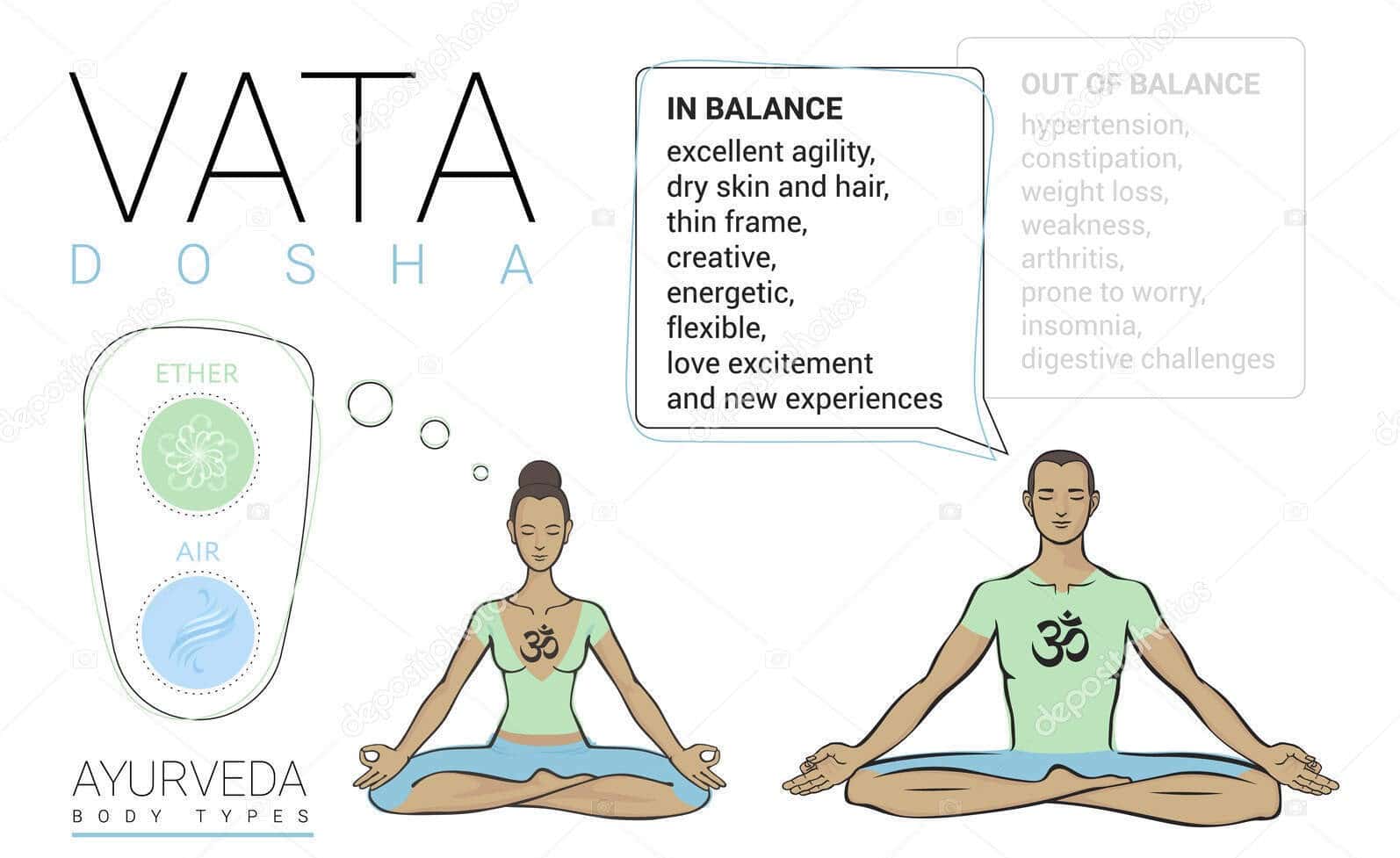
Exercises in General
Vata predominant people need to experience stability and grounding as they engage in exercise that does not fatigue them. Walking with breath timed to be in harmony with the natural swaying of the arms and legs will help to release suppressed emotions and ecess thoughts. When this is done in a natural environment free from distractions, Vata will come to balance gently and easily. Even a short walk following meals can help to promote harmony in those of this sensitive constitution.
Yoga Poses
Vata predominant students need to practice poses that focus on the pelvic region and the colon, whuch are the main sites of Vata. The most useful poses promote freedom in the major joint areas of the lower body- the hips, lumbar spine, and knees joints. Forward bending poses are good, but should not be forced or held in a prolonged fashion. Some Vatas are naturally flexible and must be cautioned not to promote any increases range of motion, which can diminish their prana, their will power and their ability to hear their own inner voice.
Balancing poses such as those in the balancing Tree Vinyasa- Balancing Tree (Vrksasana), eagle (Garudasana), and Dancer King ( Natarajasana) – will increase concentration. This tends to make prana smootehr, steadier and when accompanied by Pranayama, refined and subtle.
A Vata balancing practice would place primary emphasis on developing sensitivity through inquiry practices. Asking “what do I feel?” and “where do I feel it?” does more to balance Vata than anything else. The deeper a Vata can go inside, the better.
Asanas should be done with rhythmic, steady, and regular breathing (Sama Vritti Ujjaye Pranayama- throat breathing of equal effort and duration) mild and gentle in relative silence. Seated poses, which are traditionally used in breathing and meditation, are also recommended for keeping the hips supple and the pelvic floor mobile and open. Among these practices are easy pose- Sukhasana, half lotus-Ardha padmasana, adept`s pose- Siddhasana, and thunderbolt- Vajrasana. It is good for Vata to discipline their memory by learning sequences that build upon previous weeks’ training. A teacher can promote Vata balance by making their voice soft, quiet, and steady to verbally affirm Patanjali`s guidelines. Teaching with contemplation of the classical guidelines of the Yoga Sutras consistently generates discipline. Regular deep relaxation and brief guided meditation throughout a class are very important.
Pranayama
Pranayama is more important for Vata predominant students than for Pitta or Kaphas as it soothes their sensitive nature, which is more prone to disturbances than the other doshas. Ujjaye Pranayama should form the core of the Vata pranayama practice. Variations such as alternate nostril breathing (anuloma Viloma)- also known as purification of the subtle channels (Nadi shodhana in the hathayoga Pradipaka II, 7-10) are useful in balancing Vata. This can be done in the early morning or on an empty stomach for up to five minutes.
Once a consistent practice is established, the next step is to learn Mula Bandha and Aswini Mudra. These practices develop the pelvic floor by strengthening the pubococcygeal muscles, the bladder, and sex organs. On the subtler level, they can help to refine the Pranas, developing the Apana Prana by prolonging the exhale, and Samana and Vyana Pranas by lengthening the Kumbhaks or breath pause. Variations of these practices are innumerable though I do not recommend that Vatas do more variety but instead concentrate on deepening their sensitivity to prana. These practices root our disturbed Vata from its home in the pelvic cavity. With patience and persistence, serenity can form simply by doing Ujjaye Pranayama with a mild root lock( Mula bandha) during exhalations.
Purification (Shatkarmas)
In general, cleansing practices for Vata should be mild and done only for brief periods during the early phases of the changeable seasons os fall and spring under supervision. Once they learn the practice their trained pranic sensitivity will reveal when and how much is appropriate in the seasons to follow. Strong purification practices like Vamana Dhouti (intestinal cleansing with water) should be avoided. Milder forms of shatkarma (6 cleansing actions) can be done daily such as Agnisar Dhouti ( purifying the fire), Jala Neti ( water purifying), and Trataka ( fixed gazing).
Mantra Meditation
One meaning of the word mantra is “ the sound that protects you”. Mantras for Vata can be especially as Vata rules the mind. By receiving a mantra that affirms your spiritual nature or cultivated the process of inquiry into ‘Who am I?” can help the student go deeper into their inner world. One example is ‘so.ham’ (I am that) , known as a breath mantra as the breath is said to make the sound of this mantra as it goes in and out. By repeating so`ham with the inhalation on the first syllable and the exhalation on the second, the vibratory energy of the sound can be directly felt. With persistence and Grace , the vibration of the mantra or even the cosmos.
Other mantras are variations on the Shakti mantras that honor the qualities of prosperity and abundance as personified by the Godesses Lakshmi or those of the creative energies personified by the Goddess Sarasvati. Sarasvati is the ruler of the first chakra in the pelvic floor region. Lakshmi is the ruler of the second chakra , located in the bladder region. These mantras are particularly good for dispelling the hidden fears that plague Vata , as they create calmness and serenity.
My guru said repeatedly that for Vata predominant students” the mind is like a dangerous dark alley , you should never go there alone. Take the help of a mantra to protect you.”
Sadhana
The ideal yogic spiritual path for Vata is jnana ir Raja yoga . Whatever method they close should be coupled with the study of the yoga sutras supervised by a competent teacher that they have faith in. If the Raja yoga tradition is not appealing to them, then scriptural study of their religious heritage is recommended. For instance, a Christian Yoga teacher could study the Bible,especially the Book of Job and the prophets- Daniel, psalms, and Revelations;a Jewish Yoga student could study the Torah, and be thoroughly engaged in the practice of daily and seasonal rituals. The most important quality is that spiritual practice includes svadhaya or self study aided by reflection on a spiritual text of their preference. Optimal if possible is to have time spent with a spiritual mentor.
Ayurveda Yoga therapy for Vata conditions
IN yoga `s repertoire , we have practices for balancing the Vata qualities within us thus promoting natural biological rhythms like menstruation , elimination, sexual expression, speech , sleep , digestion, physical motions, therby calming the mind, and elevating ouor intuition. On the therapeutic level, the practices that restore Vata balance are useful for Vata disturbed condition such as motion sickness, hypertension, poor circulation, headaches, constipation, hypoglycemia, irregular menstrual rhythms , insomnia and epilepsy. The practices of pranayama and meditation can be adapted to address psychological issues of fear, anxiety, fatigue, seslf-confidence , improve memory and to develop a stronger will power . Note that specific recommendation should be given to each individual based on personal needs.
Summary of Yoga For Vata
The focus for treatment of Vata is on promoting relaxation and sensitivity for the inner self. The method for implementation this is through a combination of practices of regular attention to breathing and air pranic life force, by Vinyasa done rhythmically led by the natural pace of the breath and movements which put pressure in your pelvis and legs. Some general examples include gentle warm-up bring series such as the joint freeing series (Pavanmuktasana) described in Structural Yoga Therapy harmonized as breath pace, the wave breath (Ujjayi Pranayama ) sitting postures, forward bending postures, and palm tree or balancing tree Vinyasa.
Benefits and Drawbacks of Online Yoga Teacher Training
Yoga industry has been mushrooming significantly these days. You may have noticed that online yoga teacher training has taken the world by storm these recent years. This has been pretty convenient for people to pursue teaching yoga professionally, you just need a stable internet connection to get the benefits of face to face teachings. So, this article shows the benefits and drawbacks of online yoga teacher training courses.
I think we can all agree that 2020, and 2021 have been full of surprises and challenges. Adapting the situation every yoga studio has shifted their yoga teacher training programs to an online basis for the time being. There’s an emerging trend of online yoga teacher training. But, you may have doubts about their credibility. It’s understandable if you feel that way in the beginning.
Don’t worry we are here to respond to all the questions you may have and reassure you that they’re excellent alternatives to in-person training. No doubt, A yoga teacher training (YTT) course leads you towards the beautiful journey of yogic life. Your life will be positively transformed as well as you will find the way to ultimate happiness. It lets you share the benefits of asana practice, meditation, pranayama, shatkarmas, and many other important practices for living a mindful life with others.
To be a good yoga teacher , one must work upon oneself. Knowing about asanas , philosophies , history or doing a few sessions is not enough to be able to take this experience to others. A yoga teacher training course helps you deep dive into the whole yogic experience become a teacher yourself.
Is online yoga teacher training worth it?
It all depends on what you are seeking. It is surely a life-changing experience, also online teacher training benefits you in many ways. Such as it will deepen your knowledge, improve your abilities to have better control and alignment in postures, and sequences, and most importantly it will train you in such a way that you can help others to learn from you.
An online yoga program can be a highly valuable experience, but depending only on virtual sessions can affect students’ true learning. Online programs depend much on the teachers and structure of the online course to be successful and meaningful.
What should be considered when choosing an Online Yoga Teacher Training?
First you should know why you want to take the course. Online courses are designed for different levels so you have to analyze your level whether you are beginners or intermediate practitioner. And most importantly you have to make sure that the school providing the teacher training course has a experienced teachers.
Most of the online courses you’ll find on the internet are provided by established yoga academies, considering present situations, they have started to offer online programs too. But not all of them are legit. So, one way to know if you can trust the school is by asking about their years of experience in teaching as well as if they offer offline programs.
Last but not least, look for a program that includes the study of ancient texts, like the yoga sutras of Patanjali, and the Hatha yoga pradapika. All certified programs include and mandatory areas of study for anyone who wants to become an instructor.
What does an online yoga teacher training course feel like?
Online YTT is a budget friendly and time-efficiency with plenty of benefits, starting with the fact that you can access with any kind of device. Online yoga TTC are usually broad and thorough. They cover all the main aspects of regular teacher training and in person training sessions. Moreover, in some advanced programs, you get to do the whole course at your own pace and timing.
Even though the class is virtual, a student can feel the teacher’s influence by the way they conduct classes. Being able to ask questions, get live feedback, and more better guidance benefits more in the learning. No doubt in-person training is the best way to learn.
Benefits and Drawbacks of Online Yoga Teacher Training
Before it wasn’t always possible to do a YTT course online, this has changed since COVID-19. Online YTTs were a great help for many challenges like social distancing, and lockdowns. In this stressful time, online programs let people find a new way of living a balanced life. Also, yoga is considered a boon in this pandemic time as it teaches people to survive through these tough times. Best efforts are made to make online YTTC an all-inclusive experience. But, like everything, it has its benefits and drawbacks.
Benefits of Online Yoga Teacher Training
- It fits you in your busy schedule
Online yoga teacher training courses provide you with flexibility. Most people can’t drop everything in their lives to take a YTTC. Thus, online teacher training courses offer you flexibility so that you can easily fit into your already busy lifestyle. This works well for working people and those having families or other responsibilities.
2. More affordable
Honestly, a good YTT course can be expensive. The course fee is only one part of the expenses. Your travel and preparations for staying in the retreat or an ashram will have their costs. So, one of the main pros of OYTC is that it becomes less expensive. Plus, many online programs offer good discounts.
3. You can play it back
Online YTT course offers lifetime access to all the classes. But, in a live teacher training session you get to do each session only once. Also, you can get many tutorial videos from your seasoned teachers then you can use them in developing your own style and self practice.
4. Supports eco-friendly future
People are taking Online YTT courses from home so that there are lesser numbers of vehicles and lesser use of consumer goods and services during COVID-19 has greatly reduced carbon emissions.
Drawbacks of Online Yoga Teacher Training
- Same level of guidance is missing
You can understand your teacher’s guidance well and think that you are doing your asanas correctly. But you may need some help or adjustments from your teachers. It may also be easier to correct your postures when you see a student being adjusted up close. A teacher’s comments do not become less in seems online training. However, In online classes, guidance seems to get reduced in an online class.
2. Difficult to find focus, discipline, and community in online classes
We are all learning to build community online and we know it’s possible to make connections online. But it can be harder for some people to build and maintain connections online. In live YTTC, living and learning with other people create more disciplines and focus in a student. But, doing so in an online class is harder, especially for beginners.
3. Becomes less immersive
A yoga teacher training is a life-transforming experience where you dive deep into the yogic lifestyle. You not only practice asanas, meditation, pranayamas, and philosophies in training, but you will experience a change in your diet, your daily routine, and your habits. You connect with other friends and your teachers in a personal and interactive way as you live and breathe together. Online yoga teacher training can be good in many ways but seeing videos and practicing or sharing views is not as same as learning via a traditional, on-site course.
FAQs about Online Yoga teacher training
You might have different questions before joining online YTTC, So here are some questions and its answering you may be searching for:
- Can I still join online yoga teacher training courses as a beginner?
Yes, you can . you don’t need much experience to enter a yoga teacher training. The courses are available to cover everything from scratch, and you will be given proper guidance and support during your learning. You can interact with your teachers more deeply as whole the session is only for you. You just have to be physically and mentally healthy and ready to take the responsibility of following training.
2. Which styles of yoga can I learn?
First of all, research the online YTT classes for any style of yoga you want to learn. Every teacher has their expertise. So, there might be available online courses based on their learning. You can join more classical Hatha yoga programs. you may also like Vinyasa yoga, yin yoga, or kids or teens yoga.
3. Are all teacher training courses of the same duration?
No, they are not. The period of each course is based on the purpose of the course. Like- In the traditional Hatha yoga program, there are 200 and 300-hour programs. 200 hours course requires less time than a 300 hours course. In a 300-hour course, you have to go deeper in each topics which takes a bit longer time.
4. Will I receive an internationally recognized certificate?
For an international yoga teaching certificate, you must first complete an extensive course such as 200 hours or 300 hours YTTC. Such course required to attend on-site training to complete a certain duration of contact hours.
But, this has been changed since the pandemic crisis, Yoga Alliance registered school (RYS) members who’ve applied and met the qualifications requirement can offer virtual class hours ( pre-recorded and live) in lieu of live contact hours.
5. Will I be able to teach after completing a YTTC?
Yes, you will be able to teach once you complete your teacher training course. Many choose to pursue a higher training course once they finish their beginning level course prior to start a teaching career. It depends on how comfortable and prepared you feel.
Conclusion of Best Yoga Teacher Training in Nepal
What does yoga practice mean to you or how it can influence your life depends on many personal factors. For many people, the possibility to attain Online YTTC make it possible to learn yoga in the first place.
And while we all are concerned about pandemic crisis, its okay to go for online YTTC . The future will surely give us a chance for a in-site training and live sessions.