
Poon Hill Yoga Trek in Nepal: Yoga, Meditation and Sunrise in the Annapurna Himalayas
Imagine waking up in a peaceful Himalayan village, breathing in the fresh mountain air, and beginning your morning with gentle yoga as the surrounding hills come alive. Later, you walk along beautiful mountain trails, through rhododendron forests and traditional Nepalese villages, before ending your day with meditation beneath the magnificent Annapurna mountains. This is the extraordinary experience of the Poon Hill Yoga Trek in Nepal, a journey that combines Himalayan adventure with yoga, meditation, mindful breathing, and cultural discovery.
Located in Nepal’s spectacular Annapurna region, Poon Hill is one of the country’s most celebrated Himalayan viewpoints. Standing at approximately 3,210 meters above sea level, it offers breathtaking sunrise views of the Annapurna and Dhaulagiri mountain ranges. Unlike traditional trekking holidays focused primarily on reaching a destination, a Poon Hill yoga trek invites you to appreciate every step of the journey.
At Himalayan Yoga Academy, our 7-day Ghorepani Poon Hill Yoga Trek brings together guided Himalayan trekking, daily yoga, pranayama, meditation, and authentic local experiences.
Whether you are a beginner in yoga, an experienced practitioner, or a traveler searching for a meaningful Himalayan adventure, this journey offers a wonderful balance of physical activity, peaceful surroundings, and personal reflection.
What Is the Poon Hill Yoga Trek in Nepal?
The Poon Hill Yoga Trek is a combination of traditional trekking in Nepal’s Annapurna foothills and guided yogic practices.
Throughout the journey, participants explore scenic mountain trails while incorporating yoga, meditation, and mindful breathing into their daily routine. Rather than rushing from one destination to another, travelers are encouraged to experience the Himalayan environment with greater awareness. Morning yoga prepares the body for walking, gentle breathing exercises encourage a comfortable rhythm, and evening meditation provides an opportunity to unwind after exploring the mountains.The trekking route passes through beautiful locations including Tikhedhunga, Ghorepani, Tadapani, and Ghandruk.
One of the most unforgettable moments is the early morning ascent to Poon Hill, where the first rays of sunlight illuminate the snow-covered Himalayas.
For travelers looking for yoga trekking in Annapurna, this experience brings together outdoor adventure and the reflective traditions of yoga.
Why Poon Hill Is One of Nepal’s Most Beautiful Sunrise Destinations
Poon Hill is widely recognized for its extraordinary Himalayan panoramas.
Situated above Ghorepani village, this viewpoint provides spectacular views of some of Nepal’s most beautiful mountains.
On a clear morning, trekkers can admire:
- Dhaulagiri (8,167 m) – One of the world’s highest mountains.
- Annapurna South (7,219 m) – A magnificent snow-covered peak.
- Machhapuchhre (6,993 m) – The iconic Fishtail Mountain.
- Nilgiri Himal – A striking Himalayan mountain massif.
- Hiunchuli (6,441 m) – A beautiful mountain within the Annapurna region.
The most magical experience begins before sunrise.
- Trekkers leave Ghorepani in the early morning darkness, walking uphill beneath the stars with headlamps. As daylight approaches, the distant mountain peaks gradually become visible.
- Within minutes, the rising sunlight transforms the mountains into beautiful shades of gold, orange, and pink.
- For participants in a yoga and meditation trek in Nepal, this moment provides a natural setting for gratitude, silence, and contemplation.
- Although Poon Hill can become busy during popular trekking seasons, the surrounding Himalayan landscape remains deeply inspiring.
- The sunrise is more than a photographic opportunity. It is a chance to experience the beauty of nature through attentive observation.
Why Combine Yoga and Meditation With Himalayan Trekking?
Trekking and yoga complement each other in meaningful ways.
Trekking develops endurance, coordination, and appreciation for the natural world. Yoga adds mindful movement, flexibility, body awareness, and opportunities for relaxation.
When combined thoughtfully, these practices can create a more balanced experience.
1. Morning Yoga to Prepare for Trekking
Beginning the day with gentle yoga helps prepare the body for walking on uneven Himalayan trails.Simple movements may include standing stretches, ankle rotations, hip mobility exercises, gentle twists, and comfortable balancing postures.These activities encourage body awareness before the day’s trek.Sessions should be adapted to the group’s fitness, weather conditions, available space, and elevation.
2. Pranayama and Mindful Breathing
- Pranayama is an important element of traditional yoga practice.
- During trekking, gentle and natural breathing awareness can help participants develop a comfortable walking rhythm.
- Rather than focusing on difficult breathing techniques, Himalayan yoga trekking emphasizes relaxed, unforced breathing and awareness of the present moment.
- Forceful breathwork and prolonged breath retention are inappropriate during strenuous walking or when altitude symptoms are present.
3. Evening Meditation for Relaxation
- After several hours of trekking, the body naturally welcomes rest.
- Gentle stretching, seated meditation, and guided relaxation provide an opportunity to slow down and reflect on the day’s experiences.
- Imagine sitting quietly in a mountain village, listening to the wind moving through the trees while the distant Himalayas gradually disappear into the evening clouds.
- These simple experiences are often among the most memorable aspects of a yoga trek.
4. Mindfulness Through Walking
- Walking meditation does not always require a dedicated session.
- During the trek, participants can practice noticing their footsteps, surroundings, posture, and breathing.
- This approach transforms ordinary hiking into an opportunity for mindful observation.
7-Day Poon Hill Yoga Trek Itinerary With Himalayan Yoga Academy
The 7-day Ghorepani Poon Hill Yoga Trek offered by Himalayan Yoga Academy begins and ends in Pokhara, one of Nepal’s most beautiful tourist destinations.
The following itinerary combines mountain adventure, yoga, meditation, and cultural exploration.
Day 1: Arrival in Pokhara – Welcome and Yoga Practice
- Your journey begins in Pokhara, a beautiful lakeside city surrounded by green hills and magnificent Himalayan scenery.
- After arriving, you will be welcomed and transferred to your accommodation.
- The first day provides an opportunity to relax, settle into the environment, and prepare for the journey ahead.
- An introductory yoga and meditation session helps participants become familiar with the yogic approach used throughout the trek.
- Highlights: Arrival in Pokhara, gentle yoga, meditation, trekking orientation.
Day 2: Pokhara to Nayapul – Trek to Tikhedhunga (1,527 m)
- The morning begins with yoga and pranayama before traveling toward Nayapul, a traditional starting point for treks in the Annapurna region.
- From here, the walking adventure begins.
- The trail passes through picturesque settlements, terraced agricultural landscapes, river crossings, and green hillsides.
- This introductory trekking day provides a wonderful opportunity to experience rural Nepal.
- Highlights: Morning yoga, Himalayan foothills, local villages, riverside trekking.
Day 3: Tikhedhunga to Ghorepani (2,810 m)
- Today is one of the most physically demanding sections of the journey.
- The route climbs through the well-known stone staircases near Ulleri before continuing through beautiful mountain forests.
- As the trail gains elevation, the surroundings gradually change.
- The lower agricultural landscape gives way to dense forest, mountain settlements, and increasingly impressive Himalayan views.
- Eventually, you arrive in Ghorepani, a charming mountain village famous for its proximity to Poon Hill.
- After resting, a gentle meditation or relaxation practice can provide a peaceful conclusion to the day.
- Highlights: Ulleri stone staircases, rhododendron forests, Himalayan scenery, Ghorepani village.
Day 4: Poon Hill Sunrise (3,210 m) – Trek to Tadapani (2,700 m)
- This is the most anticipated day of the entire Poon Hill yoga trek.
- Before sunrise, the group begins the uphill walk toward Poon Hill.
- As dawn arrives, the Annapurna and Dhaulagiri ranges appear against the morning sky.
- Standing in front of these extraordinary Himalayan mountains is an unforgettable experience.
- After enjoying the sunrise, the group returns to Ghorepani for breakfast before continuing toward Tadapani.
- The route passes through beautiful forests and scenic mountain landscapes.
- Depending on the conditions and available time, gentle stretching or meditation may be included later in the day.
- Highlights: Poon Hill sunrise, panoramic Annapurna views, Dhaulagiri mountains, forest trekking.
Day 5: Tadapani to Ghandruk (1,940 m)
- After breakfast, the trail gradually descends toward Ghandruk, one of the Annapurna region’s best-known traditional Gurung villages.
- Ghandruk is famous for its distinctive cultural heritage, traditional houses, local hospitality, and wonderful views of Annapurna South and Machhapuchhre.
- Travelers can explore the village, learn about Gurung traditions, and observe everyday life in the Himalayan foothills.
- This cultural experience adds another dimension to the journey.
- Yoga encourages awareness not only of ourselves but also of the people, communities, and environments around us.
- Highlights: Ghandruk village, Gurung culture, mountain views, cultural exploration.
Day 6: Ghandruk to Nayapul – Return to Pokhara
- Your final trekking day begins with a peaceful morning yoga session.
- After breakfast, the journey continues downhill toward the road connection for the return to Pokhara.
- The exact walking and driving sections may vary depending on local road and trail conditions.
- Returning to the lakeside atmosphere of Pokhara offers a wonderful opportunity to relax after several days in the mountains.
- You may spend the evening resting, exploring the city, or reflecting on your Himalayan adventure.
- Highlights: Final trekking experience, morning yoga, return to Pokhara, relaxation.
Day 7: Final Yoga Session and Departure
- The final morning begins with yoga and meditation.
- This is an opportunity to reflect on the experiences, friendships, and insights developed during the journey.
- After breakfast, participants prepare for departure or continue their travels in Nepal.
- Although the trek ends in Pokhara, the awareness developed through yoga, meditation, and mindful trekking can continue long after returning home.

Best Time for the Poon Hill Yoga Trek in Nepal
The Annapurna region experiences different landscapes throughout the year, making seasonal planning important.
Spring: March to May
- Spring is one of the most beautiful periods for the Ghorepani Poon Hill trek.
- Rhododendron forests often bloom in vibrant shades of red, pink, and white, especially during March and April.
- The colorful forest trails, pleasant daytime conditions, and impressive mountain scenery make spring particularly attractive.
Autumn: September to November
- Autumn is another excellent trekking season in Nepal.
- October and November generally offer favorable trekking conditions and some of the clearest Himalayan views.
- This makes autumn particularly appealing for travelers hoping to enjoy the famous Poon Hill sunrise.
Winter: December to February
- Winter trekking can be possible when conditions are suitable.
- However, mornings at higher elevations can be extremely cold, and snow or icy trails may affect the itinerary.
- Warm clothing and appropriate trekking equipment are essential.
Monsoon: June to August
- The monsoon season brings lush greenery but also rainfall, slippery trails, leeches, and frequent cloud cover.
- Mountain views may be limited, making this period less reliable for sunrise-focused trekking.
- For most travelers, March–April and October–November are particularly attractive months for the Poon Hill Yoga Trek in Nepal.
Is the Poon Hill Yoga Trek Suitable for Beginners?
- Yes. The Poon Hill Yoga Trek is generally considered an easy-to-moderate Himalayan trekking experience and can be suitable for beginners with reasonable physical fitness.
- No technical mountaineering experience is required.
- However, participants should be prepared for several hours of walking each day, including steep uphill sections, stone staircases, and uneven mountain terrain.
- Himalayan Yoga Academy’s itinerary estimates approximately 4–7 hours of walking on trekking days, depending on the route and conditions.
- Although Poon Hill is lower than many famous Himalayan trekking destinations, its altitude of 3,210 meters still requires attention. Altitude sickness is possible, and trekkers should report symptoms promptly and follow their guide’s advice.
- Before beginning the trek, it is helpful to practice regular walking, climbing stairs, gentle strength exercises, and yoga for mobility.
- The yoga sessions can be adjusted for different experience levels.
- You do not need to be an advanced yoga practitioner to participate.
Discover the Beauty of Rhododendron Forests and Himalayan Villages
One of the greatest attractions of the Ghorepani Poon Hill route is its remarkable natural diversity.The journey begins among terraced farms and traditional settlements before gradually ascending into oak and rhododendron forests.
- During spring, flowering rhododendron trees create a colorful mountain landscape.
- The quieter sections of these trails provide wonderful opportunities for mindful walking and nature observation.
- The trek also passes through communities with rich Gurung and Magar cultural traditions.
- Travelers can experience local hospitality, traditional Himalayan lifestyles, and the distinctive charm of Nepal’s mountain villages.
- Respecting local customs, asking permission before photographing residents, minimizing waste, and supporting local businesses are important parts of responsible Himalayan travel.
What to Pack for a Poon Hill Yoga Trek
Packing carefully makes the journey more comfortable, particularly because Himalayan weather can change quickly.
Important items include:
- Comfortable, broken-in trekking boots
- Moisture-wicking trekking clothes
- Warm fleece and insulated jacket
- Waterproof jacket and trousers
- Thermal base layers
- Comfortable yoga clothes
- Lightweight travel yoga mat
- Headlamp for the Poon Hill sunrise hike
- Reusable water bottle
- Sunscreen, sunglasses, and lip balm
- Personal medication and hygiene essentials
- Small daypack
- Gloves, warm hat, and extra socks
- Travel insurance with trekking and emergency evacuation coverage
Avoid carrying unnecessary items, and confirm porter arrangements and luggage limits before the journey.
Poon Hill Yoga Trek Cost and Inclusions
Himalayan Yoga Academy offers its 7-day, 6-night Ghorepani Poon Hill Yoga Trek with guided trekking arrangements and integrated yoga practices.
The advertised package prices are:
Sharing accommodation: From USD 600 per person
Private accommodation: From USD 720 per person
Special group rates may be available upon request.
Package Inclusions
The advertised program includes yoga and meditation classes, scheduled transfers, two nights of accommodation in Pokhara, four nights of trekking teahouse accommodation, a licensed trekking guide, porter support, trekking meals, Annapurna trekking permits, group first-aid supplies, and pre-departure information.
Personal trekking equipment, travel insurance, tips, and personal expenses are not included.
Private accommodation may be subject to availability in mountain teahouses. Confirm the latest prices, permit requirements, meal arrangements, and room availability before booking.
Why Choose Himalayan Yoga Academy for the Poon Hill Yoga Trek?
Himalayan Yoga Academy combines its experience in yoga education and wellness retreats with guided trekking experiences in Nepal.
The aim is to offer more than a conventional Himalayan holiday.
Experienced Yoga Guidance
Daily yoga, pranayama, and meditation are integrated into the journey, allowing participants to maintain a meaningful yogic routine while exploring the mountains.
A Balance Between Adventure and Relaxation
The itinerary combines active trekking days with gentle movement, meditation, cultural experiences, and time to appreciate the natural surroundings.
An Authentic Himalayan Experience
Travelers experience Nepal through its mountain villages, forests, local communities, hospitality, and breathtaking landscapes.
An Opportunity to Continue Your Yoga Journey
Himalayan Yoga Academy also offers yoga teacher training, meditation programs, sound healing training, Ayurveda training, and yoga retreats in Nepal.
Travelers interested in extending their journey may explore these programs before or after their trekking experience.
Frequently Asked Questions About the Poon Hill Yoga Trek
1. How many days does the Poon Hill Yoga Trek take?
Himalayan Yoga Academy offers a 7-day, 6-night Ghorepani Poon Hill Yoga Trek starting and ending in Pokhara. The program includes trekking, yoga, meditation, cultural exploration, and the famous Poon Hill sunrise.
2. What is the maximum altitude of the Poon Hill Yoga Trek?
The highest point is Poon Hill, approximately 3,210 meters above sea level. Although this is lower than many other Himalayan trekking routes, altitude-related symptoms are still possible.
3. Do I need previous yoga experience?
No advanced yoga experience is required. Beginners and experienced practitioners can participate, with yoga practices adapted to the group’s needs and trekking conditions.
4. Is the Poon Hill sunrise trek difficult?
The trek is generally categorized as easy to moderate. It includes uphill walking, stone staircases, forest trails, and several hours of daily trekking. Basic fitness and preparation are recommended.
5. What is the best month for the Poon Hill Yoga Trek in Nepal?
October and November are popular for clear mountain views, while March and April are particularly beautiful for rhododendron flowers. Weather and visibility vary from year to year.
6. Can solo travelers join the Poon Hill Yoga Trek?
Solo travelers can enquire about joining a scheduled group or arranging a private departure. Availability and pricing should be confirmed directly with Himalayan Yoga Academy.
7. What makes a yoga trek different from a regular Poon Hill trek?
A yoga trek includes structured yoga, pranayama, meditation, and mindful walking alongside traditional trekking activities. It offers travelers opportunities for relaxation and reflection throughout the journey.
8. Can I combine the Poon Hill Yoga Trek with a yoga retreat in Nepal?
Yes. Travelers may arrange additional yoga retreats, yoga teacher training, sound healing programs, or Ayurveda experiences through Himalayan Yoga Academy, depending on schedules and availability.
Final Thoughts: Discover the Himalayas Through Yoga, Meditation and Adventure
Some journeys are remembered for the places we visit. Others stay with us because of how we experience them.
The Poon Hill Yoga Trek in Nepal offers both.
- It is a journey through beautiful Himalayan forests, traditional mountain villages, and breathtaking Annapurna landscapes. But it is also an opportunity to discover the peaceful rhythm of walking, breathing, and practicing yoga in nature.
- The sunrise over Poon Hill may be the most photographed moment of the adventure, yet the quieter experiences can become equally meaningful.
- A few moments of meditation beneath the mountains. The sound of footsteps along a forest trail. The satisfaction of reaching a Himalayan village after a challenging climb. The simple joy of watching sunlight illuminate the Annapurna peaks.
- These are the moments that make a yoga trek special.
At Himalayan Yoga Academy, we invite you to discover the beauty of the Annapurna region through our 7-day Ghorepani Poon Hill Yoga Trek.
Explore our 7-Day Ghorepani Poon Hill Yoga Trek in Nepal and begin planning your Himalayan yoga adventure.
Walk through the Himalayas. Breathe with awareness. Discover the beauty of the journey.
Private Sound Bath: What to Expect During a One-to-One Sound Healing Session
Imagine stepping away from everyday noise into a peaceful room filled with the gentle resonance of Himalayan singing bowls. A soft gong begins to vibrate, delicate chimes echo through the space, and your attention gradually shifts from endless thoughts to the sounds around you. You do not have to perform any movements, follow complicated instructions, or know how to meditate. You simply rest, listen, and experience the moment.
This is the beauty of a private sound bath, an immersive relaxation experience combining Himalayan singing bowls, gongs, guided meditation, and mindful listening. Unlike a group session, a private sound healing experience provides personal attention, allowing the practitioner to adapt the pace, instruments, and sound intensity to your preferences.
At Himalayan Yoga Academy in Kathmandu, Nepal, our sound healing experiences draw upon Himalayan sound traditions, Nada Yoga (the yoga of sound), meditation, and the knowledge shared through our professional sound healing training programs.
Our academy welcomes individuals, couples, travelers, yoga practitioners, and corporate groups who wish to explore the relaxing and meditative qualities of sound.Whether you are experiencing sound healing for the first time or returning to deepen your practice, this guide explains what to expect from a private sound bath, how it works, and why Kathmandu is a meaningful destination for this unique wellness experience.
What Is a Private Sound Bath?
- A private sound bath is a personalized sound meditation session during which a trained practitioner plays resonant instruments while you rest comfortably.
- Despite its name, a sound bath does not involve water. The term describes being surrounded or immersed in different layers of sound and vibration.
- During a typical session, participants lie down or sit in a comfortable position while instruments such as Himalayan singing bowls, gongs, bells, and chimes create an evolving soundscape.
- Unlike conventional music, a sound bath does not necessarily follow a recognizable melody or rhythm. Instead, sustained tones, harmonics, gentle pulses, and moments of silence encourage attentive listening.
- A private sound healing session is particularly appealing because it can be adapted to your individual needs.
- Some guests prefer a gentle, quiet introduction to sound meditation. Others enjoy the deeper resonance of gongs or wish to explore traditional chakra-focused meditation.
- The practitioner can discuss these preferences beforehand and guide the experience accordingly.
- At Himalayan Yoga Academy, our private sound healing approach combines traditional Himalayan instruments with meditation and grounding practices in a peaceful environment.
Private Sound Bath vs. Group Sound Bath: What’s the Difference?
Both private and group sound baths offer opportunities for meditation, mindful listening, and relaxation.
However, the experience can feel quite different.

| Private Sound Bath | Group Sound Bath |
|---|---|
| Personalized attention from a practitioner | Shared experience with several participants |
| Sound intensity can be adapted individually | Sound is designed for the entire group |
| More opportunity to discuss personal preferences | Usually follows a predetermined sequence |
| Greater privacy and individual comfort | Creates a communal meditation atmosphere |
| Suitable for individual intentions or private bookings | Suitable for retreats, events, and group wellness activities |
A one-to-one sound bath is ideal for someone who wants a quieter, more personal introduction to sound healing.
A group sound bath, meanwhile, can create a wonderful sense of collective stillness as participants experience the same sound journey together.
Himalayan Yoga Academy offers private sound healing experiences and can discuss private-group and corporate sound bath arrangements according to group size and requirements.
What to Expect During a 75-Minute Private Sound Healing Session
- One of the most common questions from beginners is: What actually happens during a private sound bath?
- At Himalayan Yoga Academy, our advertised private sound healing experience lasts approximately 75 minutes.
- The exact flow may vary depending on the practitioner and the needs of the participant, but a typical session includes several stages.
1. Personal Consultation and Introduction
- Before the instruments begin, your practitioner introduces the experience and discusses your expectations.
- You may be asked whether you have participated in sound healing before, how comfortable you are with louder sounds, and whether you have any particular preferences.
- This conversation is an important part of personalized sound therapy.
- You can also discuss physical comfort, sound sensitivity, and whether you prefer to experience the session lying down or seated.
- There is no pressure to share personal information beyond what is relevant to your comfort and safety.
2. Gentle Grounding and Guided Meditation
- The experience generally begins with a short grounding practice.
- Your practitioner may guide you to notice your natural breathing, relax your shoulders, and become aware of the contact between your body and the resting surface.
- These simple practices help create a transition from everyday activity into mindful listening.
- At Himalayan Yoga Academy, meditation and grounding are part of the private sound healing experience.
- The intention is not to force the mind into silence, but to create a comfortable environment where attention can gradually settle.
3. Himalayan Singing Bowl Sound Healing
- Once you are comfortable, the practitioner begins introducing the sounds of traditional Himalayan singing bowls.
- Each bowl produces distinctive tones depending on its size, shape, craftsmanship, and playing technique.
- The practitioner may gently strike a bowl, circle its rim, or combine different bowls to create layers of resonance.
- Some sounds are soft and delicate, while others are deeper and longer-lasting.
- These changing tones become the focus of the listening practice.
- In traditional Himalayan sound meditation, singing bowls are also associated with chakra-focused and energy-balancing practices.
- Participants may choose to explore these traditional spiritual interpretations, although no particular belief system is required.
4. Gong Sound Bath and Deeper Sound Meditation
- Gongs can add an extraordinary dimension to the sound bath experience.
- Unlike a singing bowl, which often produces a more recognizable sustained tone, a gong creates a complex range of evolving harmonics.
- When played gently, the sound may resemble distant waves or a continuous flowing vibration.
- A skilled practitioner carefully manages the volume, intensity, and duration of gong playing.
- In a private sound bath, this is especially valuable because sound preferences vary between individuals.
- The purpose is not to overwhelm the listener but to create a comfortable, immersive listening environment.
5. Gentle Closing, Silence, and Reflection
- Toward the end of the session, the soundscape gradually becomes softer.
- The final tones are allowed to fade naturally, followed by a period of silence.
- Your practitioner may encourage you to notice your breathing, move your fingers and toes, and slowly return to a comfortable seated position.
- Some participants prefer to remain quiet for a few minutes, while others enjoy discussing the experience.
- There is no correct emotional or physical response.
- The value of a private sound bath lies in having the space to experience sound and stillness in your own way.
Himalayan Singing Bowls: The Heart of Sound Healing in Nepal
- Himalayan singing bowls are among the most recognizable instruments used in sound healing and meditation.
- Traditionally associated with Himalayan spiritual and contemplative practices, these metal instruments produce beautiful sustained tones when struck or played around their rims.
- Their rich harmonics make them particularly suitable for immersive sound meditation.
- At Himalayan Yoga Academy, singing bowls play an important role in both our private sound healing sessions and professional singing bowl training programs.
- Our practitioners understand how to combine bowls of different sizes and tonal qualities to create a balanced sound experience.
- Rather than simply playing instruments randomly, sound practitioners work with timing, resonance, silence, and the gradual progression of the session.
- This thoughtful approach helps transform a collection of sounds into a meaningful meditation experience.
Our Experienced Sound Healing Teachers at Himalayan Yoga Academy
- One of the distinguishing features of Himalayan Yoga Academy is our established approach to professional sound healing education.
- We do not view sound healing simply as a relaxing activity for tourists.
- It is also a field of dedicated practice and study within our academy, incorporating Nada Yoga, meditation, Himalayan singing bowl techniques, sound awareness, and the responsible facilitation of individual and group sessions.
- Our professional sound healing training instructors are experienced practitioners who share their knowledge with students interested in learning the traditional and practical applications of sound.
Yogi Rajkumar – Sound Healing and Nada Yoga Instructor
Yogi Rajkumar is one of Himalayan Yoga Academy’s lead sound healing instructors. His yoga journey began in 2008, and he has been teaching singing bowl practices since 2018.His background includes meditation, pranayama, traditional yoga, and Nada Yoga.
Through his teaching, students develop an understanding of how sound and attentive listening can be incorporated into meditation and wellness practices.
Yogi Prapti – Sound Healing and Yoga Instructor
Prapti Shahi is another lead instructor associated with Himalayan Yoga Academy’s sound healing training programs.Her teaching background includes Nada Chikitsa (sound healing), Hatha Yoga, Ashtanga Yoga, and Vinyasa Yoga. She brings an integrated approach combining breath awareness, traditional yogic understanding, and the practical use of sound in meditation.
Learning From a Himalayan Sound Healing Tradition
Our sound healing training has also been shaped by the teachings and legacy of the late Swami Padmasattva, whose work incorporated Himalayan singing bowls, meditation, Reiki, and traditional yoga. Through these teaching traditions, Himalayan Yoga Academy continues to share knowledge of singing bowl meditation and sound-based wellness practices.
Our private and group sound healing services benefit from this wider educational environment and are arranged with suitable practitioners according to availability.
Why Choose a Private Sound Bath in Kathmandu, Nepal?
Kathmandu offers a distinctive setting for sound healing. The city is known for its temples, Buddhist monasteries, traditional craftsmanship, yoga centers, and living spiritual traditions. For international travelers, experiencing sound meditation in Kathmandu can provide a meaningful connection between Himalayan culture and personal wellness.
At Himalayan Yoga Academy, located in the peaceful Raniban area of Kathmandu, guests can step away from the city’s busy streets and spend time in a quieter environment dedicated to yoga and meditation.
A private sound bath can be incorporated into many types of Nepal travel itineraries.
For example, travelers may choose a sound healing session after a long international flight, following several days of sightseeing, before attending a yoga retreat, or after returning from a Himalayan trek.
The experience requires no strenuous physical activity, making it appealing to travelers seeking a restful wellness activity.
Corporate Sound Bath and Group Sound Healing in Kathmandu
Sound healing is not limited to individual relaxation.
At Himalayan Yoga Academy, we also organize private and corporate sound bath experiences for organizations, wellness groups, retreat organizers, and teams seeking a distinctive shared activity.
Corporate sound meditation can provide employees and colleagues with an opportunity to temporarily step away from meetings, screens, and demanding schedules.
Corporate Sound Healing for Workplace Wellness
- Our corporate sound bath experiences can be discussed and adapted for organizations interested in incorporating relaxation and mindfulness into their workplace wellness activities.
- Depending on the arrangement, a session may include guided breathing awareness, group meditation, Himalayan singing bowls, gong sound meditation, and a gentle closing reflection.
- These experiences can be incorporated into team wellness days, company retreats, leadership gatherings, and workplace well-being initiatives.
Private Sound Baths for Retreats and Special Groups

Himalayan Yoga Academy also welcomes enquiries from yoga retreat organizers, wellness travel groups, friends, and couples seeking a shared sound meditation experience.
- Private-group sessions can be planned around the participants’ interests, available facilities, and the appropriate number of practitioners.
- Whether you are organizing a personal wellness experience or a corporate sound healing event in Kathmandu, our team can help discuss a suitable program.
- Group size, duration, venue, equipment, and pricing are confirmed individually.
Benefits of a Private Sound Bath: What Does Research Say?
Many people attend sound baths because they find the experience relaxing and enjoyable.
Participants may report feeling calmer, more rested, or more present after spending time listening to singing bowls and gongs.
Potential wellness benefits of sound meditation include:
- Creating an opportunity for deep relaxation
- Supporting mindful attention and present-moment awareness
- Providing a restful break from demanding routines
- Encouraging engagement with meditation
- Offering a peaceful setting for emotional reflection
- Complementing an existing yoga or wellness practice
Scientific interest in singing bowl interventions has grown in recent years.
- A 2025 systematic review published in Integrative Medicine Research examined 19 clinical studies and reported potential benefits for certain psychological and physiological outcomes, including anxiety, sleep, and mood.
- However, the researchers also identified limitations in the available evidence, and further high-quality studies are needed.
- Sound baths should therefore be understood as complementary wellness experiences, not proven medical treatments or substitutes for professional healthcare.
- Traditional concepts such as chakra balancing can be explored as part of personal spiritual practice without presenting them as established medical effects.
Who Should Try a Private Sound Healing Session?
A private sound bath can appeal to a wide range of people.
- First-time visitors: Those unfamiliar with sound healing may appreciate individual explanations and a gentle introduction.
- Yoga and meditation practitioners: Sound meditation can complement an existing practice by providing a different focus for awareness.
- Travelers in Nepal: A session can be a restful addition to a busy travel schedule.
- Couples: A privately arranged session offers an opportunity to share a quiet wellness experience.
- Wellness retreat participants: Sound baths can be incorporated into retreat programs focused on relaxation and mindfulness.
- Corporate teams: Group sound meditation provides a shared, non-strenuous wellness activity.
If you have tinnitus, significant sound sensitivity, a health condition affected by sensory stimulation, or concerns about participating, discuss them with your practitioner in advance. Seek healthcare advice when appropriate.
There is no need to be flexible, physically fit, or experienced in meditation.
How to Prepare for Your First Private Sound Bath
- A little preparation can make your first sound healing experience more comfortable.
- Wear loose, comfortable clothing that allows you to rest without restriction. Avoid scheduling the session immediately after a very heavy meal, and allow some time to settle before beginning.
- It is also helpful to silence your phone and approach the experience without expecting a specific emotional or physical outcome.
- If you are sensitive to sound, inform the practitioner before the session begins.
- You should always feel comfortable requesting adjustments to the volume, changing your resting position, or stopping the experience if necessary.
- Afterwards, allow yourself a few quiet moments before continuing with the rest of your day.
- Some people enjoy journaling, drinking tea, or taking a peaceful walk.
- Others simply continue their routine feeling pleased to have dedicated time to rest.
Private Sound Bath Cost at Himalayan Yoga Academy
Himalayan Yoga Academy currently advertises a personalized sound healing experience with the following details.
Duration: 75 minutes
Starting price: USD 45 per person
Location: Himalayan Yoga Academy, Raniban, Kathmandu, Nepal
The session includes guided meditation and grounding, Himalayan singing bowls, sacred sound instruments, personalized guidance, and a peaceful practice environment.
One-to-one availability, private-group arrangements, transport, and final pricing should be confirmed before booking.
For corporate sound healing sessions and special group experiences, contact the academy with your preferred date, group size, and requirements for a customized quotation.
Continue Your Sound Healing Journey With Himalayan Yoga Academy
For some guests, a private sound bath becomes the beginning of a deeper interest in Himalayan sound traditions.
Himalayan Yoga Academy also offers structured sound healing education for students who wish to understand the instruments, techniques, and principles behind these practices.
Our programs include:
- Introduction to Singing Bowl Training: An introductory program exploring singing bowls and basic sound meditation techniques.
- Professional Singing Bowl Training – Level 1: A 6-day, 5-night program with 20 instructional hours.
- Advanced Singing Bowl Training – Levels 1 and 2: A more comprehensive exploration of singing bowl techniques and sound healing practices.
- Gong Master Training: Professional instruction in gong playing and sound meditation.
- Yoga and Meditation Retreats: Experiences that can complement sound-based relaxation and mindfulness.
These programs allow interested participants to progress from enjoying a sound bath to developing their own practical understanding of sound meditation.
Frequently Asked Questions About Private Sound Baths
1. What happens during a private sound bath?
During a private sound bath, you rest comfortably while a trained practitioner plays Himalayan singing bowls, gongs, and other resonant instruments. The experience may include guided meditation, gentle breathing awareness, and a period of silence.
2. How long does a private sound bath last?
Session lengths vary between providers. Himalayan Yoga Academy’s advertised private sound healing session lasts approximately 75 minutes.
3. How much does a private sound bath cost in Kathmandu?
Himalayan Yoga Academy currently lists its 75-minute private sound healing experience from USD 45 per person. Private-group and corporate arrangements may have different pricing.
4. Is a private sound bath suitable for beginners?
Yes. Most sound baths require no previous meditation, yoga, or musical experience. A private format allows the practitioner to introduce the instruments gradually and adjust the experience to your comfort.
5. Do I have to believe in chakras or spiritual healing?
No. You can enjoy a sound bath simply as an opportunity for relaxation and attentive listening. Spiritual concepts are optional and depend on your personal interests.
6. Can couples book a private sound bath in Kathmandu?
Couples can enquire about privately arranged sessions at Himalayan Yoga Academy. Confirm availability and the booking format directly with the academy.
7. Does Himalayan Yoga Academy organize corporate sound healing?
Yes. Himalayan Yoga Academy welcomes corporate and private-group sound bath enquiries. Programs can be discussed according to the number of participants, preferred venue, and event requirements.
8. Who conducts the sound healing sessions at Himalayan Yoga Academy?
The academy works within an established sound healing teaching environment. Its training faculty includes experienced instructors such as Yogi Rajkumar and Prapti Shahi. The practitioner assigned to a particular private or corporate session should be confirmed when booking.
9. Can sound healing cure anxiety or sleep disorders?
A sound bath may be a pleasant relaxation practice, and preliminary research suggests possible wellness benefits. However, sound healing has not been established as a cure for anxiety, insomnia, or other medical conditions and should not replace appropriate healthcare.
Final Thoughts: Experience the Beauty of Himalayan Sound Healing
In our increasingly busy world, finding time to rest without distraction can feel like a luxury.
A private sound bath offers something beautifully simple: an opportunity to experience sound, silence, and mindful awareness without needing to achieve anything.
The gentle resonance of Himalayan singing bowls, the evolving harmonics of gongs, and the peaceful guidance of an experienced practitioner create an environment where you can slow down and reconnect with the present moment.
At Himalayan Yoga Academy in Kathmandu, we bring together traditional sound meditation, experienced teaching, and a welcoming Himalayan wellness environment.
From one-to-one sound healing sessions to private-group and corporate sound bath experiences, our aim is to help guests discover the relaxing and meditative possibilities of sound.
Whether you are visiting Nepal for a short holiday, attending a yoga retreat, recovering from a demanding travel schedule, or organizing a corporate wellness experience, we welcome you to explore the practice of Himalayan sound meditation.
Book Your Private Sound Healing Session in Kathmandu
Discover the relaxing resonance of Himalayan singing bowls and gongs with Himalayan Yoga Academy.
Explore Our Private Sound Healing Session in Nepal
Location: Raniban, Kathmandu, Nepal
WhatsApp: +977 9860831725
Website: www.himalayanyoganepal.com
Private sessions | Couples | Corporate sound baths | Professional sound healing training
Experience the sound. Embrace the silence. Discover a quieter moment within yourself.
The Complete Guide to Gong Master Training: Become a Certified Gong Practitioner
The gong is much more than a musical instrument. For yoga teachers, meditation facilitators, sound practitioners, wellness professionals, and spiritual seekers, it has become a powerful tool for creating immersive sound experiences, supporting meditation, and guiding people into periods of deep rest and inner awareness.
As interest in sound-based wellness grows worldwide, Gong Master Training has become an increasingly attractive path for those who want to move beyond simply listening to a gong and learn how to play, structure, and facilitate professional gong sessions.
But what exactly happens during gong training? Do you need previous musical experience? What techniques should a professional practitioner learn? And how can a training course help you begin offering gong baths or integrate the gong into yoga and meditation?
This complete guide explains the journey.
What Is Gong Master Training?
Gong Master Training is a structured course designed to teach students how to understand, play, and facilitate sessions using the gong. A good training course goes far beyond teaching someone how to strike an instrument.
Students learn to:
- Select and use different gong mallets
- Develop correct playing posture and technique
- Control volume and intensity
- Create rolls, swells, accents, textures, and transitions
- Listen to harmonics and overtones
- Build a complete gong sound journey
- Open and close a session appropriately
- Work with individuals and groups
- Create an appropriate environment for sound practice
- Understand practitioner ethics and responsibilities
The objective is to move from random gong playing toward intentional and responsive facilitation.
What Does a Gong Practitioner Do?
A gong practitioner uses different gong-playing techniques to create structured sound experiences. Depending on the practitioner’s background and local professional regulations, gong practice may be incorporated into:
- Gong baths
- Sound meditation
- Yoga classes
- Meditation retreats
- Wellness retreats
- Relaxation sessions
- Sound journeys
- Spiritual gatherings
- Private wellness sessions
- Group workshops
Some practitioners specialize entirely in gong baths, while others combine gongs with singing bowls, meditation, breathwork, yoga, mantra, or other sound instruments. The most important distinction is that professional gong playing requires awareness and sensitivity rather than simply producing loud sound.
A skilled practitioner learns when to increase intensity, when to soften the sound, when to create silence, and how to observe the atmosphere of a group.
Do You Need Musical Experience to Learn Gong?
Not necessarily. Many people entering gong sound healing training are yoga teachers, meditation practitioners, therapists, wellness professionals, retreat facilitators, or spiritual seekers rather than trained musicians.
The gong is unusual because one instrument can produce an enormous range of tones, harmonics, textures, and vibrations. Beginners therefore don’t need to memorize melodies or complicated musical notation to start. However, good gong playing still requires practice.
Essential skills include:
- Listening ability
- Timing
- Mallet control
- Rhythm
- Sensitivity
- Coordination
- Dynamic control
- Awareness of silence
These skills develop through hands-on practice, not theory alone.
Essential Gong Playing Techniques
One of the most important parts of Gong Master Training is learning how different movements create different sounds.
1. Gong Rolls
Repeated controlled strokes can gradually create a continuous wall of sound. The practitioner learns how to increase or decrease intensity without suddenly overwhelming the listener.
2. Swells
A swell gradually builds volume and then allows the vibration to soften naturally. Understanding crescendos and decrescendos is essential for creating an emotional and musical journey.
3. Muted Strikes
Not every gong stroke needs a long sustain. Controlled damping and muted techniques provide contrast and rhythm.
4. Fluttering Techniques
Faster and lighter movements can create changing textures and shimmering harmonic effects.
5. Scraping and Friction Techniques
Certain mallets and tools can produce unusual textures when used correctly.
6. Harmonic Exploration
The gong does not produce only one note. Different striking locations and mallets reveal different frequencies and overtones. Learning to listen is therefore just as important as learning to strike.
Learning to Facilitate a Gong Bath
Playing individual techniques is only the beginning. A professional practitioner must eventually learn to combine them into a complete experience.
The typical arc of a gong bath follows this progression:
Arrival → Grounding → Opening → Development → Expansion → Peak → Softening → Integration → Silence
The progression should feel natural. The practitioner should avoid treating a gong bath as a performance where louder automatically means better. Sometimes the most powerful element of a sound session is the silence after the final vibration disappears.
Gong, Singing Bowls, and Nada Yoga
One particularly interesting approach is to study the gong within the broader tradition of sound and meditation. At Himalayan Yoga Academy in Kathmandu, the current Professional Gong Master Training in Nepal combines gong practice with Himalayan Singing Bowls and Nada Yoga. The course is presented as a three-day, two-night beginner-level program taught in English.
Nada Yoga is commonly understood as the yogic exploration of sound and inner listening. This creates a different educational approach from studying the gong only as a musical instrument.
Instead of asking only, “How do I produce this sound?” students also begin asking, “How do I listen? How does silence change the experience? How can sound support meditation? What is my responsibility when guiding another person?”
These questions are central to becoming a thoughtful practitioner.
Why Learn Gong and Singing Bowls Together?
Gongs and singing bowls have different acoustic personalities. Singing bowls can provide defined, focused tones and work beautifully for grounding, meditation, and gentle sound sequences. A large gong can create much broader layers of harmonics and changing frequencies.
Combining the instruments gives practitioners more possibilities for designing a sound journey. A session might begin gently with singing bowls, expand through the gong, and return to softer bowl tones before ending in silence. For people planning to work in yoga studios, retreats, meditation centers, wellness spaces, or sound baths, versatility can be extremely valuable.
Why In-Person Gong Training Matters
Online theory can certainly help you understand terminology and observe techniques. However, the gong is a physical instrument. You need to experience:
- How different mallets feel
- How hard you actually need to strike
- How vibration changes across the gong
- How your distance affects the sound
- How large gongs respond
- How sound fills a room
- How technique changes when you become tired
- How another person hears your playing
This makes hands-on practice particularly valuable for beginners. International gong training programs also commonly distinguish between foundational gong-practitioner skills and more advanced therapeutic or professional pathways, reinforcing the importance of progressive practical learning.
Why Study Gong Master Training in Nepal?
Nepal offers something difficult to reproduce in a purely online course. Students can study sound while being immersed in a country strongly associated with yoga, meditation, Himalayan spiritual traditions, monasteries, temples, and traditional singing bowls.
Kathmandu is also an important center for handmade Himalayan sound instruments. For an international student, learning here can therefore become more than a short certification course. It becomes an immersion into:
- Yoga
- Meditation
- Himalayan culture
- Singing bowls
- Gong practice
- Spiritual philosophy
- Vegetarian ashram living
- Connection with teachers and fellow students
Professional Gong Master Training at Himalayan Yoga Academy
Himalayan Yoga Academy currently offers a 3-Day Professional Gong Master Training in Nepal at its Kathmandu center. The published curriculum includes Nada Yoga philosophy, gong anatomy, mallet selection, harmonics, more than 15 playing techniques, gong-bath structuring, facilitation, ethics, and professional-development topics.
The program currently includes accommodation, vegetarian meals during the residential training period, practice equipment, course resources, certification from Himalayan Yoga Academy, and airport pickup and drop-off. The live course page should always be checked for current dates, inclusions, and pricing before booking.
Can Gong Training Become a Career?
It can become part of a broader professional wellness practice. After appropriate training and continued practice, people may incorporate gong sessions into:
- Yoga studios
- Retreat centers
- Meditation centers
- Wellness resorts
- Sound-healing events
- Private practice
- Group workshops
- Festivals
- Corporate wellness programs
Training, however, should be viewed as the beginning rather than the end. Confidence develops through regular personal practice, listening, observing experienced practitioners, receiving feedback, and continuing education. Practitioners should also understand the laws, insurance requirements, and professional scope that apply in the country where they intend to work.
How to Choose the Right Gong Master Training
Before enrolling, look beyond the certificate. Ask whether the course provides:
- Extensive hands-on practice
- Access to professional gongs
- Clear playing techniques
- Training in sound dynamics
- Gong-bath construction
- Facilitation practice
- Ethical guidance
- Small-group instruction
- Opportunities for feedback
- A clearly explained curriculum
The teacher and learning environment matter as much as the number of hours printed on a certificate.
Begin Your Gong Journey in the Himalayas
Becoming a gong practitioner is not about learning how to make the loudest sound. It is about learning how to listen. You gradually learn to understand vibration, rhythm, harmonics, silence, timing, intention, and the people sharing the space with you.
For students who want to combine practical gong playing with Himalayan Singing Bowls, meditation, and Nada Yoga, Nepal offers a particularly meaningful environment for study. The Professional Gong Master Training in Nepal at Himalayan Yoga Academy provides a short but concentrated introduction for beginners who want hands-on experience with the gong while immersing themselves in Himalayan yoga and sound traditions.
For some students, those three days will simply introduce a fascinating new instrument. For others, they may mark the beginning of an entirely new path in sound, meditation, and professional wellness practice.
How to Become an Ayurvedic Massage Therapist: The Complete Guide to Training, Skills, and Career Path
Becoming an Ayurvedic massage therapist is a journey that goes far beyond memorizing a sequence of movements. It invites you to step into a holistic system of healing refined over thousands of years. Unlike conventional massage, Ayurvedic bodywork is deeply connected to a wider philosophy that considers your client’s unique constitution (Prakriti), the current season, their daily routine, digestion, lifestyle, and the subtle qualities of different oils and techniques.
For a student who wants to work professionally, the goal is to weave together practical touch skills with sound judgment, ethical boundaries, and a deep understanding of where massage fits within a wellness practice. No single, universally recognized international license is called “Ayurvedic massage therapist.” Requirements vary significantly by country, state, and profession. Some regions regulate massage therapy closely, while others allow wellness bodywork under broader rules.
This is why a high-quality training program should not only teach you how to give a massage but also encourage you to understand the legal scope of your work wherever you plan to practice. This guide will walk you through the essential steps to becoming a confident, skilled, and professional Ayurvedic massage therapist.
Step 1: Learn the Foundations of Ayurveda
Before you learn the more advanced-looking treatments, you must start with the logic of Ayurveda. A strong foundation is non-negotiable. Students should understand the five-element framework (Earth, Water, Fire, Air, Ether), the three doshas—Vata, Pitta, and Kapha—and the idea of Prakriti, or an individual’s unique constitution.
You will also learn how qualities such as warm, cool, dry, heavy, light, or oily are used in traditional reasoning. This knowledge is the key that unlocks the “why” behind the techniques. Instead of asking, “Which oil is always best?” a trained student learns to ask why a particular oil, pace, or amount of stimulation might be selected for a specific person in a given situation. This foundation helps prevent the common mistake of turning Ayurveda into a rigid list of universal rules.
Step 2: Build Hands-On Massage Competence
Professional bodywork is a physical skill that requires repetition and dedicated practice. You cannot learn it from a book alone. In a professional course, students spend countless hours practicing:
- Therapist Stance: Learning to use body weight rather than muscle strength to prevent strain.
- Hand Placement & Pressure: Applying the right amount of pressure with precision.
- Rhythm & Transitions: Creating a seamless, flowing session.
- Draping & Client Comfort: Ensuring privacy and maintaining a professional environment.
- Session Flow: Mastering a full-body sequence so it feels smooth and intuitive.
A longer residential course is often the most effective way to learn because it allows the same skills to be practiced repeatedly under expert supervision. For example, Himalayan Yoga Academy’s Professional Ayurveda Massage Training in Nepal is structured as a 200-hour, 22-day program in Kathmandu, designed for both beginners and wellness practitioners who want a deeper practical base.
Step 3: Study Core Ayurvedic Bodywork Methods
A complete program will cover the foundational methods of Ayurvedic bodywork. This may include:
- Abhyanga-style full-body oil massage
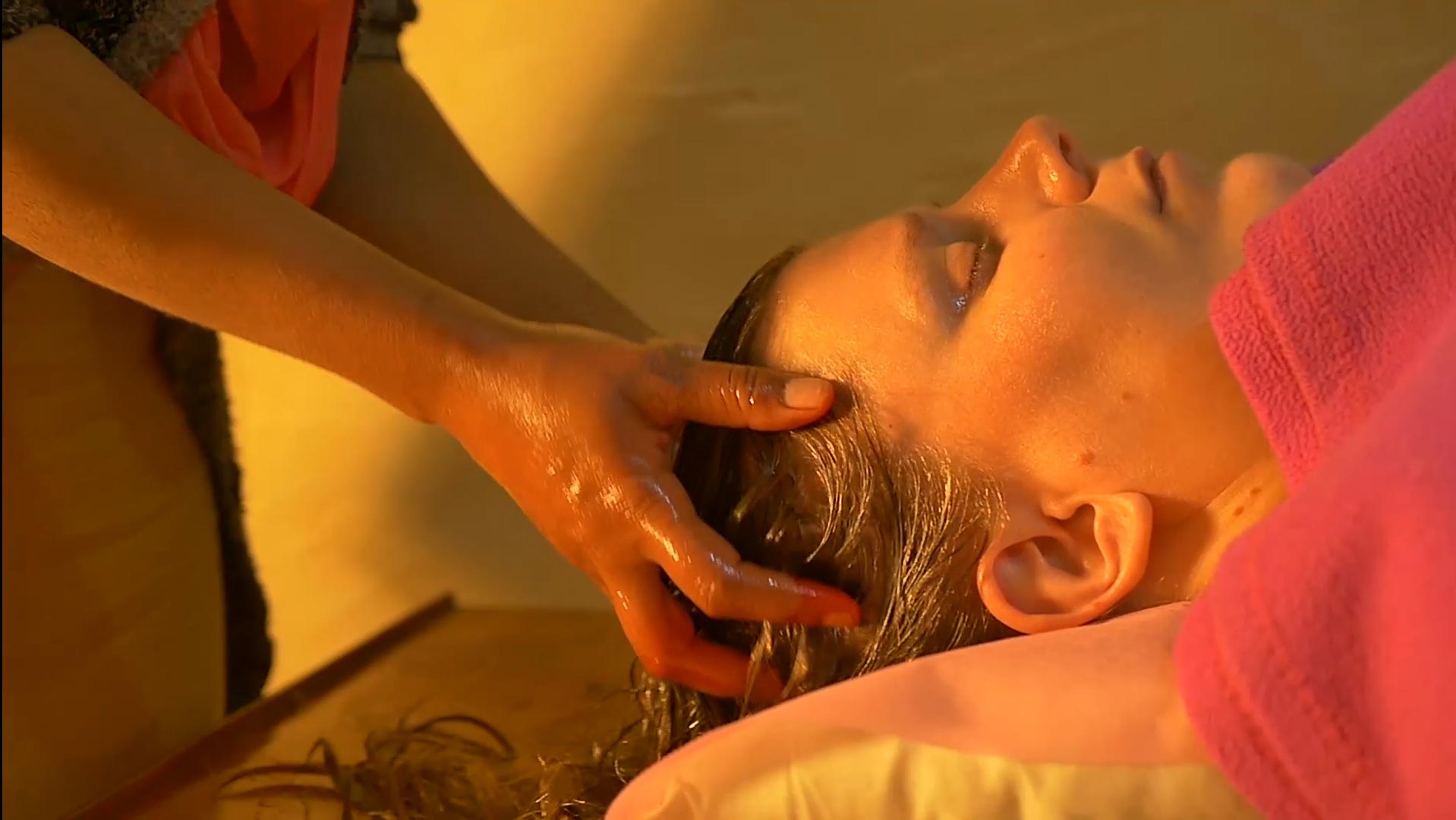
- Head and foot massage
- Basic Marma awareness (vital energy points)
- Shirodhara setup (pouring warm oil on the forehead)
- Swedana-related procedures (herbal steam therapy)
- Guidance on selecting oils based on traditional Ayurvedic principles
However, technique names alone are not enough. A professional therapist must also learn the crucial operational aspects: how to set up a serene space, communicate effectively with the client, protect their privacy, work hygienically, and modify or stop a session when appropriate. These professional habits often determine whether a graduate feels truly ready to work with real people.
Step 4: Learn Anatomy, Safety, and Contraindications
A credible Ayurvedic training should never exclude basic anatomy and safety. It is essential to understand major bones, joints, muscle groups, and common movement limitations. This knowledge forms the bedrock of safe practice.
Just as important is learning how to screen clients. Massage is not suitable in every situation. Conditions like fever, acute injury, certain skin problems, recent surgery, and pregnancy-related considerations may require modification, postponement, or referral to a medical professional. A responsible course teaches students to stay within their level of competence and to avoid diagnosing or claiming to treat medical conditions unless they hold the appropriate professional qualifications. Your role is to support wellness, not to practice medicine.
Step 5: Practice Communication and Client Care
Technical skill can be easily undermined by poor communication. A great therapist is also a great listener and communicator. You will need to:
- Explain the treatment process clearly.
- Ask about comfort and pressure preferences throughout the session.
- Obtain informed consent before beginning.
- Maintain professional draping at all times.
- Create a calm, safe, and non-judgmental environment.
- Avoid making exaggerated medical promises.
Students should also learn how to take basic, non-medical intake information and document sessions appropriately. If you plan to work in a spa, retreat center, yoga studio, or private practice, these habits are just as important as the massage sequence itself.
Step 6: Choose Training That Matches Your Career Goal
The right training for you depends on your ultimate goal. Someone who wants personal knowledge for family and friends may be happy with a short introductory course. A person planning to offer paid, professional treatments will need extensive practice and may also need a locally recognized massage qualification.
This is why course length should be chosen based on the outcome you want, not just on convenience. Himalayan Yoga Academy offers a 50-Hour Ayurveda Foundation Training for those who want a shorter entry point, while its Professional Ayurveda & Panchakarma Training provides a much broader, Ayurveda-focused direction.
Step 7: Add Complementary Skills Carefully
Many successful wellness professionals combine disciplines. A yoga teacher may add Ayurvedic massage to better understand relaxation and body awareness. A massage therapist may study yoga to improve their movement knowledge and self-care. A retreat facilitator may combine massage with meditation or sound healing.
At Himalayan Yoga Academy, students can continue into 200-Hour and 300-Hour Yoga Teacher Training, Professional Singing Bowl Training, Gong Master Training, and Meditation Teacher Training. These programs create powerful synergies. However, the best approach is to add skills that support a clear professional direction rather than simply collecting unrelated certificates.
Step 8: Understand Certification and Local Regulation
It is crucial to understand the difference between a certificate and a license. A certificate shows that you have completed a particular course. It does not automatically grant you the legal right to practice massage in every country or region. Before you market yourself as a massage therapist, you must check the specific rules that apply in your home country or destination.
When choosing a school, ask them to explain exactly what its certificate states, who issues it, how hours are documented, and what assessments are required. Always keep copies of your syllabus, attendance record, and practical assessments, as future employers or regulators may want more than just the final certificate.
Step 9: Gain Experience After Graduation
Graduation is not the end of your journey; it is the beginning of your professional development. New therapists improve by working slowly, receiving feedback, practicing within their scope of competence, and committing to continued education. You might start by offering sessions in a supervised environment, joining an established wellness center, or working with a small group of practice clients where local rules allow.
Keep detailed notes on your timing, client comfort, and your own ergonomics. Therapists who ignore their posture can develop strain injuries quickly, so self-care and proper body mechanics should remain a core part of your professional routine.
Why Study Ayurvedic Massage in Nepal?
Nepal offers a uniquely immersive environment for studying Ayurveda. Here, training can sit alongside yoga, meditation, Himalayan culture, and residential study. Kathmandu is accessible to international students and has a long-established wellness and spiritual education scene.
At Himalayan Yoga Academy, the 200-hour massage program is part of a broader school, not a stand-alone weekend workshop. Students who want to deepen their knowledge can stay within the same supportive learning community to study Ayurveda & Panchakarma, Yoga Teacher Training, Singing Bowl Training, Gong Master Training, or Meditation Teacher Training.
Final Thoughts
To become a successful Ayurvedic massage therapist, focus on four pillars: sound foundations, repeated hands-on practice, professional safety, and a clear understanding of your legal scope of practice. A certificate is a useful milestone, but true skill develops through supervised training and responsible experience.
For students seeking an immersive and transformative route, a 200-hour Ayurveda massage training in Nepal can provide the time and space to learn techniques, receive personal correction, and experience Ayurveda as part of a wider yogic lifestyle. The strongest career path is one that combines practical competence with ethics, a commitment to continued learning, and realistic professional expectations
Frequently Asked Questions (FAQ)
Q: How long does it take to become an Ayurvedic massage therapist?
A: The time required varies greatly. A foundational course can be a few weeks (like a 40-hour program), while a comprehensive professional training might be 200 hours or more, spread over several weeks or months. The depth of your training directly impacts your readiness to practice professionally.
Q: Is Ayurvedic massage the same as regular massage?
A: No. While both involve hands-on techniques, Ayurvedic massage is rooted in the philosophy of the doshas (Vata, Pitta, Kapha). It is highly individualized, with the choice of oils, pressure, and technique tailored to a person’s constitution and current state of balance, rather than following a single standardized routine.
Q: Can I practice Ayurvedic massage anywhere in the world with a certificate from Nepal?
A: Not necessarily. A certificate from a reputable school like Himalayan Yoga Academy demonstrates your training and hours. However, the legal right to practice is determined by the laws of the country, state, or region where you intend to work. Always research and comply with local regulations.
Q: What is the most important skill for an Ayurvedic massage therapist?
A: While technical skill is vital, the ability to listen and communicate is arguably the most important. Understanding the client’s needs, explaining the process, ensuring their comfort, and maintaining ethical boundaries are the hallmarks of a true professional.
Altitude Sickness Prevention: Yogic Breathing and Mindful Pacing in the Himalayas
The Himalayas have a way of humbling even the most experienced trekkers. One moment you are enjoying crisp mountain air, dramatic Himalayan views, and prayer flags moving in the wind; the next, a headache, unusual fatigue, or shortness of breath may remind you that your body is adjusting to a higher elevation.
For anyone preparing to trek in Nepal, altitude sickness prevention should be an important part of the journey. Physical fitness alone does not guarantee protection from altitude illness. Proper acclimatization, gradual ascent, hydration, awareness of symptoms, and responsible pacing are all important.
At Himalayan Yoga Academy, we introduce travelers and yoga practitioners to gentle breathing, mindfulness, and movement practices that may complement responsible acclimatization. These practices are not a substitute for medical care or appropriate descent when symptoms worsen. Instead, they can help trekkers become more aware of their breathing, energy levels, pace, and overall condition while traveling in the mountains.
Understanding Altitude Sickness Prevention
- Effective altitude sickness prevention begins with understanding what happens to the body as elevation increases.
- Above approximately 2,500 meters, atmospheric pressure decreases. Although the percentage of oxygen in the air remains similar, the reduced pressure means less oxygen is available with each breath.
- The body gradually responds by increasing breathing and heart rate and making other physiological adaptations. However, these changes require time. Ascending too quickly can make it difficult for the body to adapt.
- This is why proper acclimatization remains one of the most important aspects of altitude sickness prevention in Nepal.
- Yoga and pranayama should therefore be viewed as supportive practices rather than treatments. Gentle breathing may help you stay calm, develop greater respiratory awareness, and avoid unnecessary exertion while your body adapts naturally to altitude.
Yogic Breathing for Altitude Sickness Prevention
Pranayama is the yogic practice of conscious breathing. When practiced gently and responsibly, certain breathing techniques can be incorporated into a broader altitude sickness prevention strategy.
The emphasis should always be on comfortable breathing rather than forcing the respiratory system.
Avoid Aggressive Breathing at High Altitude
Some trekkers assume that taking very forceful breaths or practicing intense breathwork will automatically provide more oxygen. That is not necessarily helpful. At altitude, your respiratory system is already working harder. Aggressive hyperventilation, prolonged breath retention, or demanding pranayama techniques may cause light-headedness, tingling, anxiety, or additional discomfort. For this reason, Himalayan Yoga Academy generally emphasizes gentle and relaxed breathing practices for trekkers. Breathing should feel smooth, comfortable, and sustainable.
Samvritti Pranayama for Calm and Breath Awareness
Samvritti Pranayama, or equal-ratio breathing, is one of the simplest practices for developing calm breathing awareness.
- Sit comfortably with your spine upright. Inhale gently through the nose for approximately four counts and then exhale for approximately four counts.
- Continue only as long as the breathing remains easy.
- Do not struggle to maintain a particular number.
- The objective is not to force more oxygen into the body. Instead, this practice can encourage slower, more conscious breathing and greater awareness of how your body is responding.
- Practicing Samvritti at lower elevations before your trek can also help you become familiar with conscious breathing before reaching higher altitudes.
Extended Exhalation and High-Altitude Calm
Anxiety and altitude discomfort can sometimes create a cycle in which a person feels short of breath, becomes anxious, and then begins breathing even more rapidly.
A gentle extended exhalation may help promote relaxation.
For example, inhale comfortably for around four counts and exhale slowly for approximately six counts.
The ratio should always feel natural.
This technique should not be used to ignore or suppress genuine altitude sickness symptoms. If symptoms are persistent or worsening, appropriate medical evaluation and descent are more important than continuing breathing exercises.
For altitude sickness prevention, learning the difference between normal exertion and concerning symptoms is essential.
Anulom Vilom for Mindful Breathing
Anulom Vilom, commonly known as alternate nostril breathing, is another traditional pranayama practice.
- Close the right nostril gently and breathe in through the left. Change sides and breathe out through the right. Then inhale through the right and exhale through the left.
- Keep the breathing gentle and avoid breath retention while trekking at high elevation unless you have been specifically advised otherwise by an appropriately qualified professional.
The primary benefit in this context is mindful breathing and relaxation rather than treating altitude sickness itself.
Mindful Pacing for Altitude Sickness Prevention
One of the most valuable lessons Himalayan trekking teaches is simple:
Going slower is often better than going faster.
Trekkers sometimes make the mistake of treating the mountains like a fitness competition. They walk quickly because they feel strong at lower elevations and assume they can maintain the same pace higher up.
For altitude sickness prevention, sustainable pacing is far more important than reaching the next destination quickly.
Walk slowly enough that you can maintain reasonably comfortable breathing. If you are constantly gasping for air during an ordinary section of the trail, reducing your pace may be appropriate.
Many experienced mountain guides around the world emphasize the same philosophy: slowly, steadily, and patiently.
Synchronize Your Breath With Your Walking Pace
- Breath-synchronized walking can be a practical mindfulness technique during trekking.
- On moderate terrain, you may find it comfortable to inhale over two steps and exhale over two steps. When the trail becomes steeper, the rhythm may naturally change.
- There is no universal breathing ratio that every trekker must follow.
- The goal is simply to notice your breath.
- If your breathing suddenly becomes much more difficult, your energy drops significantly, or symptoms begin appearing, treat those changes as information from your body rather than something to fight against.
- That awareness is an important part of responsible altitude sickness prevention in the Himalayas.
Acclimatization Is Essential
- Breathing exercises cannot compensate for an itinerary that ascends too rapidly.
- Proper acclimatization remains essential.
- Whenever possible, trekking itineraries should allow sufficient time for the body to adapt gradually to higher elevations. Rest days may also be necessary, particularly during treks that move above 3,000 meters.
- Popular Nepal trekking routes such as Everest Base Camp, the Annapurna Circuit, Manaslu Circuit, Gokyo Valley, and other high-altitude journeys require sensible ascent planning.
- Anyone researching altitude sickness prevention in Nepal should therefore look at the entire trekking itinerary rather than focusing only on breathing techniques.
Preparing Your Breath Before Trekking in Nepal
- Altitude preparation can begin before you arrive in Nepal.
- Walking, hiking, cardiovascular exercise, and stair climbing can help develop general trekking fitness.
- You can combine this training with gentle breath awareness.
- For example, while climbing stairs or walking uphill, notice whether your breathing stays smooth. Avoid holding your breath when effort increases.
- Learning to recognize your breathing patterns before reaching Nepal can help you become more aware of changes once you begin trekking at altitude.
- However, physical conditioning should not be confused with acclimatization. A highly trained athlete can still develop altitude sickness.
Morning Breathing Practice During Your Trek
A short morning practice may help you begin the trekking day calmly.
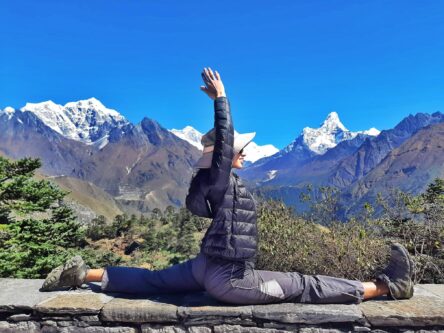
- Five to ten minutes of comfortable breathing, gentle stretching, and quiet observation can help you assess how your body feels before beginning the day’s walk.
- Notice whether you have a headache, unusual fatigue, dizziness, nausea, loss of appetite, or significant breathing difficulty.
- Your morning practice should therefore serve partly as a self-awareness check rather than simply another yoga exercise.
- That makes mindfulness particularly useful within a broader altitude sickness prevention routine.
Take Regular Mindful Breaks
- Instead of waiting until you are completely exhausted, take short breaks throughout the day.
- Use these pauses to notice your breathing, hydration, energy level, mental clarity, and physical symptoms.
- A sixty-second check-in can sometimes reveal that you have been walking faster than necessary.
- High-altitude trekking rewards patience.
- Your goal should not be to prove how quickly you can reach the next teahouse. Your goal should be to arrive safely and in a condition that allows you to continue enjoying the journey.
Evening Breathing and Recovery
- At the end of the trekking day, gentle breathing and restorative yoga may help you relax after several hours of walking.
- An extended, comfortable exhalation may be particularly calming before sleep.
- However, difficulty sleeping, worsening headaches, nausea, unusual breathlessness, confusion, or coordination problems should never simply be attributed to normal trekking tiredness.
- Monitor symptoms carefully.
- Breathing practices should support awareness—not encourage trekkers to ignore warning signs.
Common Altitude Sickness Prevention Mistakes
Some mistakes can increase unnecessary risk during high-altitude travel:
- Ascending too quickly because you feel physically strong
- Continuing upward despite worsening symptoms
- Using intense breathing exercises at altitude
- Holding the breath for long periods
- Trying to compete with faster trekkers
- Ignoring headaches, nausea, dizziness, or poor coordination
- Assuming excellent fitness prevents altitude illness
- Using yoga or pranayama as a substitute for medical advice
- Failing to include acclimatization time in the trekking itinerary
The most important principle is simple: listen to your body and respect the altitude.
Altitude Sickness Prevention and Hydration
- Staying appropriately hydrated is also important during trekking.
- However, drinking excessive amounts of water is not an altitude sickness treatment and can create its own health problems.
- Drink according to your needs and follow guidance from experienced trekking and healthcare professionals.
- Nutrition and rest are equally important.
- High-altitude trekking places considerable demand on the body. Adequate food, sleep, pacing, hydration, and acclimatization all work together.
- There is no single breathing exercise that can replace these fundamentals.
When Should You Descend?
Knowing when to stop ascending is one of the most important parts of altitude sickness prevention and safety.
- If symptoms become more serious or continue worsening, continuing upward may be dangerous.
- Severe headache, repeated vomiting, confusion, extreme weakness, unusual behavior, significant shortness of breath at rest, or difficulty walking normally should be taken seriously.
- Seek appropriate medical assistance and descend when medically indicated.
- High-altitude illness can become life-threatening.
- No yoga pose, meditation technique, pranayama exercise, or personal determination should take priority over safety.
Himalayan Yoga Academy’s Approach to Trek Preparation
At Himalayan Yoga Academy in Kathmandu, we teach yoga, pranayama, meditation, and mindful movement to international students and travelers.
For trekkers, these practices can be particularly useful before and after a Himalayan journey.
- Our approach focuses on developing breath awareness, body awareness, relaxation, and mindful movement rather than making unrealistic claims about preventing altitude illness.
- Travelers preparing for trekking in Nepal may benefit from learning gentle pranayama before beginning their journey so the techniques are already familiar by the time they reach higher elevations.
- Our programs can also incorporate restorative yoga, meditation, massage, and sound-based relaxation practices for travelers returning from demanding treks.
Altitude Sickness Prevention FAQ
What is the best altitude sickness prevention strategy?
Gradual acclimatization and responsible ascent planning are among the most important considerations. Travelers should also recognize symptoms early, avoid unnecessary overexertion, maintain appropriate hydration and nutrition, and follow medical or trekking safety guidance.
Can pranayama prevent altitude sickness?
Pranayama should not be considered a guaranteed method of preventing altitude sickness.
Gentle yogic breathing may support relaxation, breathing awareness, and mindful pacing, but it does not replace acclimatization, appropriate descent, oxygen, medication, or medical treatment when those are required.
Is altitude sickness common while trekking in Nepal?
Altitude-related symptoms can occur during high-altitude treks in Nepal, particularly when travelers ascend faster than their bodies can acclimatize.
Anyone planning Everest Base Camp, Annapurna Circuit, Manaslu, Gokyo, or other high-elevation routes should learn about altitude sickness prevention before trekking in Nepal.
Can beginners practice yogic breathing for trekking?
Yes. Gentle breathing awareness can be accessible to beginners.
- Start at lower elevations before the trek and keep all breathing comfortable and unforced.
- Avoid intense breath retention or aggressive breathing techniques, particularly at high altitude.
Should I continue trekking if I develop altitude sickness symptoms?
- Do not simply push through symptoms.
- Stop ascending and assess the situation. If symptoms worsen or become severe, seek appropriate medical help and descend as required.
Can Himalayan Yoga Academy teach breathing techniques before my trek?
Yes. Himalayan Yoga Academy offers pranayama, meditation, yoga, and residential programs in Kathmandu that can help travelers establish a mindful breathing practice before beginning a Himalayan trek.
Altitude Sickness Prevention Begins With Respect for the Mountain
The Himalayas reward awareness, patience, and humility.
Altitude sickness prevention is not about discovering one secret technique that allows you to climb faster. It is about giving your body enough time to adapt, recognizing warning signs, pacing yourself responsibly, and making safe decisions as conditions change.
Gentle pranayama and mindful walking can become valuable companions during this process. They encourage you to notice your breath, observe your energy, stay calmer during exertion, and develop a closer relationship with your body’s signals.
At Himalayan Yoga Academy, we encourage trekkers to approach the mountains with awareness rather than ambition alone.
Whether you are preparing for Everest Base Camp, Annapurna, Manaslu, Langtang, or another Himalayan adventure, developing a mindful breathing practice before your trek can become part of your overall preparation.
Contact Himalayan Yoga Academy to learn about pranayama, meditation, yoga, and pre- or post-trek wellness programs in Kathmandu, Nepal.
Medical disclaimer: This article is for general educational purposes only and is not a substitute for professional medical advice, diagnosis, or treatment. Altitude sickness can become serious or life-threatening. Seek appropriate medical help if symptoms are concerning or worsening.
Why Yoga Teacher Training in Nepal is Famous Worldwide – And Why Himalayan Yoga Academy Stands Apart
Introduction
Nepal – the land of the Himalayas, the birthplace of Lord Buddha, and a country steeped in spiritual heritage. For thousands of years, seekers, sages, and yogis have been drawn to these sacred mountains in search of wisdom, peace, and self-realization.
Today, Nepal has become one of the world’s most sought-after destinations for Yoga Teacher Training (YTT) . But what makes this small Himalayan nation so special? And why do students from across the globe choose Himalayan Yoga Academy for their transformative journey?
In this blog, we explore the magic of Nepal and the unique offerings that make our academy a beacon for yoga practitioners worldwide.
Part 1: Why Yoga Teacher Training in Nepal is Famous Worldwide
1. The Spiritual Heart of the Himalayas
Nepal is home to eight of the world’s fourteen highest peaks, including Mount Everest. But beyond the breathtaking landscapes, the Himalayas hold a profound spiritual energy. It is believed that the great yogis and siddhas of ancient times meditated in these mountains, and their presence still vibrates through the valleys and caves.
Practicing yoga here is not just a physical exercise – it is a pilgrimage into your own soul.
2. The Birthplace of Lord Buddha
Lumbini, in southern Nepal, is the birthplace of Siddhartha Gautama – Lord Buddha. His teachings on mindfulness, compassion, and inner peace form the foundation of meditation practice across the world. Studying yoga and meditation in the land where Buddhism was born adds a depth and authenticity that cannot be replicated elsewhere.
3. Authentic Yogic Traditions
Unlike many Western yoga studios that focus primarily on asanas (postures), Nepal offers authentic, holistic yoga rooted in ancient traditions. Here, you learn not just how to move your body, but how to:
- Master the breath (Pranayama)
- Calm the mind (Meditation)
- Purify the body (Shatkarma)
- Understand yogic philosophy (Patanjali’s Yoga Sutras, Bhagavad Gita, Upanishads)
- Live a yogic lifestyle (Ahimsa, Satya, Brahmacharya, and more)
4. The Power of Sacred Sites
Nepal is dotted with temples, monasteries, and pilgrimage sites that carry immense spiritual energy:
- Pashupatinath Temple – one of the holiest Hindu temples
- Boudhanath Stupa – a center of Tibetan Buddhism
- Swayambhunath (Monkey Temple) – ancient Buddhist stupa with panoramic views
- Pharping – home to sacred caves where Guru Padmasambhava meditated
Practicing yoga in such environments deepens your connection to the practice and accelerates your spiritual growth.
5. Immersion in a Yogic Lifestyle
In Nepal, yoga is not something you do for an hour – it is a way of life. During a YTT, you live in an ashram or retreat center, eat sattvic (pure, vegetarian) food, wake before sunrise, and follow a disciplined daily routine. This full immersion transforms not just your body, but your entire being.
6. Affordable and Accessible
Compared to Western countries, yoga teacher training in Nepal is significantly more affordable without compromising on quality. You receive world-class instruction, certification, accommodation, and meals – all at a fraction of the cost.
7. Internationally Recognized Certification
Reputable yoga schools in Nepal offer Yoga Alliance certified 200-hour, 300-hour, and 500-hour teacher training programs. This certification allows you to teach yoga anywhere in the world.

Part 2: Why Himalayan Yoga Academy Stands Apart
At Himalayan Yoga Academy, we are not just another yoga school. We are a spiritual family, dedicated to preserving the authentic teachings of yoga while making them accessible to modern practitioners from all backgrounds.
Here is what makes us unique:
1. Located in the Lap of Nature
Our academy is nestled in Raniban, Kathmandu, next to the serene Nagarjuna Jungle. Away from the noise and pollution of the city, we offer a peaceful, natural environment perfect for deep practice and introspection.
2. Experienced and Devoted Teachers
Our teachers are not just instructors – they are lifelong practitioners and scholars of yoga. Led by Shanta Kharel, an Associate Professor of Yoga with a Master’s degree in Human Consciousness and Yogic Science, our faculty brings decades of experience in:
- Hatha Yoga
- Ashtanga Vinyasa
- Yin Yoga
- Pranayama and Meditation
- Yoga Philosophy and Anatomy
- Ayurveda and Sound Healing
3. Comprehensive Curriculum
Our 200-Hour Yoga Teacher Training covers every aspect of yoga:
- Asana (postures) with alignment and adjustments
- Pranayama (breath control)
- Meditation and Mindfulness
- Yoga Philosophy (Patanjali’s Yoga Sutras, Bhagavad Gita)
- Anatomy and Physiology
- Teaching Methodology and Practicum
- Ayurveda and Yogic Diet
- Sound Healing with Singing Bowls
4. Small Class Sizes
We keep our groups small to ensure personalized attention for every student. Whether you are a beginner or an advanced practitioner, you will receive guidance tailored to your needs.
5. Authentic Monastery Retreats
We are one of the few academies that offer monastery-based retreats in sacred locations like Pharping and Nagi Gumba. This is a rare opportunity to live among monks, participate in daily puja (prayers), and experience the monastic way of life.
6. Yoga and Trekking Combinations
For those who love adventure, we offer unique Yoga + Trekking packages:
- Ghorepani Poonhill Yoga Trek – Sunrise over the Annapurna range
- Valley Rim Yoga Trek – Quiet trails close to Kathmandu
- Everest Base Camp Yoga Trek – The ultimate Himalayan adventure
7. Holistic Healing Therapies
Beyond yoga, we offer:
- Sound Healing with Tibetan Singing Bowls
- Ayurvedic Massage and Panchakarma
- Shirodhara (oil pouring therapy)
- Steam Bath and Herbal Treatments
8. Comfortable Accommodation and Nourishing Food
Our rooms are clean, comfortable, and equipped with heating for colder months. We serve delicious, sattvic vegetarian and vegan meals prepared with love and fresh local ingredients.
9. Warm, Family-Like Atmosphere
Many of our students arrive as strangers and leave as family. We create a supportive, welcoming community where you can be yourself, heal, and grow.
10. Affordable Pricing with High Value
We believe yoga should be accessible to all. Our pricing is transparent, affordable, and includes:
- Accommodation
- All meals
- Daily yoga and meditation classes
- Course materials
- Certification
- Airport transfers
Part 3: What Our Students Say
“My time at Himalayan Yoga Academy was life-changing. The teachers were knowledgeable, kind, and truly cared about my growth. I arrived stressed and left with a deep sense of peace. I highly recommend this place to anyone seeking authentic yoga training.”
— Sarah M., USA
“The monastery retreat was the highlight of my trip. Living with monks, waking up to chanting, and meditating in sacred caves – it was beyond anything I imagined.”
— Lena K., Germany
“I completed my 200-hour YTT here and felt fully prepared to teach. The curriculum was thorough, and the practical teaching sessions gave me confidence. Thank you, Himalayan Yoga Academy!”
— Rajesh P., India
Part 4: Courses We Offer
| Course | Duration | Certification |
|---|---|---|
| 200-Hour Yoga Teacher Training | 22 Days | Yoga Alliance Certified |
| 300-Hour Yoga Teacher Training | 30 Days | Yoga Alliance Certified |
| 50-Hour Yin Yoga TTC | 7 Days | Yoga Alliance Certified |
| 100-Hour Pranayama TTC | 10 Days | Himalayan Yoga Academy |
| 100-Hour Meditation TTC | 10 Days | Himalayan Yoga Academy |
| Singing Bowl / Sound Healing Course | 2–10 Days | Himalayan Yoga Academy |
| Ayurveda & Panchakarma Course | 22 Days | Himalayan Yoga Academy |
| Yoga Retreats (3–10 Days) | Various | – |
| Yoga + Trekking Packages | 7–12 Days | – |
Part 5: Why You Should Choose Nepal for Your YTT
- Authenticity – Learn yoga where it was born and preserved for millennia.
- Spiritual Energy – Practice in the land of the Himalayas and Lord Buddha.
- Affordability – Get world-class training at a fraction of Western prices.
- Cultural Immersion – Experience Nepal’s rich culture, festivals, and hospitality.
- Adventure – Combine your training with trekking, rafting, and exploration.
- Lifelong Community – Join a global family of yogis who share your journey.
Conclusion: Your Journey Begins Here
Yoga is not just a practice – it is a path to self-discovery, healing, and liberation. And there is no better place to walk this path than in the sacred Himalayas of Nepal.
At Himalayan Yoga Academy, we are honored to be your guide. Whether you are seeking a 200-hour teacher training, a peaceful retreat, or a yoga and trekking adventure, we welcome you with open arms and open hearts.
Come, breathe the mountain air. Meditate in ancient caves. Practice yoga by the river. Discover the peace that has always been within you.
Namaste. We will see you in Nepal.
Mardi Himal Yoga Trekking: The Best Short High-Altitude Retreat in Nepal
Nepal is a land that calls to the soul. The Himalayas don’t just tower over the landscape—they command a presence that makes you feel both insignificant and deeply connected to something greater. Over the years of trekking across this magnificent country, I’ve come to believe that the mountains have a way of meeting you exactly where you are. And sometimes, what you need isn’t the longest or most challenging trek—it’s the one that brings you back to yourself. That’s exactly what the Mardi Himal Yoga Trek offers.
Why Mardi Himal Treks in Nepal?
Tucked away in the Annapurna region, Mardi Himal is one of Nepal’s best-kept secrets. Unlike the bustling trails of Everest Base Camp or the well-worn paths of Annapurna Circuit, Mardi Himal remains refreshingly uncrowded and peaceful. The trail takes you through ancient rhododendron and oak forests, past traditional farming villages, and ultimately to the base camp of the majestic Machhapuchhre (Fishtail Mountain) at 4,500 meters.
What makes this trek truly special is its moderate difficulty—accessible to beginners with basic fitness, yet rewarding enough for seasoned trekkers. In just 5 to 7 days, you can experience the full majesty of the Himalayas without the exhaustive commitment of longer expeditions.
The Yoga Element: Where Trekking Meets Transformation
Here’s where the Mardi Himal Yoga Trek becomes something more than just a hike. Imagine starting each day not with a rushed breakfast and hurried packing, but with a guided yoga session as the first light touches the snow-capped peaks. Picture yourself practicing pranayama (breathing techniques) that not only calm your mind but actually enhance your lung capacity for the altitude ahead.
Each day of this 7-day journey blends mindful trekking with daily yoga, meditation, and nature-based healing practices. The certified yoga teachers who accompany the trek guide you through sessions tailored for all levels—from absolute beginners to experienced practitioners. Whether you’re meditating above the clouds or practicing asanas before the towering presence of Mt. Machhapuchhre, every moment is designed for inner transformation.
And here’s the beauty of it: you don’t need any prior yoga experience. All sessions are beginner-friendly and guided with care.
Why Himalayan Yoga Academy For Trek Experience?
Since 2007, Himalayan Yoga Academy has been at the forefront of promoting spiritual and yoga tourism in Nepal. Located on the lap of Nagarjun Jungle in Kathmandu and registered with Yoga Alliance US, the Academy has earned a stellar reputation—4.82 out of 5 stars from 168 reviews.
What sets them apart isn’t just their expertise—it’s their heart. Travelers consistently praise the knowledgeable and passionate instructors, the warm and helpful staff, and the nourishing food. One guest described their experience as “a beautiful experience towards self-discovery and acceptance”. Another said the academy “already feels like a second home”.
More Than Just Mardi Himal: Trekking Packages for Every Journey
While the Mardi Himal Yoga Trek is a standout experience, Himalayan Yoga Academy offers a diverse range of trekking packages to suit every traveler’s needs and timeline. Whether you want to combine yoga with your trek or prefer a more traditional hiking experience, there’s something for everyone.
Yoga Trekking Packages
- Ghorepani Poon Hill Yoga Trek (7 Days) – A unique Himalayan journey that beautifully blends trekking, yoga, meditation, and cultural immersion in the heart of the Annapurna region. The sunrise view from Poon Hill is legendary.
- Everest Base Camp Yoga Trek (15-17 Days) – For those dreaming of the ultimate Himalayan adventure, this iconic trek combines the world’s most famous trekking destination with daily yoga and meditation practice. Maximum altitude reaches 5,550 meters.
- Pikey Peak Yoga Trek– 7 Days – A newly discovered, short and easy trek in the lower Everest region that offers majestic views of seven 8,000-meter peaks, including Everest, Kanchenjunga, Makalu, and Lhotse. Perfect for those seeking spiritual immersion in Sherpa Buddhist culture.
- Valley Rim Yoga Retreat (7 Days) – A healing and magical hiking yoga retreat along the spectacular Valley Rim Trail near Kathmandu.
Trekking Without Yoga
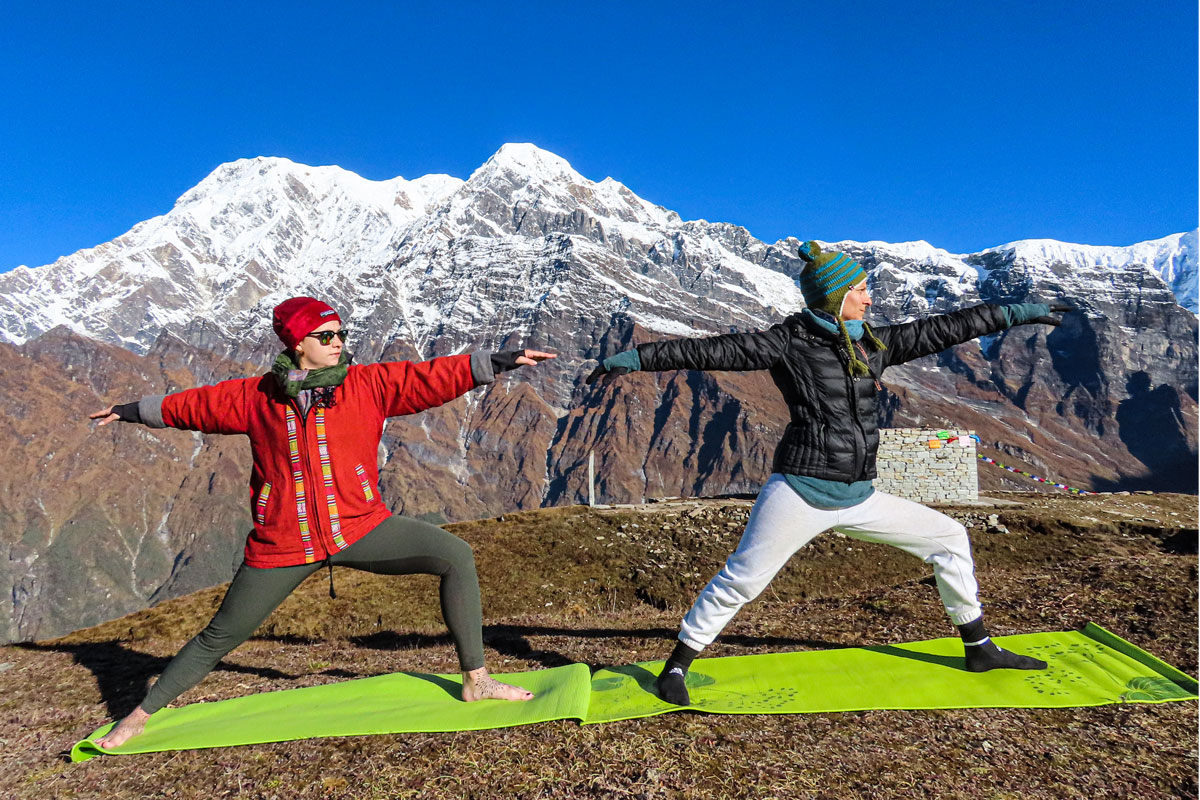
For travelers who prefer a more traditional trekking experience, Himalayan Yoga Academy also offers all of these same treks without the yoga component. This flexibility allows you to customize your Nepali adventure exactly the way you want it.
The Perfect Combination: Mix and Match
One of the greatest advantages of booking with Himalayan Yoga Academy is the ability to combine multiple packages to create your dream itinerary. Imagine starting with a yoga retreat in Kathmandu, followed by the Mardi Himal Yoga Trek, and then transitioning to a cultural sightseeing tour. Or perhaps you’d prefer to begin with the Ghorepani Poon Hill trek and add on a few days of relaxation and yoga in Pokhara.
The Academy’s team can help you craft a seamless journey that maximizes every moment of your time in Nepal. Whether you have a week or a month, there’s a combination that works for you.
Best Seasons and Practical Details
The ideal times for the Mardi Himal Yoga Trek are spring (March to May) and autumn (September to November), when the skies are clear and the mountain views are nothing short of spectacular.
Accommodation throughout the trek is in cozy teahouses, with comfortable hotel stays in Pokhara. Solo travelers are warmly welcomed, and group sizes typically range from 4 to 16 participants.
Final Thoughts :
The Mardi Himal Yoga Trek isn’t just a trek—it’s a homecoming. It’s a chance to step away from the noise of daily life and reconnect with what truly matters. The mountains of Nepal have a way of stripping away the unnecessary and revealing the essential.
Whether you choose Mardi Himal, Everest Base Camp, Ghorepani Poon Hill, or any of the other incredible routes, Himalayan Yoga Academy offers the expertise, warmth, and authenticity to make your journey unforgettable. With options for yoga-integrated treks, traditional treks, and customizable combinations, your perfect Himalayan adventure is waiting.
The trail calls. The mountains are ready. All that’s left is for you to take that first step.
Ready to plan your Himalayan yoga trekking adventure? Visit Himalayan Yoga Academy to explore packages, check availability, and start your journey toward the mountains—and yourself.
7 best highlights of this amazing Mardi Himal Yoga Trek.
1. Walking Through Beautiful Forests
The trek starts near Pokhara. You leave the busy roads behind and walk into quiet, green forests.
- Spring Flowers: If you come in March or April, the rhododendron trees are full of bright red, pink, and white flowers. The ground is covered with fallen petals. It feels like walking through a garden.
- Cool Shade: Even in other seasons, the oak and maple trees give nice shade. It is very peaceful. Our yoga teachers often stop here for a short “forest meditation” where we just listen to the birds and breathe fresh air.
2. Getting Close to Fishtail Mountain (Machhapuchhre)
This is the most famous mountain in the area. It looks like a fish tail. The local people believe it is a holy mountain, so nobody has ever climbed it.
On the Mardi Himal trek, you get very close to it. As you go up from Low Camp to High Camp, the mountain looks bigger and bigger. By the last day, it feels like you can almost touch it. It is a powerful and beautiful sight.
3. The Big View from Mardi Himal Base Camp (4,500m)
This is the main goal of the trek. The final walk to the top viewpoint is steep and hard work, but the view is worth every step.
- You get a full 360-degree view of the mountains.
- You can see the huge Annapurna range, including Annapurna I (the 10th highest mountain in the world).
- The best time to go is early morning. We bring our yoga mats to the top. Imagine doing Sun Salutations while the sunrise turns the snowy peaks orange and pink. It is a moment you will never forget.
4. A Quiet Trail with Fewer People
Let’s be honest. The Everest Base Camp trail is very busy. You have to walk in long lines of trekkers.
Mardi Himal is different. It is much quieter. There are fewer tourists, so you can enjoy the mountains in peace. The teahouses at Forest Camp and High Camp are small and cozy. You get to know your group, your guides, and your porters very well. This solitude is perfect for relaxation and meditation.
5. Visiting Local Gurung Villages
Nepal is not just about mountains. It is also about the kind people who live there.
On this trail, you pass through small Gurung villages. You will see traditional stone houses, colorful prayer flags, and old women weaving wool. We stop to drink local tea and eat Dal Bhat (rice and lentil soup) cooked on a wood fire. Meeting these friendly locals gives you a real taste of Nepali mountain life.
6. Safe and Gradual Climbing (Good for Beginners)
Mardi Himal is a great choice for first-time trekkers.
The height increases slowly, day by day. You start at about 1,100 meters and go up to 4,500 meters over several days. This slow climb gives your body time to get used to the thin air.
At Himalayan Yoga Academy, we also teach you simple breathing exercises (pranayama). These help you take in more oxygen. They calm your mind and help prevent altitude sickness. You do not need to be a super athlete to do this trek.
7. Beautiful Sunrises and Sunsets
At High Camp, the sunsets are incredible. As the sun goes down, the snow on the mountains glows red and gold.
We do a gentle stretching session at this time. We hold easy poses to relax our tired leg muscles while we watch the sky change colors. It is a perfect way to end the day.
How Himalayan Yoga Academy Makes It Better
We don’t just give you a map and say “good luck”. We add daily yoga to your trek.
- Morning session: Energizing stretches to warm up your body before you start walking.
- Evening session: Soft, relaxing poses to heal your muscles after a long day of hiking.
- You don’t need experience: If you have never done yoga before, that is okay. Our teachers guide you step-by-step.
(Note: If you prefer just to trek without yoga, we offer the same Mardi Himal package without the yoga classes. The choice is yours.)
Mix and Match with Other Packages
Why stop at just one adventure? You can combine Mardi Himal with other trips to make the most of your time in Nepal.
For example:
- Add a 3-day Chitwan Jungle Safari to see elephants, rhinos, and crocodiles.
- Add the Ghorepani Poon Hill Yoga Trek for another short trek with a famous sunrise view.
- Start or end with a Kathmandu Valley Yoga Retreat to relax near the capital city.
Our team can help you plan a custom trip that fits your schedule and interests. You can mix treks with yoga or just do treks. We are flexible.
Best Time to Go and Final Thoughts
- Best months: Spring (March to May) for flowers, and Autumn (September to November) for clear skies.
- Duration: 5 to 7 days.
Mardi Himal is proof that you do not need a month to have a great Himalayan experience. It is short, safe, and stunning. Whether you come for the mountain views, the yoga, or both, this trek will stay in your heart forever.
Ready to plan your trip? Contact Himalayan Yoga Academy today. We will help you design the perfect Nepal adventure—with yoga, without yoga, or combined with other packages. We are here to make your journey simple, safe, and unforgettable.
See you in the mountains!
How Much Yoga Experience Do You Need Before a 200-Hour Yoga Teacher Training?
“I’m not flexible enough.”
“I can’t even touch my toes.”
“I don’t know all the Sanskrit names.”
If these thoughts have ever crossed your mind while considering a 200-hour yoga teacher training, you’re not alone. But here’s what might surprise you: none of these things determine whether you’re ready. So How Much Yoga Experience Do You Need Before a 200-Hour Yoga Teacher Training?
Here is everything you need to know about preparing for a 200-Hour Yoga Teacher Training TTC, what to expect, and how to embark on this life-changing journey.
1. The Central Question: What Does “Readiness” Look Like?
Too often, aspiring yoga teachers delay their training because they compare themselves to flawless poses on social media. Real readiness, however, isn’t found online. It becomes clear through:
- Consistent personal practice
- Direct feedback from experienced teachers
- Honest self-observation
Change one variable at a time in your practice and notice whether your breath, control, and confidence improve. That awareness is the true heart of yoga.
2. What a 200-Hour Yoga Teacher Training Is Designed to Do
A 200-hour course is meant to establish a broad, responsible foundation—it is not promised to make you a master overnight.
A well-structured curriculum introduces:
- Asana & Functional Alignment (Hatha, Ashtanga, Vinyasa)
- Anatomy & Safety
- Pranayama & Meditation
- Yoga Philosophy & Ethics
- Teaching Methodology & Practicum
Its true value lies in giving you a coherent roadmap, supervised teaching experience, and the tools to identify what you need to study next.
3. How to Prepare Before Arrival
You don’t need extreme flexibility or to memorize every Sanskrit name before day one. Instead, set yourself up for success with these practical steps:
- Build a steady personal practice: Focus on consistency over intensity.
- Read the published curriculum: Understand the flow of your course.
- Communicate openly: Disclose any relevant injuries or health concerns to your instructors.
- Logistics & Essentials: Confirm equipment provided, pack comfortable clothing, secure travel insurance, and give yourself enough time to recover from travel.
- Clear your schedule: Reduce unnecessary work commitments so you can fully immerse yourself without distraction.
Arrive willing to ask questions, receive constructive feedback, and respect the pace of a diverse, international group of students.
4. The Residential Learning Experience
Studying residentially creates an unmatched continuity between morning practice, lectures, meals, self-study, and community life.
However, an intensive program can be physically and emotionally demanding. To thrive:
- Prioritize sleep and hydration.
- Remember that a disciplined schedule is meant to support learning—not reward exhaustion.
- Practice patience, punctuality, and respect within shared living spaces.
5. Key Pillars of a Foundational Yoga Training
Asana, Alignment & Different Bodies
One visible pose shape cannot fit every unique skeleton. Functional alignment respects individual body structures by adjusting stances, ranges, props, and transitions. Depth is not evidence of teaching ability—stable breathing and appropriate sensation matter far more.
Anatomy, Safety & Scope
Understanding movement and body mechanics helps teachers keep students safe. However, a yoga teacher certificate does not authorize medical diagnosis or rehabilitation. Sharp, electrical pain or persistent symptoms require stopping immediately and referring to a medical professional. Consent and progressive sequencing are essential to reduce risk.
Pranayama & Meditation
Breathwork and meditation broaden training beyond physical postures. Beginners benefit from conservative progressions, especially with forceful breathing or retention. Meditation instruction should offer an accessible focus and permission to adjust positions whenever necessary.
Philosophy, Lifestyle & Ethics
Rooted in traditional texts like the Yoga Sutras and Bhagavad Gita, yoga is a wider way of life. Ethical principles such as Ahimsa (non-harming) and truthfulness guide language, boundaries, and teaching practices. Spiritual authority must never be misused to pressure students, dismiss pain, or excuse misconduct.
Teaching Methodology & Practicum
Practicum turns theory into real-world confidence. Trainees learn to cue, demonstrate, observe, and manage class time. Constructive feedback focuses on clarity, safety, and responsiveness—preparing you to guide real people safely and effectively.
6. Highlight: Himalayan Yoga Academy’s 22-Day 200-Hour YTTC Program
If you are looking for an immersive experience in a peaceful setting, Himalayan Yoga Academy offers a 22-day residential 200-hour yoga teacher training program in Kathmandu, Nepal, designed for beginner-to-intermediate students.
Set against a tranquil Himalayan backdrop, the curriculum covers a complete foundation in Hatha, Ashtanga, Vinyasa, philosophy, anatomy, pranayama, meditation, and teaching methodology.
(Always confirm current dates, room options, fees, and prerequisites directly before booking travel.)
7. Life After Graduation: The Journey Begins
Graduation is not the end; it is the beginning of a new chapter. As a new graduate:
- Start with small, manageable classes to build confidence.
- Keep reflective notes after every class to track your growth.
- Obtain appropriate liability insurance and seek ongoing mentorship.
A certificate opens the door, but lasting trust from your students grows through preparation, humility, consistency, and placing their well-being first.
Frequently Asked Questions (FAQ)
- Q: Do I need advanced yoga experience to join?
- A: No. A consistent practice and a readiness to learn matter far more than holding advanced poses.
- Q: Does a 200-hour certificate guarantee a job?
- A: No. It provides a strong foundation. Teaching opportunities depend on your continued practice, local requirements, and practical skill.
- Q: Where can I study residentially in Nepal?
- A: Himalayan Yoga Academy offers a structured 22-day 200-hour residential program in Kathmandu.
Take the Next Step on Your Yoga Journey
The strongest 200-hour training balances challenge with care, tradition with critical thinking, and personal transformation with professional responsibility.
Ready to explore your potential? Review the curriculum, upcoming dates, and fees directly at:
Himalayan Yoga Academy – 200-Hour Yoga Teacher Training Nepal
Why Nepal is the World’s Best Destination for Monastery Retreats & Yoga Retreats
Introduction : Destination for Monastery Retreats and Yoga Retreats
Nepal attracts travelers who want more than a holiday. They are looking for a change of rhythm: quieter mornings, purposeful movement, fewer distractions, and a closer relationship with Nepal’s landscape and living spiritual traditions.
For those seeking genuine spiritual renewal rather than a mere vacation, Nepal is the world’s best destination for monastery retreats and yoga retreats. The country offers something that few other destinations can match: a living spiritual tradition that has flourished for centuries, set against one of the most dramatic landscapes on Earth.
Why Nepal Makes This Experience Different
What sets Nepal apart is not a single brand of yoga or a handful of well-marketed retreat centers. Nepal’s strength as a wellness destination comes from the coexistence of Himalayan pilgrimage, household devotion, monastic learning, Ayurveda, meditation, music, craft, and outdoor life.
In Nepal, landscape and practice reinforce each other. Forested ridges, mountain horizons, monasteries, temples and family-run retreat settings make mindfulness tangible. The destination does not perform the inner work for you, but it creates fewer barriers to doing that work consistently.
As one international publication noted, monastery retreats, Buddhist meditation, yoga workshops, sacred rituals and guided reflection make Nepal one of the world’s most spiritually healing wellness destinations.
What the Experience Feels Like
A monastery yoga retreat in Nepal is fundamentally different from a standard wellness holiday. This is an immersive spiritual getaway held within the sacred walls of an active Buddhist monastery.
Monastic environments favor modest movement, seated practice, chanting, silence, and observation. Yoga should support the setting rather than turn a monastery into a studio backdrop. A good program feels personal without becoming intrusive. Teachers offer structure, hosts answer practical questions, and participants still have room to observe their own pace.
The Shift: From “Monkey Mind” to “Monk Mind”
The term “monkey mind” describes the restless, chaotic, and constantly chattering state of our ordinary consciousness—a mind that jumps from thought to thought like a monkey swinging from branch to branch. The antidote, the “monk mind,” is not about becoming a monk but about cultivating the same focused, disciplined, and serene quality of awareness that dedicated practitioners embody.
At Himalayan Yoga Academy, the Monastery Retreats is specifically designed to facilitate this shift through a combination of daily yoga, deep meditation practices, and the unique environmental influence of the monastery’s atmosphere.
“A monastery is not just a building. It is a field of energy, charged with centuries of devotion and spiritual practice. When you step inside, that vibration begins to cleanse your mind, almost effortlessly.”
— Yogacharya Rajkumar Karki, Himalayan Yoga Academy
Sacred Locations: Where the Monastery Retreats Happen
Pharping – A Sacred Yoga & Meditation Destination
Pharping, also known as Yanglesho, is one of Nepal’s most spiritually charged places. Nestled just 23 km from Kathmandu, it is believed to be the site where Guru Padmasambhava (Guru Rinpoche) attained enlightenment.
Just 45 minutes from the capital, Pharping offers the perfect balance of natural beauty, spiritual depth, and peaceful seclusion—making it an ideal destination for a monastery yoga retreat in Nepal. Monasteries, caves, and prayer flags adorn the hills, creating an atmosphere of devotion and serenity. Pilgrims from across the world come here to meditate, study, and absorb the powerful vibrations of the land.
Pharping’s sacred sites, including the Asura Cave, Yanglesho Cave, and Tibetan monasteries, provide a rare opportunity to meditate in the footsteps of enlightened masters.
Kathmandu Valley
The Kathmandu Valley itself offers numerous monastery retreat options. Himalayan Yoga Academy is located on the lap of Nagarjun Jungle, very close to town in Kathmandu, registered with Yoga Alliance US. The academy has been established for the promotion of spiritual and yoga tourism in Nepal since 2007, run by qualified yoga masters and experienced registered yoga teachers.
Neydo Monastery and Nagi Gompa
Retreats often take place at authentic monasteries like Neydo Monastery and Nagi Gompa. One guest who spent six days at Nagi Gompa described it as “a very special place to be, quiet as I wanted, in the middle of a national park, surrounded by jungle.” The experience included yoga classes, meditation, hiking, a full silence day, and the opportunity to join puja ceremonies.
Connecting the Topic with Himalayan Yoga Academy
Himalayan Yoga Academy currently offers a short 3-day monastery immersion and an 8-day spiritual yoga and meditation monastery retreat, along with residential meditation teacher training in Kathmandu.
The academy describes itself as a residential yoga center established in 2007 near the Nagarjun forest area of Raniban, Kathmandu, and registered with Yoga Alliance since 2015.
Available programs include:
- 3-Day Insight to Buddhism & Monastery Yoga Retreat – A brief but potent escape in the sacred hills of Pharping
- 8-Day Spiritual Yoga & Meditation Monastery Retreat – A transformative journey combining yoga, meditation, and monastery experience
- Residential Meditation Training – Longer programs for deeper practice
The academy collaborates with multiple monasteries to offer authentic, enriching retreats that blend traditional yoga practices with Buddhist philosophy.
What Guests Are Saying
Reviews consistently highlight the transformative nature of these retreats. One guest who chose the 8-day 7-night Monastery Yoga Retreat program described it as “absolutely the right decision,” noting the perfectly curated program covering airport transfers, Kathmandu sightseeing, daily yoga and meditation sessions, hiking, sound healing, tree planting, and three vegetarian meals a day.
Another guest shared: “I spent 8 nights, 7 days in Kathmandu in HYA & Neydo Monastery retreat to learn how to implement yoga practices and meditation in my life. People working there, yogis and all staff were really friendly, nice caring.”
The food receives consistent praise—”delicious and homemade”—and the atmosphere is described as “nice and light.” One guest noted: “My stay at the Himalayan Yoga Academy was just perfect, starting from the amenities to the yoga teaching course.”
Travelers from around the world—Switzerland, Taiwan, Singapore, Australia, Colombia, and France—have found connection and community at these retreats.
How to Prepare and Plan Well
What to Bring
- Modest, quiet clothing (cover shoulders and knees in monastery grounds)
- Easy slip-on footwear
- A notebook for reflection
- A refillable water bottle
- Basic toiletries and any required medication
- Layers—mornings can be cool, afternoons warm
Questions to Ask Before Booking
Ask about silence rules, phone use, meal times, bedding, heating, shared bathrooms and whether donations or offerings are customary.
Best Time to Visit
The best seasons for a monastery yoga retreat in Nepal are spring (March to May) and autumn (September to November), when the weather is pleasant, offering optimal conditions for exploration and spiritual rejuvenation.
A Simple Way to Personalize the Experience
Before booking a monastery retreat or yoga retreat, write down three needs and three limits. Needs might include quiet, physical challenge, or cultural learning. Limits might include an injury, a fixed flight, or a need for private accommodation. Sharing these details helps the retreat organizer recommend a realistic program instead of the most expensive one.
A useful inquiry is specific: travel dates, number of guests, room preference, practice experience, injuries, dietary needs and whether the person wants quiet, training, sightseeing, or trekking.
Common Mistakes to Avoid
Common mistakes include expecting instant bliss, treating monks as performers, ignoring silence rules, bringing revealing practice clothes, and filling every free period with photography or messages.
For a monastery yoga retreat, a slower and more transparent plan is usually the stronger one.
Health, Safety and Ethical Boundaries
A retreat is not therapy or emergency mental-health care. Guests with active medical or psychological concerns should discuss suitability with a qualified professional and the organizer before booking.
Content should distinguish personal experience, traditional belief, and research-based guidance, especially when discussing health, trauma, stress, or altitude.
Choosing the Right Level of Structure
Some people need a firm timetable; others need space. Ask how much of the day is compulsory, whether classes are adapted and how private time is respected.
Himalayan Yoga Academy offers formats ranging from short visits to multi-week residential programs, so the duration should serve the goal rather than become a badge of seriousness.
Who This Experience May Not Suit
Not every traveler is a good match for a monastery yoga retreat at every moment. Someone with an untreated injury, acute illness, severe sleep difficulty, unstable mental health, unrealistic luxury expectations or a schedule with no travel buffer may need a different format or professional advice first.
Clear suitability guidance improves bookings because guests arrive knowing what the program can and cannot provide.
The Deeper Practice Behind the Itinerary
Spiritual travel is most useful when it makes a person more attentive, not more self-important. The most sustainable outcome is a simple personal routine that can continue without mountains, robes, special music or constant guidance.
Frequently Asked Questions
- Do I need to be Buddhist for a monastery yoga retreat?
Usually not. Respectful visitors from different backgrounds can join many programs, but each monastery sets its own rules and teaching eligibility. - Will I live exactly like an ordained monk?
No. Visitor retreats borrow elements of monastic rhythm but do not reproduce the vows, responsibilities or lifelong training of ordained community members. - Is yoga practiced inside every monastery?
No. Some programs combine yoga with monastery residence through an outside organizer; others focus only on Buddhist teachings and meditation. - Which Himalayan Yoga Academy option is most relevant?
The academy currently presents short and longer monastery formats plus meditation training. Ask which monastery, room type, practices and transfers apply to your chosen dates. - What is the dress code?
Dress respectfully. Both men and women should cover shoulders and knees within monastery grounds. Avoid bright colors and logos that would be conspicuous in a monastic setting. - Are solo travelers welcome?
Yes. Solo travelers are safe and welcome at these retreats, with many guests arriving independently.
Creating Your Own Retreat Experience
Whether you choose a 3-day immersion or an 8-day spiritual journey, the key is to match the experience to your personal goals rather than trying to fit a pre-set mold.
- For a shorter escape: The 3-day Pharping monastery retreat offers a gentle introduction to monastic life, combining yoga, meditation, and Buddhist wisdom.
- For deeper immersion: The 8-day program/monastery retreats provides more time to settle into the monastic rhythm, with daily yoga, meditation, and the unique experience of living alongside monks.
- For extended practice: Multi-week residential programs allow for profound transformation and the development of a sustainable personal practice.
Final Thoughts
Nepal is the world’s best destination for monastery retreats and yoga retreats because it offers something no other destination can replicate: a living spiritual tradition in one of the most awe-inspiring landscapes on Earth.
The retreats are not about escape—they are about return. Return to yourself, to a slower rhythm, to a deeper awareness. The mountains and monasteries don’t do the work for you, but they create the conditions in which that work becomes possible.
Are you ready to trade the monkey mind for the monk mind?
Detailed Report on the Major Flood Disaster in Rasuwa, Nepal (as of 29 August 2026)
Prepared by: Himalayan Yoga Academy, Kathmandu
1. Overview of the Disaster
On 26 August 2026, at approximately 9:00 AM local time, a catastrophic flash flood surged down the Bhote Koshi River from the Tibet Autonomous Region of China into Nepal, severely affecting Rasuwa, Nuwakot, Dhading, and Gorkha districts. The floodwaters continued along the Trishuli River corridor, impacting areas as far south as Chitwan.
Probable Cause: Preliminary investigations point to a Glacial Lake Outburst Flood (GLOF), possibly triggered by an earthquake recorded that morning. Satellite imagery also suggests an ice-rock avalanche about 20 km northeast of the border as a potential source.
Affected Areas in Rasuwa: Several settlements, including Timure, Syaphrubesi, Hakubesi, Mailung, and Shantibazar, were inundated or severely damaged. The Gyirong Port (Sino‑Nepal border) also sustained damage. Infrastructure losses are immense – 19 road bridges were destroyed, and 40 km of paved roads are impassable. Schools, markets, health posts, police stations, weather stations, and the Timure customs office were wrecked. The Nepali government has declared Rasuwa, Nuwakot, and Dhading as “disaster crisis zones”.
2. Latest Casualty and Missing Figures (as of 28 August 2026)
Confirmed Deaths: 539
Breakdown by district:
| District | Death Toll |
|---|---|
| Chitwan | 221 |
| Nuwakot | 161 |
| Nawalparasi East | 134 |
| Gorkha | 46 |
| Kavrepalanchok | 37 |
| Dhading | 34 |
| Tanahun | 28 |
| Nawalparasi West | 28 |
| Rasuwa | 13 |
Missing Persons: 977
Breakdown:
- Nepali security forces, customs & immigration personnel: 105 (Army 45, Police 28, Armed Police 13, Customs 15, Immigration 4)
- Reported via District Emergency Operation Centres: 228 (Rasuwa 161, Kavrepalanchok 66, Nuwakot 1)
- Foreign nationals or non‑resident Nepalis: 644 (517 foreign nationals, 127 Nepalis living abroad)
Injured: 73 (Rasuwa 43, Nuwakot 27, Dhading 3)
Note: These figures are based on preliminary government reports and are subject to change as search and verification continue.
3. Rescue and Relief Operations Update
The Government of Nepal has mobilised full national resources:
- Deployed personnel: 13,295 security forces (4,200 Army, 7,250 Police, 1,845 Armed Police)
- Helicopters deployed: 15 (6 Army, 9 private)
- Rescued persons: 3,742 evacuated
- Helicopter rescues: 1,976 persons airlifted
- Tunnel rescue: The Army rescued about 350 people from the Trishuli‑1 hydropower project tunnel; search continues for an estimated 100 still trapped inside.
International Aid: The government has stated that foreign search‑and‑rescue assistance is not currently required. Médecins Sans Frontières (MSF) arrived within 24 hours and is preparing emergency medical support. The government has released NPR 25 million in cash assistance (NPR 10 million each to Rasuwa and Nuwakot, NPR 5 million to Dhading).
4. Latest Risk Warnings
Secondary Dam/Breach Risk: A lake formed by a landslide at the source of the Bhote Koshi has begun overflowing, raising concerns of a possible rise in downstream water levels. Authorities report that water flow into Nepal has not yet significantly increased, but residents have been urged to remain vigilant. The Nepal Flood Forecasting Section has stated that there is no reliable information indicating an imminent second major flood in Rasuwa or Nuwakot.
5. Impact on Kathmandu and Our School
Kathmandu Valley Has Not Been Directly Affected
The disaster is geographically confined to the northern mountainous districts (Rasuwa, Nuwakot, Dhading, Gorkha) and the downstream Trishuli corridor. Kathmandu Valley is distinctly separated and has experienced no direct flooding or physical impact from the event.
Himalayan Yoga Academy – Operations Normal
Our school is located in Kathmandu, far from the affected zones. As of today:
- Our campus sustained no damage whatsoever.
- All academic and administrative activities continue as usual without interruption.
- All staff and students are safe.
We extend our deepest condolences to all those who have lost loved ones, homes, and livelihoods in this tragedy. Himalayan Yoga Academy will continue to monitor the situation closely and stands ready to support relief efforts in coordination with the government and humanitarian agencies if needed.
Date of Report: 29 August 2026
Sources: ReliefWeb, Nepal Disaster Risk Reduction and Management Authority (NDRRMA), Nepal Police, Nepal Army, and multiple news outlets.