
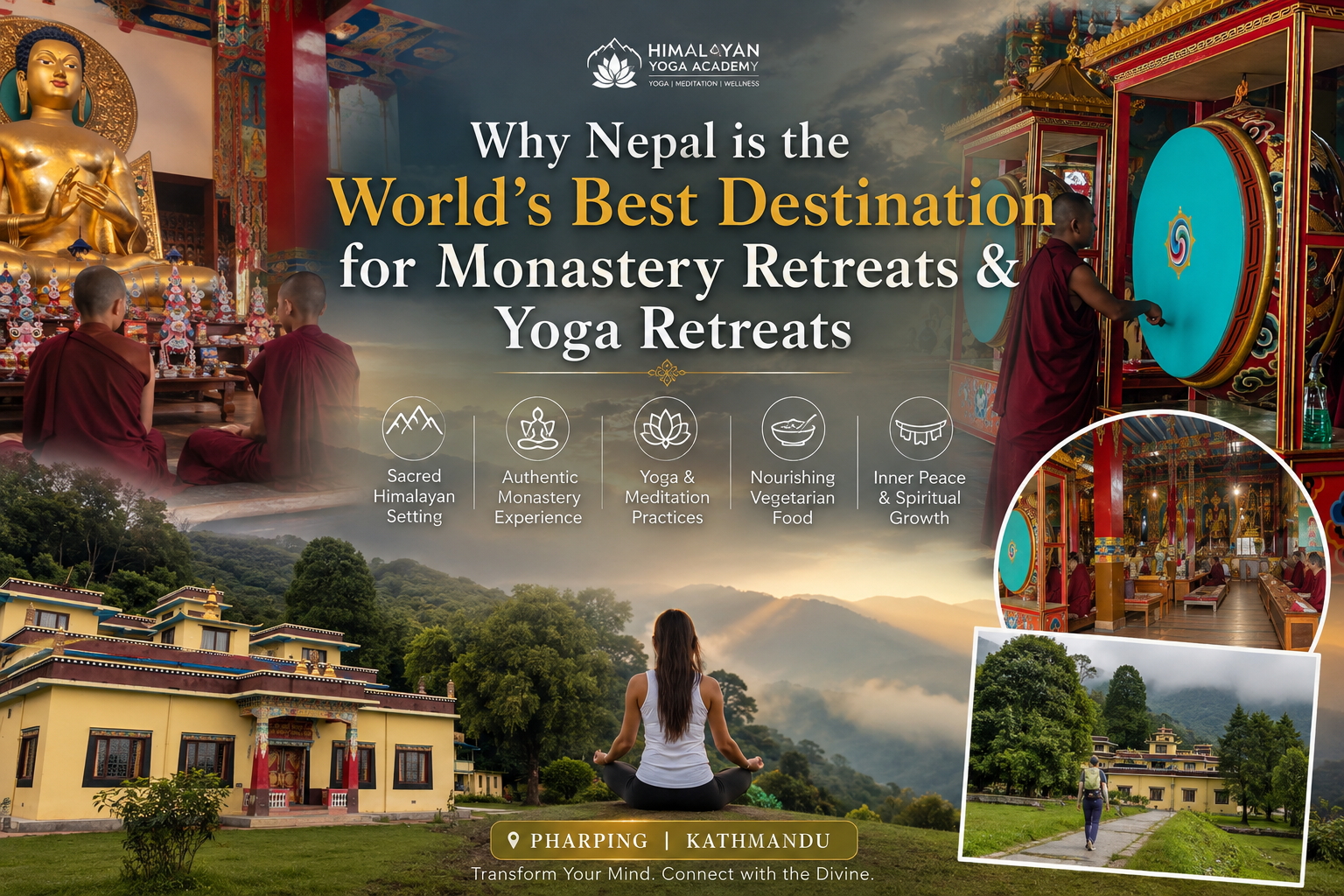
Why Nepal is the World’s Best Destination for Monastery Retreats & Yoga Retreats
Introduction : Destination for Monastery Retreats and Yoga Retreats
Nepal attracts travelers who want more than a holiday. They are looking for a change of rhythm: quieter mornings, purposeful movement, fewer distractions, and a closer relationship with Nepal’s landscape and living spiritual traditions.
For those seeking genuine spiritual renewal rather than a mere vacation, Nepal is the world’s best destination for monastery retreats and yoga retreats. The country offers something that few other destinations can match: a living spiritual tradition that has flourished for centuries, set against one of the most dramatic landscapes on Earth.
Why Nepal Makes This Experience Different
What sets Nepal apart is not a single brand of yoga or a handful of well-marketed retreat centers. Nepal’s strength as a wellness destination comes from the coexistence of Himalayan pilgrimage, household devotion, monastic learning, Ayurveda, meditation, music, craft, and outdoor life.
In Nepal, landscape and practice reinforce each other. Forested ridges, mountain horizons, monasteries, temples and family-run retreat settings make mindfulness tangible. The destination does not perform the inner work for you, but it creates fewer barriers to doing that work consistently.
As one international publication noted, monastery retreats, Buddhist meditation, yoga workshops, sacred rituals and guided reflection make Nepal one of the world’s most spiritually healing wellness destinations.
What the Experience Feels Like
A monastery yoga retreat in Nepal is fundamentally different from a standard wellness holiday. This is an immersive spiritual getaway held within the sacred walls of an active Buddhist monastery.
Monastic environments favor modest movement, seated practice, chanting, silence, and observation. Yoga should support the setting rather than turn a monastery into a studio backdrop. A good program feels personal without becoming intrusive. Teachers offer structure, hosts answer practical questions, and participants still have room to observe their own pace.
The Shift: From “Monkey Mind” to “Monk Mind”
The term “monkey mind” describes the restless, chaotic, and constantly chattering state of our ordinary consciousness—a mind that jumps from thought to thought like a monkey swinging from branch to branch. The antidote, the “monk mind,” is not about becoming a monk but about cultivating the same focused, disciplined, and serene quality of awareness that dedicated practitioners embody.
At Himalayan Yoga Academy, the Monastery Retreats is specifically designed to facilitate this shift through a combination of daily yoga, deep meditation practices, and the unique environmental influence of the monastery’s atmosphere.
“A monastery is not just a building. It is a field of energy, charged with centuries of devotion and spiritual practice. When you step inside, that vibration begins to cleanse your mind, almost effortlessly.”
— Yogacharya Rajkumar Karki, Himalayan Yoga Academy
Sacred Locations: Where the Monastery Retreats Happen
Pharping – A Sacred Yoga & Meditation Destination
Pharping, also known as Yanglesho, is one of Nepal’s most spiritually charged places. Nestled just 23 km from Kathmandu, it is believed to be the site where Guru Padmasambhava (Guru Rinpoche) attained enlightenment.
Just 45 minutes from the capital, Pharping offers the perfect balance of natural beauty, spiritual depth, and peaceful seclusion—making it an ideal destination for a monastery yoga retreat in Nepal. Monasteries, caves, and prayer flags adorn the hills, creating an atmosphere of devotion and serenity. Pilgrims from across the world come here to meditate, study, and absorb the powerful vibrations of the land.
Pharping’s sacred sites, including the Asura Cave, Yanglesho Cave, and Tibetan monasteries, provide a rare opportunity to meditate in the footsteps of enlightened masters.
Kathmandu Valley
The Kathmandu Valley itself offers numerous monastery retreat options. Himalayan Yoga Academy is located on the lap of Nagarjun Jungle, very close to town in Kathmandu, registered with Yoga Alliance US. The academy has been established for the promotion of spiritual and yoga tourism in Nepal since 2007, run by qualified yoga masters and experienced registered yoga teachers.
Neydo Monastery and Nagi Gompa
Retreats often take place at authentic monasteries like Neydo Monastery and Nagi Gompa. One guest who spent six days at Nagi Gompa described it as “a very special place to be, quiet as I wanted, in the middle of a national park, surrounded by jungle.” The experience included yoga classes, meditation, hiking, a full silence day, and the opportunity to join puja ceremonies.
Connecting the Topic with Himalayan Yoga Academy
Himalayan Yoga Academy currently offers a short 3-day monastery immersion and an 8-day spiritual yoga and meditation monastery retreat, along with residential meditation teacher training in Kathmandu.
The academy describes itself as a residential yoga center established in 2007 near the Nagarjun forest area of Raniban, Kathmandu, and registered with Yoga Alliance since 2015.
Available programs include:
- 3-Day Insight to Buddhism & Monastery Yoga Retreat – A brief but potent escape in the sacred hills of Pharping
- 8-Day Spiritual Yoga & Meditation Monastery Retreat – A transformative journey combining yoga, meditation, and monastery experience
- Residential Meditation Training – Longer programs for deeper practice
The academy collaborates with multiple monasteries to offer authentic, enriching retreats that blend traditional yoga practices with Buddhist philosophy.
What Guests Are Saying
Reviews consistently highlight the transformative nature of these retreats. One guest who chose the 8-day 7-night Monastery Yoga Retreat program described it as “absolutely the right decision,” noting the perfectly curated program covering airport transfers, Kathmandu sightseeing, daily yoga and meditation sessions, hiking, sound healing, tree planting, and three vegetarian meals a day.
Another guest shared: “I spent 8 nights, 7 days in Kathmandu in HYA & Neydo Monastery retreat to learn how to implement yoga practices and meditation in my life. People working there, yogis and all staff were really friendly, nice caring.”
The food receives consistent praise—”delicious and homemade”—and the atmosphere is described as “nice and light.” One guest noted: “My stay at the Himalayan Yoga Academy was just perfect, starting from the amenities to the yoga teaching course.”
Travelers from around the world—Switzerland, Taiwan, Singapore, Australia, Colombia, and France—have found connection and community at these retreats.
How to Prepare and Plan Well
What to Bring
- Modest, quiet clothing (cover shoulders and knees in monastery grounds)
- Easy slip-on footwear
- A notebook for reflection
- A refillable water bottle
- Basic toiletries and any required medication
- Layers—mornings can be cool, afternoons warm
Questions to Ask Before Booking
Ask about silence rules, phone use, meal times, bedding, heating, shared bathrooms and whether donations or offerings are customary.
Best Time to Visit
The best seasons for a monastery yoga retreat in Nepal are spring (March to May) and autumn (September to November), when the weather is pleasant, offering optimal conditions for exploration and spiritual rejuvenation.
A Simple Way to Personalize the Experience
Before booking a monastery retreat or yoga retreat, write down three needs and three limits. Needs might include quiet, physical challenge, or cultural learning. Limits might include an injury, a fixed flight, or a need for private accommodation. Sharing these details helps the retreat organizer recommend a realistic program instead of the most expensive one.
A useful inquiry is specific: travel dates, number of guests, room preference, practice experience, injuries, dietary needs and whether the person wants quiet, training, sightseeing, or trekking.
Common Mistakes to Avoid
Common mistakes include expecting instant bliss, treating monks as performers, ignoring silence rules, bringing revealing practice clothes, and filling every free period with photography or messages.
For a monastery yoga retreat, a slower and more transparent plan is usually the stronger one.
Health, Safety and Ethical Boundaries
A retreat is not therapy or emergency mental-health care. Guests with active medical or psychological concerns should discuss suitability with a qualified professional and the organizer before booking.
Content should distinguish personal experience, traditional belief, and research-based guidance, especially when discussing health, trauma, stress, or altitude.
Choosing the Right Level of Structure
Some people need a firm timetable; others need space. Ask how much of the day is compulsory, whether classes are adapted and how private time is respected.
Himalayan Yoga Academy offers formats ranging from short visits to multi-week residential programs, so the duration should serve the goal rather than become a badge of seriousness.
Who This Experience May Not Suit
Not every traveler is a good match for a monastery yoga retreat at every moment. Someone with an untreated injury, acute illness, severe sleep difficulty, unstable mental health, unrealistic luxury expectations or a schedule with no travel buffer may need a different format or professional advice first.
Clear suitability guidance improves bookings because guests arrive knowing what the program can and cannot provide.
The Deeper Practice Behind the Itinerary
Spiritual travel is most useful when it makes a person more attentive, not more self-important. The most sustainable outcome is a simple personal routine that can continue without mountains, robes, special music or constant guidance.
Frequently Asked Questions
- Do I need to be Buddhist for a monastery yoga retreat?
Usually not. Respectful visitors from different backgrounds can join many programs, but each monastery sets its own rules and teaching eligibility. - Will I live exactly like an ordained monk?
No. Visitor retreats borrow elements of monastic rhythm but do not reproduce the vows, responsibilities or lifelong training of ordained community members. - Is yoga practiced inside every monastery?
No. Some programs combine yoga with monastery residence through an outside organizer; others focus only on Buddhist teachings and meditation. - Which Himalayan Yoga Academy option is most relevant?
The academy currently presents short and longer monastery formats plus meditation training. Ask which monastery, room type, practices and transfers apply to your chosen dates. - What is the dress code?
Dress respectfully. Both men and women should cover shoulders and knees within monastery grounds. Avoid bright colors and logos that would be conspicuous in a monastic setting. - Are solo travelers welcome?
Yes. Solo travelers are safe and welcome at these retreats, with many guests arriving independently.
Creating Your Own Retreat Experience
Whether you choose a 3-day immersion or an 8-day spiritual journey, the key is to match the experience to your personal goals rather than trying to fit a pre-set mold.
- For a shorter escape: The 3-day Pharping monastery retreat offers a gentle introduction to monastic life, combining yoga, meditation, and Buddhist wisdom.
- For deeper immersion: The 8-day program/monastery retreats provides more time to settle into the monastic rhythm, with daily yoga, meditation, and the unique experience of living alongside monks.
- For extended practice: Multi-week residential programs allow for profound transformation and the development of a sustainable personal practice.
Final Thoughts
Nepal is the world’s best destination for monastery retreats and yoga retreats because it offers something no other destination can replicate: a living spiritual tradition in one of the most awe-inspiring landscapes on Earth.
The retreats are not about escape—they are about return. Return to yourself, to a slower rhythm, to a deeper awareness. The mountains and monasteries don’t do the work for you, but they create the conditions in which that work becomes possible.
Are you ready to trade the monkey mind for the monk mind?
Detailed Report on the Major Flood Disaster in Rasuwa, Nepal (as of 29 August 2026)
Prepared by: Himalayan Yoga Academy, Kathmandu
1. Overview of the Disaster
On 26 August 2026, at approximately 9:00 AM local time, a catastrophic flash flood surged down the Bhote Koshi River from the Tibet Autonomous Region of China into Nepal, severely affecting Rasuwa, Nuwakot, Dhading, and Gorkha districts. The floodwaters continued along the Trishuli River corridor, impacting areas as far south as Chitwan.
Probable Cause: Preliminary investigations point to a Glacial Lake Outburst Flood (GLOF), possibly triggered by an earthquake recorded that morning. Satellite imagery also suggests an ice-rock avalanche about 20 km northeast of the border as a potential source.
Affected Areas in Rasuwa: Several settlements, including Timure, Syaphrubesi, Hakubesi, Mailung, and Shantibazar, were inundated or severely damaged. The Gyirong Port (Sino‑Nepal border) also sustained damage. Infrastructure losses are immense – 19 road bridges were destroyed, and 40 km of paved roads are impassable. Schools, markets, health posts, police stations, weather stations, and the Timure customs office were wrecked. The Nepali government has declared Rasuwa, Nuwakot, and Dhading as “disaster crisis zones”.
2. Latest Casualty and Missing Figures (as of 28 August 2026)
Confirmed Deaths: 539
Breakdown by district:
| District | Death Toll |
|---|---|
| Chitwan | 221 |
| Nuwakot | 161 |
| Nawalparasi East | 134 |
| Gorkha | 46 |
| Kavrepalanchok | 37 |
| Dhading | 34 |
| Tanahun | 28 |
| Nawalparasi West | 28 |
| Rasuwa | 13 |
Missing Persons: 977
Breakdown:
- Nepali security forces, customs & immigration personnel: 105 (Army 45, Police 28, Armed Police 13, Customs 15, Immigration 4)
- Reported via District Emergency Operation Centres: 228 (Rasuwa 161, Kavrepalanchok 66, Nuwakot 1)
- Foreign nationals or non‑resident Nepalis: 644 (517 foreign nationals, 127 Nepalis living abroad)
Injured: 73 (Rasuwa 43, Nuwakot 27, Dhading 3)
Note: These figures are based on preliminary government reports and are subject to change as search and verification continue.
3. Rescue and Relief Operations Update
The Government of Nepal has mobilised full national resources:
- Deployed personnel: 13,295 security forces (4,200 Army, 7,250 Police, 1,845 Armed Police)
- Helicopters deployed: 15 (6 Army, 9 private)
- Rescued persons: 3,742 evacuated
- Helicopter rescues: 1,976 persons airlifted
- Tunnel rescue: The Army rescued about 350 people from the Trishuli‑1 hydropower project tunnel; search continues for an estimated 100 still trapped inside.
International Aid: The government has stated that foreign search‑and‑rescue assistance is not currently required. Médecins Sans Frontières (MSF) arrived within 24 hours and is preparing emergency medical support. The government has released NPR 25 million in cash assistance (NPR 10 million each to Rasuwa and Nuwakot, NPR 5 million to Dhading).
4. Latest Risk Warnings
Secondary Dam/Breach Risk: A lake formed by a landslide at the source of the Bhote Koshi has begun overflowing, raising concerns of a possible rise in downstream water levels. Authorities report that water flow into Nepal has not yet significantly increased, but residents have been urged to remain vigilant. The Nepal Flood Forecasting Section has stated that there is no reliable information indicating an imminent second major flood in Rasuwa or Nuwakot.
5. Impact on Kathmandu and Our School
Kathmandu Valley Has Not Been Directly Affected
The disaster is geographically confined to the northern mountainous districts (Rasuwa, Nuwakot, Dhading, Gorkha) and the downstream Trishuli corridor. Kathmandu Valley is distinctly separated and has experienced no direct flooding or physical impact from the event.
Himalayan Yoga Academy – Operations Normal
Our school is located in Kathmandu, far from the affected zones. As of today:
- Our campus sustained no damage whatsoever.
- All academic and administrative activities continue as usual without interruption.
- All staff and students are safe.
We extend our deepest condolences to all those who have lost loved ones, homes, and livelihoods in this tragedy. Himalayan Yoga Academy will continue to monitor the situation closely and stands ready to support relief efforts in coordination with the government and humanitarian agencies if needed.
Date of Report: 29 August 2026
Sources: ReliefWeb, Nepal Disaster Risk Reduction and Management Authority (NDRRMA), Nepal Police, Nepal Army, and multiple news outlets.
Who Should Join a Yin Yoga Teacher Training in Nepal?
Discover who benefits most from a Yin Yoga teacher training in Nepal—from certified teachers and dedicated practitioners to wellness professionals seeking deeper study.
Yin Yoga teacher training isn’t only for people who already teach yoga. It serves certified teachers, committed practitioners, and wellness professionals who want to understand stillness, functional anatomy, and mindful movement more deeply. The important question isn’t whether you can perform impressive poses—it’s whether you’re ready to study your body patiently and respect the limits of your professional role.
Himalayan Yoga Academy’s 50-hour Yin Yoga Teacher Training in Nepal is a 7-day, 6-night immersion designed for yoga practitioners with a minimum of six months of experience in any yoga style, as well as certified teachers holding a 200-hour qualification or above. Recognized by Yoga Alliance, the program offers continuing education credits (YACEPs) and provides a comprehensive foundation in the philosophy, anatomy, and teaching methodology of Yin Yoga.
But is this training right for you? Let’s explore who should join—and who might benefit from waiting.
Certified Teachers Seeking a Complementary Skill
Teachers trained mainly in Hatha, Vinyasa, or Ashtanga often know how to create rhythm, strength, and heat. Yin adds a different teaching language: fewer poses, longer holds, quieter observation, and less emphasis on visual uniformity.
A specialist Yin course can help an active-style teacher:
- Offer balanced class schedules that include both dynamic and restorative elements
- Understand why a student may need support rather than intensity
- Improve cueing across all yoga styles through deeper awareness of anatomy and fascia
The program covers 30+ Yin asanas with modifications, counterposes, and hold times, alongside functional anatomy of fascia, ligaments, joints, and bone remodeling. This knowledge translates directly into more informed, safer teaching across any style.
For prospective students, the practical lesson is this: look beyond the name of a pose or certificate. Notice how the method is taught, whether questions are welcomed, and whether choices are explained. This develops discernment—the ability to adapt practice without losing its purpose. It’s one of the clearest differences between simply attending classes and learning to guide others responsibly.
Committed Practitioners Seeking Personal Depth
Some students join without an immediate plan to teach. They want to understand why a pose feels different from one side to the other, how props change load, or why stillness can reveal restlessness.
Himalayan Yoga Academy requires a minimum of six months of experience in any yoga style—which helps participants arrive with enough body awareness to engage meaningfully with the material. The immersion can become a bridge between casual practice and disciplined study.
What does this look like in practice?
- Comparing sensations across different poses
- Observing classmates with different body proportions
- Testing whether a prop changes the intended experience
Reflection after practice is equally important. Writing down what happened—rather than what was expected to happen—trains the honest observation that safe Yin teaching requires.
The training explores the three tattvas (principles) of Yin Yoga: come to your edge, resolve to be still, hold for time. These principles apply whether you’re teaching a class or simply deepening your own practice.
Meditation and Wellness Professionals
Meditation guides, massage practitioners, and other wellness professionals may value Yin because it creates a structured transition from movement to stillness.
Yet a Yin certificate doesn’t automatically expand a person’s legal or clinical scope. The ethical approach is to integrate only what one is trained to offer and to communicate credentials accurately. The course is education, not a licence to diagnose tissue, prescribe treatment, or claim psychological therapy.
Teachers also need language that leaves room for the student. Invitations such as “notice,” “consider,” and “you may choose” support agency when paired with clear safety guidance. This isn’t vague teaching—it’s precise communication that distinguishes an intention from a command and allows students to respond to present conditions.
Who May Need to Wait or Prepare First
Not everyone is ready for a Yin Yoga teacher training. Consider waiting if you are:
- Recovering from an acute injury—speak with an appropriate health professional before joining
- Facing an unstable medical condition—consult your doctor first
- Seeking treatment rather than education—this is a training, not therapy
- Expecting a fitness boot camp—Yin can be physically meaningful, but its challenge is often attention rather than performance
Students should be comfortable with quiet periods, reflective learning, and respectful residential routines.
The wider principle is sustainability. A valuable practice should be repeatable without demanding that students ignore pain, compete for depth, or depend permanently on the teacher. Good training measures progress through awareness, appropriate choice, and consistency. Physical range may change, but it isn’t the only outcome—and should never become a promise.
Why Nepal Suits This Kind of Student
Nepal gives the training a context that’s difficult to reproduce in a weekend studio course. At the academy’s Kathmandu setting near the Nagarjun forest, practice sits alongside meditation, yogic living, vegetarian food, and community.
The Himalayas shouldn’t be used as marketing decoration—their real value is the invitation to slow down, simplify, and examine how practice relates to daily life.
In a residential course, these ideas continue beyond formal class. Rest, meals, conversation, and quiet time reveal whether a student can balance discipline with self-care. The program includes 6 nights of accommodation and three daily vegetarian meals, creating an environment where participants can fully immerse themselves without external distractions.
One past participant described the experience as “a spiritual healing retreat indeed,” noting that the location is calm “considering the chaotic environment of Kathmandu” and that the atmosphere at the academy is “nice and light”.
How Himalayan Yoga Academy Approaches the Training
Himalayan Yoga Academy presents yoga as a lived, holistic discipline rather than an isolated exercise class. Its Yin immersion connects to a broader residential culture that includes meditation, traditional yoga, conscious daily routine, and community.
The program covers:
- Philosophy and history of Yin Yoga (Paulie Zink, Paul Grilley, Sarah Powers)
- The three tattvas (principles) of Yin Yoga
- Functional anatomy—fascia, ligaments, joints, and bone remodeling
- Meridians (Qi pathways) and how Yin poses stimulate organ health
- 30+ Yin asanas with modifications, counterposes, and hold times
- Sequencing skills for balanced Yin classes
- Teaching with thematic language, stillness cues, and trauma-informed adjustments
Students receive a Yin Yoga training manual, props for practice, and access to the academy’s yoga library. The training concludes with a practical teaching assessment (1-hour class).
A Responsible Understanding of Yin Yoga
Yin Yoga generally uses relatively passive, floor-based shapes held for time—but “passive” doesn’t mean careless. The practitioner finds an appropriate edge, becomes reasonably still, and remains attentive.
Teachers should:
- Avoid treating pain as progress
- Recognise that bones, proportions, injury history, and nervous-system state differ
- Understand that the same intention may require different shapes across different bodies
- Never promote Yin Yoga with guaranteed health outcomes
Yin Yoga is not a medical treatment. It can support reflection and complement active movement, but it should be taught and practiced with appropriate boundaries.
Final Perspective
The best training decision is the one that supports long-term practice and honest teaching. A Himalayan setting can inspire transformation, but integration happens through repeated choices after the course:
- Practising consistently
- Studying anatomy
- Asking for feedback
- Respecting scope
- Teaching students rather than performing expertise
Himalayan Yoga Academy can provide a focused environment and an educational pathway. The graduate’s responsibility is to carry that learning forward with patience.
“Our 200H training was amazing, the academy already feels like a second home… we had teachers that really cared about us and our progress and it was more than exercise, it was the authentic yoga!”
Frequently Asked Questions
- Can beginners join?
The published program asks for at least six months of practice in any yoga style. Beginners should contact the academy to discuss readiness honestly. - Must I already be a 200-hour teacher?
No, for personal immersion, although an existing foundational qualification gives a clearer professional base for teaching afterward. - Is Yin only suitable for flexible people?
No. Functional Yin education explicitly recognises skeletal variation and uses props and alternatives to support different bodies
The Power of Sound Healing: How Singing Bowl Therapy Reduces Stress
Introduction: Beyond the Picture
When most people begin searching for sound healing, they start with an image. Prayer flags dancing in the Himalayan breeze. A golden sunrise spilling over ancient peaks. A silent meditation hall waiting for footsteps. A trail disappearing above the clouds.
These images are beautiful, and they matter. But the real experience of sound healing is built on something far more substantial than a photograph. It is built on preparation. On respectful participation. On a schedule that allows your nervous system to finally, truly slow down.
The power of sound healing does not lie in magical promises or instant transformations. It lies in realistic possibilities. This article explores what those possibilities actually look like, how they unfold in Nepal, and what you need to know before you book your first session or training.
What Sound Healing Really Offers
Let us be honest about what sound healing can and cannot do.
The most realistic benefits of sound healing are grounded in everyday wellness:
Improved self-awareness. You begin to notice your body’s responses more clearly. Tension that you carried unconsciously starts to reveal itself. Patterns of thought and reaction become visible.
A calmer daily rhythm. The practices you learn are not meant to stay on the meditation cushion. They are meant to accompany you into ordinary life, creating sustainable patterns of rest and activity.
Time away from habitual stressors. In a world of constant notifications, deadlines, and demands, sound healing offers a genuine pause. It is not avoidance. It is restoration.
Better movement habits. As you become more aware of physical tension, you naturally begin to move differently. Breath deepens. Shoulders drop. The body remembers how to soften.
Renewed motivation. When the nervous system calms, energy returns. Not frantic energy, but the kind that allows you to pursue what matters with clarity and purpose.
These gains emerge from the whole environment—sleep quality, daily practice, nutritional choices, time in nature, guidance from experienced teachers, and reduced digital stimulation. They do not come from any single technique alone.
Sound healing works best as part of an integrated approach to wellbeing. This is why choosing the right setting matters so much.
Why Nepal Makes This Experience Unique
Nepal’s strength as a wellness destination is not based on a single brand of yoga or therapy. It comes from something more profound. Here, multiple traditions coexist naturally:
- Himalayan pilgrimage routes that have drawn seekers for centuries
- Household devotion practiced in daily life, not just in temples
- Monastic learning preserved in ancient monasteries
- Ayurveda’s comprehensive approach to health
- Meditation techniques refined over millennia
- Musical and craft traditions that produce authentic instruments
- An outdoor lifestyle that keeps people connected to nature
The topic of sound healing works best when practical planning, cultural context, and the felt experience of practice are treated as one connected journey. At Himalayan Yoga Academy, this integrated approach is central to every program.
The singing bowl itself carries this integration. Its history is woven into the fabric of Nepal—from the Newari communities who used the bata as a simple rice bowl, to the cultural exchanges that transformed it into a spiritual instrument, to the name “singing bowl” itself, coined by a Nepali trader in the 1960s.
When you practice sound healing in Nepal, you are not just participating in a wellness trend. You are connecting with something that has been evolving here for generations.
What to Expect in a Sound Healing Session
A proper sound healing session includes several essential elements:
- Explanation. You understand what will happen and why. There are no surprises, no hidden agendas, no vague promises.
- Demonstration. You see techniques before experiencing them. This builds trust and prepares your mind for what is coming.
- Direct experience. You practice. You feel. You listen. The singing bowls produce tones that are not just heard but felt in the body. Vibrations travel through the floor, through the cushion, through bone and tissue.
- Integration time. Space to absorb and reflect. This is where the real processing happens. Without integration, the experience remains surface-level. With it, the experience settles into something lasting.
A powerful sound bath or treatment becomes more useful when participants understand its limits and appropriate aftercare. A good program feels personal without becoming intrusive. Teachers offer structure. Hosts answer practical questions. Participants maintain room to observe their own pace.
The power of sound healing is most accessible when sessions are conducted in an environment that supports relaxation. At the Raniban setting where Himalayan Yoga Academy offers its programs, the environment is naturally present, surrounded by nature and peace.
How to Prepare for Your Sound Healing Journey
Preparation transforms a simple visit into a meaningful experience. Consider these steps:
Before Arrival:
- Share your experience level, injuries, dietary needs, and travel constraints
- Research the program structure to ensure it matches your expectations
- Arrange travel with appropriate buffer time
What to Bring:
- Comfortable clothing suitable for meditation and relaxation
- Any personal items that support your practice
- An open mind without rigid expectations
Himalayan Yoga Academy offers sound healing pathways ranging from short introductory programs to comprehensive professional training. Exact dates, prices, room categories, and inclusions should be confirmed in writing before booking.
The Deeper Practice Behind the Experience
The deeper purpose of sound healing is not escape. It is clearer participation in ordinary life.
With sound healing, the most sustainable outcome is a simple personal routine that can continue without mountains, robes, special music, or constant guidance. The singing bowl becomes a tool. A beautiful and effective one. But the real work happens in the spaces between sounds. In the breath. In the awareness that gradually develops.
This is why the power of sound healing extends far beyond the session itself. It offers skills that can be integrated into daily life, providing a reference point for calm that remains accessible even when challenges arise.
A student once told me that the most valuable thing she learned was not how to play the bowl, but how to listen. How to hear the fading resonance and let it teach her something about her own tendency to grasp and hold. The bowl sounded, and then it was silent. The silence was where she found herself.
That is the deeper practice.
Stress Relief Without Exaggerated Promises
Retreat conditions can reduce common stressors by:
- Simplifying daily decisions
- Limiting notifications and digital distractions
- Increasing natural movement
- Creating regular sleep and meal times
Meditation and sound may feel deeply calming, yet results differ. Some people experience profound shifts. Others feel subtle changes that build over time. Both are valid.
Ethical content avoids promising a cure for anxiety, trauma, insomnia, or depression. Instead, it explains when professional medical or psychological support may be necessary, alongside complementary practices such as sound healing.
Himalayan Yoga Academy follows this ethical approach, presenting sound healing as a supportive practice rather than a medical treatment. This transparency builds trust and ensures participants have realistic expectations.
From Relaxation Session to Professional Study
A casual sound session and a professional training have different goals. Understanding this distinction helps in choosing the right path:
| Program Level | Duration | Best For |
|---|---|---|
| Introduction Course | 8 hours | Personal experience and basic understanding |
| Professional Training | 20 hours | Structured techniques and intermediate practice |
| Advanced Course | 40 hours | Deep practice and teaching preparation |
| Gong Training | Specialized | Specific instrument mastery |
Himalayan Yoga Academy’s published pathway ranges from introduction to advanced levels, plus gong training. Choose based on whether you want:
- Personal experience – For self-care and stress reduction
- Structured techniques – For deeper practice and skill development
- Future practitioner role – For those considering teaching sound healing
Common Mistakes to Avoid
For Participants:
- Believing one session will cure a long-standing condition
- Buying instruments before learning how to use them properly
- Copying rituals without understanding their cultural context
- Ignoring personal limitations and pushing too hard
For Future Practitioners:
- Making medical promises to future clients
- Representing sound healing as a substitute for licensed treatment
- Using instruments without adequate training
- Failing to maintain professional boundaries
For sound healing, a slower and more transparent plan is usually the stronger one. The power of sound healing is best accessed through patience and consistent practice rather than through intensity alone.
Health, Safety and Ethical Boundaries
Healing arts can support relaxation and self-care, but they should not be marketed as guaranteed cures or substitutes for licensed medical treatment. Content should distinguish between:
- Personal experience – Individual accounts of wellbeing
- Traditional belief – Cultural and spiritual frameworks
- Research-based guidance – Evidence-informed recommendations
This distinction is especially important when discussing health, trauma, stress, or altitude. Sound healing complements—but does not replace—professional medical care.
Himalayan Yoga Academy maintains these ethical boundaries across all its programs, including sound healing, Ayurveda retreats, and yoga training.
Choosing the Right Level of Structure
Some people need a firm timetable. Others need space. When considering a sound healing program, ask:
- How much of the day is compulsory?
- Are classes adapted for different levels?
- How is private time respected?
Himalayan Yoga Academy offers formats ranging from short visits to multi-week residential programs. The duration should serve the goal rather than become a badge of seriousness. What matters is finding the structure that supports genuine experience.
Who This Experience May Not Suit
Not every reader is a good match for sound healing at every moment. Consider these factors:
A Program May Not Be Suitable For:
- Someone with an untreated injury or acute illness
- Those experiencing severe sleep difficulties
- Individuals with unstable mental health conditions
- People with unrealistic luxury expectations
- Travelers with schedules that include no buffer time
Clear suitability guidance improves bookings because guests arrive knowing what the program can and cannot provide. Honest communication builds trust.
Frequently Asked Questions
Is sound healing beginner-friendly?
It can be when the schedule, instruction, and physical demands are clearly explained and adapted. Beginners should disclose limitations and avoid programs that equate intensity with authenticity. Himalayan Yoga Academy welcomes beginners across all its sound healing pathways.
How many days should I allow?
A short format introduces the rhythm. A week or longer allows habits and relationships to settle. Add travel buffer days around flights, road journeys, and treks.
What is normally included?
Common elements are accommodation, vegetarian meals, and guided sessions. Transfers, treatments, sightseeing, and trek services may be separate.
Can sound healing help with specific conditions?
It can support stress reduction and relaxation, but it is not a cure for medical conditions. It works best alongside professional healthcare when needed.
Final Thoughts
Approach sound healing with curiosity rather than fantasy. Ask practical questions. Respect local culture. Choose a pace that allows the experience to be felt rather than merely completed.
The power of sound healing is real, but it reveals itself gradually. It speaks through the resonant tones of singing bowls, through the silence between sounds, and through the awareness that grows with consistent practice. In Nepal, surrounded by the Himalayas and supported by authentic traditions, this power becomes especially accessible.
Himalayan Yoga Academy serves as a practical base for retreats, trainings, monastery experiences, and yoga treks. Current details—including dates, prices, and program availability—should be confirmed through its official website.
For those ready to experience the power of sound healing in its authentic setting, Nepal offers something that cannot be replicated elsewhere. The mountains, the traditions, the instruments, and the teachers come together in a way that supports genuine transformation.
Ready to explore sound healing in Nepal? Visit Himalayan Yoga Academy to compare retreat durations, inquire about customized programs, or begin your journey toward professional training in this ancient healing art.
Best Meditation Teacher Training in Nepal: How to Choose the Right School
Nepal is one of the most profound places in the world to study meditation. As the birthplace of Lord Buddha and a land steeped in Hindu, Buddhist, and Himalayan contemplative traditions, spirituality isn’t just a tourist attraction here—it is a way of life. Finding the best meditation teacher training in Nepal means looking for a school that offers more than just relaxation techniques; it requires a school that offers a transformative, living educational journey.
Himalayan Yoga Academy (HYA) in Kathmandu embodies this philosophy. At HYA, meditation is presented as a lived discipline rather than a collection of stress-management tricks. Students engage in a residential rhythm that blends meditation, yoga, pranayama, philosophy, and community living. HYA also offers complementary courses in Yoga Teacher Training, Pranayama, Sound Healing, and Ayurveda, allowing students to build a holistic career path.
What to Look for in a Meditation Teacher Training
Before diving into specific courses, it is crucial to understand what separates a genuine training from a superficial one. You are not just learning to sit in silence; you are learning to guide others. The best programs combine personal practice with teaching competence.
A high-quality curriculum should cover:
- Methodology: Practical steps and how to adapt the practice for different participants.
- Philosophy: The historical and spiritual background of the practices.
- Difficulties: How to handle distractions, discomfort, and emotional releases.
- Ethics: Boundaries, consent, and scope of practice.
Meditation as a Training of the Mind
At the heart of authentic training is the understanding of the nature of the mind. The HYA curriculum begins with the study of Chitta (the mind-field) and the Vrittis (changing patterns of thought).
Meditation is not the violent suppression of thought. It is the cultivation of awareness and a steady, wise relationship with mental movement. Students learn to observe the body, breath, sensations, and emotions while reducing automatic reactions. This foundational knowledge is what separates a meditation technician from a meditation teacher.
The 40-Hour Foundation Course
The 40-hour pathway is the ideal starting point. It introduces the essential building blocks of meditation. This course is perfect for yoga teachers who want to integrate basic meditation into their classes or individuals seeking a structured introduction to practice.
The curriculum includes:
- Breath awareness (Anapana Sati)
- Witness consciousness and gratitude
- Mantra and Nada (sound) listening
- Tratak (concentrated gazing)
- Chakra and Kundalini-related practices
- Yoga Nidra (psychic sleep)
- Phased practice-teaching methods
The emphasis in this course is on foundations, direct practice, and clear instruction.
The 100-Hour Advanced Pathway
For those looking for depth and mastery, the 100-hour advanced pathway is the gold standard. This program deepens the fundamentals through extended personal practice, advanced teaching methodology, and the study of the Noble Eightfold Path and Buddhist ethics.
What the advanced course offers:
- Vipassana and Samatha (Insight and Calm-Abiding)
- The Four Brahma Viharas (Divine Abodes: Loving-kindness, Compassion, etc.)
- Tibetan Buddhist perspectives
- Dharana-Dhyana-Samadhi (Concentration, Meditation, Absorption)
- Professional responsibility and supervised teaching
- Ethical application of philosophy in daily life
Even when the focus is on one technique, the advanced course places it within a larger ethical and philosophical framework, ensuring you don’t teach meditation as a “performance” technique.
The HYA Approach: Practice, Philosophy, and Daily Life
At Himalayan Yoga Academy, meditation is not separated from how a person lives. The school integrates Yogic teachings (witness consciousness, non-attachment) alongside Buddhist teachings (compassion, impermanence).
This integrated approach helps future teachers avoid presenting meditation as a technique disconnected from real life. You learn that the way you speak, eat, rest, and relate to others is just as important as the time spent on the cushion.
Learning to Teach, Not Only to Practice
A personal meditation experience does not automatically create teaching competence. This is a vital distinction. At HYA, students learn practical facilitation skills, including:
- How to introduce a posture.
- Using accessible language.
- Timing periods of silence.
- Observing the group’s energy.
- Closing a session effectively.
Practice teaching, constructive feedback, and reflective study are core components of the program, ensuring you leave ready to facilitate with confidence.
Safety and Professional Responsibility
A responsible meditation teacher works within a clear scope of practice. You are not a therapist or a doctor. The best training teaches you to:
- Avoid diagnosing participants.
- Offer choices and respect consent.
- Know when to pause a practice or recommend professional support.
Strong breath retention, prolonged sensory deprivation, and intense Kundalini methods require additional care. Safety is paramount, and a good school will never encourage you to push students beyond their limits.
Why Choose Himalayan Yoga Academy?
Himalayan Yoga Academy isn’t just a training center; it is a holistic hub. By studying here, you gain access to an integrated ecosystem of wellness education:
- Meditation Teacher Training (40 & 100-hour)
- 200-hour and Advanced Yoga Teacher Training
- Pranayama Teacher Training
- Sound Healing programs
- Ayurveda Courses
- Yoga Retreats in Nepal
This integrated environment is particularly useful for teachers who want to understand how different practices support one another without mixing them carelessly.
Connecting Your Training with Yoga Retreats in Nepal
Perhaps you aren’t ready for certification yet. HYA also runs yoga and meditation retreats for personal renewal. Retreat life offers daily yoga, meditation, healthy meals, and cultural immersion.
A retreat can:
- Prepare a beginner for teacher training.
- Help a graduate integrate intensive study.
- Provide a gentle way for friends or family to experience the academy.
Measuring Progress: A Grounded Understanding
One of the most important lessons in teacher training is understanding what true progress looks like. In the modern world, we are used to measurable results. However, progress in meditation is not measured by visions, long periods of stillness, or impressive spiritual language.
Reliable signs of progress include:
- Less reactivity and greater patience.
- Emotional honesty.
- Clearer ethical choices.
- Steadier attention.
- Greater compassion for others.
Teachers are trained to encourage consistency rather than dramatic striving and to protect students from the trap of comparison.
The Role of Community in Residential Learning
Residential learning creates a temporary community where students share practice, meals, questions, and silence. This community reveals habits that private practice can hide: impatience, withdrawal, and the need to be recognized.
These experiences become part of the ethical education when handled with maturity. It is here that the theoretical teachings of compassion become a living reality.
Life After Teacher Training
What happens after you graduate? The best training prepares you for the transition.
- Start with short beginner sessions.
- Integrate meditation into existing yoga classes.
- Continue supervised practice before offering longer workshops.
A new teacher should always keep studying and maintain personal practice. Continuing education in pranayama, yoga philosophy, or trauma awareness can deepen professional maturity.
Adapting the Practice for All Students
A skilled teacher knows how to adapt. Meditation is not a “one size fits all” practice.
- Posture: Seated on the floor, on a chair, standing, walking, or lying down.
- Eyes: Closed, half-open, or open.
- Alternatives: For pain, pregnancy, fatigue, or trauma sensitivity.
Adaptation protects the purpose of the practice rather than weakening it. An inclusive teacher respects cultural comfort and physical limitations.\
Conclusion: Your Path to Authentic Teaching
Choosing the best meditation teacher training in Nepal is about finding a school that aligns with your values and prepares you for the responsibility of guiding others.
At Himalayan Yoga Academy, the 40-hour course establishes a strong foundation, while the 100-hour pathway expands into advanced practice, Tibetan Buddhist philosophy, and supervised teaching.
Graduates leave not with a promise of instant enlightenment, but with a clearer practice, a responsible teaching framework, and a deeper relationship with the contemplative traditions of Nepal. Whether you are starting your journey or deepening your career, HYA provides the depth, authenticity, and support you need.
Frequently Asked Questions (FAQ)
1. Do I need a yoga background to join the 40-hour meditation training?
No. While it helps, the 40-hour foundation course is designed for beginners and those seeking a structured introduction to meditation.
2. Is the 100-hour training suitable for teaching immediately?
Yes. The 100-hour course includes extensive teaching methodology and supervised practice to prepare you for professional facilitation.
3. Does HYA provide accommodation?
Yes. Himalayan Yoga Academy offers residential hospitality as part of the training experience, including healthy meals and comfortable accommodation.
4. How is HYA different from other schools in Nepal?
HYA combines multiple disciplines (Yoga, Pranayama, Ayurveda, Sound, and Meditation) into one holistic environment, ensuring you understand how these practices interconnect.