
16 Aug 2026 HYN Himalayan Yoga Academy
Discover who benefits most from a Yin Yoga teacher training in Nepal—from certified teachers and dedicated practitioners to wellness professionals seeking deeper study.
Yin Yoga teacher training isn’t only for people who already teach yoga. It serves certified teachers, committed practitioners, and wellness professionals who want to understand stillness, functional anatomy, and mindful movement more deeply. The important question isn’t whether you can perform impressive poses—it’s whether you’re ready to study your body patiently and respect the limits of your professional role.
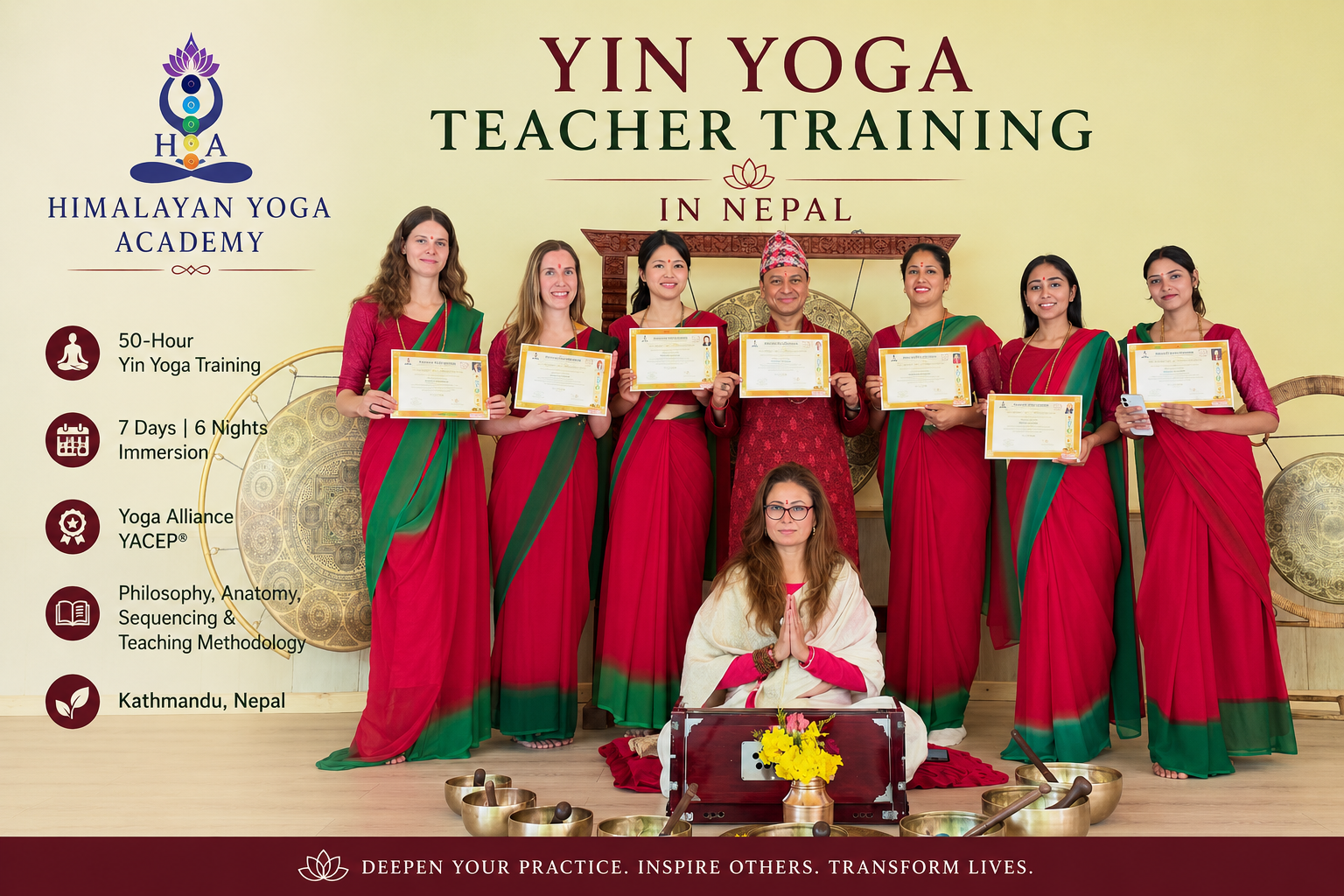
Himalayan Yoga Academy’s 50-hour Yin Yoga Teacher Training in Nepal is a 7-day, 6-night immersion designed for yoga practitioners with a minimum of six months of experience in any yoga style, as well as certified teachers holding a 200-hour qualification or above. Recognized by Yoga Alliance, the program offers continuing education credits (YACEPs) and provides a comprehensive foundation in the philosophy, anatomy, and teaching methodology of Yin Yoga.
But is this training right for you? Let’s explore who should join—and who might benefit from waiting.
Certified Teachers Seeking a Complementary Skill
Teachers trained mainly in Hatha, Vinyasa, or Ashtanga often know how to create rhythm, strength, and heat. Yin adds a different teaching language: fewer poses, longer holds, quieter observation, and less emphasis on visual uniformity.
A specialist Yin course can help an active-style teacher:
- Offer balanced class schedules that include both dynamic and restorative elements
- Understand why a student may need support rather than intensity
- Improve cueing across all yoga styles through deeper awareness of anatomy and fascia
The program covers 30+ Yin asanas with modifications, counterposes, and hold times, alongside functional anatomy of fascia, ligaments, joints, and bone remodeling. This knowledge translates directly into more informed, safer teaching across any style.
For prospective students, the practical lesson is this: look beyond the name of a pose or certificate. Notice how the method is taught, whether questions are welcomed, and whether choices are explained. This develops discernment—the ability to adapt practice without losing its purpose. It’s one of the clearest differences between simply attending classes and learning to guide others responsibly.
Committed Practitioners Seeking Personal Depth
Some students join without an immediate plan to teach. They want to understand why a pose feels different from one side to the other, how props change load, or why stillness can reveal restlessness.
Himalayan Yoga Academy requires a minimum of six months of experience in any yoga style—which helps participants arrive with enough body awareness to engage meaningfully with the material. The immersion can become a bridge between casual practice and disciplined study.
What does this look like in practice?
- Comparing sensations across different poses
- Observing classmates with different body proportions
- Testing whether a prop changes the intended experience
Reflection after practice is equally important. Writing down what happened—rather than what was expected to happen—trains the honest observation that safe Yin teaching requires.
The training explores the three tattvas (principles) of Yin Yoga: come to your edge, resolve to be still, hold for time. These principles apply whether you’re teaching a class or simply deepening your own practice.
Meditation and Wellness Professionals
Meditation guides, massage practitioners, and other wellness professionals may value Yin because it creates a structured transition from movement to stillness.
Yet a Yin certificate doesn’t automatically expand a person’s legal or clinical scope. The ethical approach is to integrate only what one is trained to offer and to communicate credentials accurately. The course is education, not a licence to diagnose tissue, prescribe treatment, or claim psychological therapy.
Teachers also need language that leaves room for the student. Invitations such as “notice,” “consider,” and “you may choose” support agency when paired with clear safety guidance. This isn’t vague teaching—it’s precise communication that distinguishes an intention from a command and allows students to respond to present conditions.
Who May Need to Wait or Prepare First
Not everyone is ready for a Yin Yoga teacher training. Consider waiting if you are:
- Recovering from an acute injury—speak with an appropriate health professional before joining
- Facing an unstable medical condition—consult your doctor first
- Seeking treatment rather than education—this is a training, not therapy
- Expecting a fitness boot camp—Yin can be physically meaningful, but its challenge is often attention rather than performance
Students should be comfortable with quiet periods, reflective learning, and respectful residential routines.
The wider principle is sustainability. A valuable practice should be repeatable without demanding that students ignore pain, compete for depth, or depend permanently on the teacher. Good training measures progress through awareness, appropriate choice, and consistency. Physical range may change, but it isn’t the only outcome—and should never become a promise.
Why Nepal Suits This Kind of Student
Nepal gives the training a context that’s difficult to reproduce in a weekend studio course. At the academy’s Kathmandu setting near the Nagarjun forest, practice sits alongside meditation, yogic living, vegetarian food, and community.
The Himalayas shouldn’t be used as marketing decoration—their real value is the invitation to slow down, simplify, and examine how practice relates to daily life.
In a residential course, these ideas continue beyond formal class. Rest, meals, conversation, and quiet time reveal whether a student can balance discipline with self-care. The program includes 6 nights of accommodation and three daily vegetarian meals, creating an environment where participants can fully immerse themselves without external distractions.
One past participant described the experience as “a spiritual healing retreat indeed,” noting that the location is calm “considering the chaotic environment of Kathmandu” and that the atmosphere at the academy is “nice and light”.
How Himalayan Yoga Academy Approaches the Training
Himalayan Yoga Academy presents yoga as a lived, holistic discipline rather than an isolated exercise class. Its Yin immersion connects to a broader residential culture that includes meditation, traditional yoga, conscious daily routine, and community.
The program covers:
- Philosophy and history of Yin Yoga (Paulie Zink, Paul Grilley, Sarah Powers)
- The three tattvas (principles) of Yin Yoga
- Functional anatomy—fascia, ligaments, joints, and bone remodeling
- Meridians (Qi pathways) and how Yin poses stimulate organ health
- 30+ Yin asanas with modifications, counterposes, and hold times
- Sequencing skills for balanced Yin classes
- Teaching with thematic language, stillness cues, and trauma-informed adjustments
Students receive a Yin Yoga training manual, props for practice, and access to the academy’s yoga library. The training concludes with a practical teaching assessment (1-hour class).
A Responsible Understanding of Yin Yoga
Yin Yoga generally uses relatively passive, floor-based shapes held for time—but “passive” doesn’t mean careless. The practitioner finds an appropriate edge, becomes reasonably still, and remains attentive.
Teachers should:
- Avoid treating pain as progress
- Recognise that bones, proportions, injury history, and nervous-system state differ
- Understand that the same intention may require different shapes across different bodies
- Never promote Yin Yoga with guaranteed health outcomes
Yin Yoga is not a medical treatment. It can support reflection and complement active movement, but it should be taught and practiced with appropriate boundaries.
Final Perspective
The best training decision is the one that supports long-term practice and honest teaching. A Himalayan setting can inspire transformation, but integration happens through repeated choices after the course:
- Practising consistently
- Studying anatomy
- Asking for feedback
- Respecting scope
- Teaching students rather than performing expertise
Himalayan Yoga Academy can provide a focused environment and an educational pathway. The graduate’s responsibility is to carry that learning forward with patience.
“Our 200H training was amazing, the academy already feels like a second home… we had teachers that really cared about us and our progress and it was more than exercise, it was the authentic yoga!”
Frequently Asked Questions
- Can beginners join?
The published program asks for at least six months of practice in any yoga style. Beginners should contact the academy to discuss readiness honestly. - Must I already be a 200-hour teacher?
No, for personal immersion, although an existing foundational qualification gives a clearer professional base for teaching afterward. - Is Yin only suitable for flexible people?
No. Functional Yin education explicitly recognises skeletal variation and uses props and alternatives to support different bodies