

1 Oct 2026 HYN Himalayan Yoga Academy
The Himalayas have a way of humbling even the most experienced trekkers. One moment you are enjoying crisp mountain air, dramatic Himalayan views, and prayer flags moving in the wind; the next, a headache, unusual fatigue, or shortness of breath may remind you that your body is adjusting to a higher elevation.
For anyone preparing to trek in Nepal, altitude sickness prevention should be an important part of the journey. Physical fitness alone does not guarantee protection from altitude illness. Proper acclimatization, gradual ascent, hydration, awareness of symptoms, and responsible pacing are all important.
At Himalayan Yoga Academy, we introduce travelers and yoga practitioners to gentle breathing, mindfulness, and movement practices that may complement responsible acclimatization. These practices are not a substitute for medical care or appropriate descent when symptoms worsen. Instead, they can help trekkers become more aware of their breathing, energy levels, pace, and overall condition while traveling in the mountains.
Understanding Altitude Sickness Prevention
- Effective altitude sickness prevention begins with understanding what happens to the body as elevation increases.
- Above approximately 2,500 meters, atmospheric pressure decreases. Although the percentage of oxygen in the air remains similar, the reduced pressure means less oxygen is available with each breath.
- The body gradually responds by increasing breathing and heart rate and making other physiological adaptations. However, these changes require time. Ascending too quickly can make it difficult for the body to adapt.
- This is why proper acclimatization remains one of the most important aspects of altitude sickness prevention in Nepal.
- Yoga and pranayama should therefore be viewed as supportive practices rather than treatments. Gentle breathing may help you stay calm, develop greater respiratory awareness, and avoid unnecessary exertion while your body adapts naturally to altitude.
Yogic Breathing for Altitude Sickness Prevention
Pranayama is the yogic practice of conscious breathing. When practiced gently and responsibly, certain breathing techniques can be incorporated into a broader altitude sickness prevention strategy.
The emphasis should always be on comfortable breathing rather than forcing the respiratory system.
Avoid Aggressive Breathing at High Altitude
Some trekkers assume that taking very forceful breaths or practicing intense breathwork will automatically provide more oxygen. That is not necessarily helpful. At altitude, your respiratory system is already working harder. Aggressive hyperventilation, prolonged breath retention, or demanding pranayama techniques may cause light-headedness, tingling, anxiety, or additional discomfort. For this reason, Himalayan Yoga Academy generally emphasizes gentle and relaxed breathing practices for trekkers. Breathing should feel smooth, comfortable, and sustainable.
Samvritti Pranayama for Calm and Breath Awareness
Samvritti Pranayama, or equal-ratio breathing, is one of the simplest practices for developing calm breathing awareness.
- Sit comfortably with your spine upright. Inhale gently through the nose for approximately four counts and then exhale for approximately four counts.
- Continue only as long as the breathing remains easy.
- Do not struggle to maintain a particular number.
- The objective is not to force more oxygen into the body. Instead, this practice can encourage slower, more conscious breathing and greater awareness of how your body is responding.
- Practicing Samvritti at lower elevations before your trek can also help you become familiar with conscious breathing before reaching higher altitudes.
Extended Exhalation and High-Altitude Calm
Anxiety and altitude discomfort can sometimes create a cycle in which a person feels short of breath, becomes anxious, and then begins breathing even more rapidly.
A gentle extended exhalation may help promote relaxation.
For example, inhale comfortably for around four counts and exhale slowly for approximately six counts.
The ratio should always feel natural.
This technique should not be used to ignore or suppress genuine altitude sickness symptoms. If symptoms are persistent or worsening, appropriate medical evaluation and descent are more important than continuing breathing exercises.
For altitude sickness prevention, learning the difference between normal exertion and concerning symptoms is essential.
Anulom Vilom for Mindful Breathing
Anulom Vilom, commonly known as alternate nostril breathing, is another traditional pranayama practice.
- Close the right nostril gently and breathe in through the left. Change sides and breathe out through the right. Then inhale through the right and exhale through the left.
- Keep the breathing gentle and avoid breath retention while trekking at high elevation unless you have been specifically advised otherwise by an appropriately qualified professional.
The primary benefit in this context is mindful breathing and relaxation rather than treating altitude sickness itself.
Mindful Pacing for Altitude Sickness Prevention
One of the most valuable lessons Himalayan trekking teaches is simple:
Going slower is often better than going faster.
Trekkers sometimes make the mistake of treating the mountains like a fitness competition. They walk quickly because they feel strong at lower elevations and assume they can maintain the same pace higher up.
For altitude sickness prevention, sustainable pacing is far more important than reaching the next destination quickly.
Walk slowly enough that you can maintain reasonably comfortable breathing. If you are constantly gasping for air during an ordinary section of the trail, reducing your pace may be appropriate.
Many experienced mountain guides around the world emphasize the same philosophy: slowly, steadily, and patiently.
Synchronize Your Breath With Your Walking Pace
- Breath-synchronized walking can be a practical mindfulness technique during trekking.
- On moderate terrain, you may find it comfortable to inhale over two steps and exhale over two steps. When the trail becomes steeper, the rhythm may naturally change.
- There is no universal breathing ratio that every trekker must follow.
- The goal is simply to notice your breath.
- If your breathing suddenly becomes much more difficult, your energy drops significantly, or symptoms begin appearing, treat those changes as information from your body rather than something to fight against.
- That awareness is an important part of responsible altitude sickness prevention in the Himalayas.
Acclimatization Is Essential
- Breathing exercises cannot compensate for an itinerary that ascends too rapidly.
- Proper acclimatization remains essential.
- Whenever possible, trekking itineraries should allow sufficient time for the body to adapt gradually to higher elevations. Rest days may also be necessary, particularly during treks that move above 3,000 meters.
- Popular Nepal trekking routes such as Everest Base Camp, the Annapurna Circuit, Manaslu Circuit, Gokyo Valley, and other high-altitude journeys require sensible ascent planning.
- Anyone researching altitude sickness prevention in Nepal should therefore look at the entire trekking itinerary rather than focusing only on breathing techniques.
Preparing Your Breath Before Trekking in Nepal
- Altitude preparation can begin before you arrive in Nepal.
- Walking, hiking, cardiovascular exercise, and stair climbing can help develop general trekking fitness.
- You can combine this training with gentle breath awareness.
- For example, while climbing stairs or walking uphill, notice whether your breathing stays smooth. Avoid holding your breath when effort increases.
- Learning to recognize your breathing patterns before reaching Nepal can help you become more aware of changes once you begin trekking at altitude.
- However, physical conditioning should not be confused with acclimatization. A highly trained athlete can still develop altitude sickness.
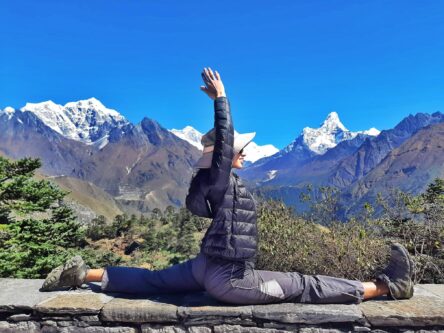
Morning Breathing Practice During Your Trek
A short morning practice may help you begin the trekking day calmly.
- Five to ten minutes of comfortable breathing, gentle stretching, and quiet observation can help you assess how your body feels before beginning the day’s walk.
- Notice whether you have a headache, unusual fatigue, dizziness, nausea, loss of appetite, or significant breathing difficulty.
- Your morning practice should therefore serve partly as a self-awareness check rather than simply another yoga exercise.
- That makes mindfulness particularly useful within a broader altitude sickness prevention routine.
Take Regular Mindful Breaks
- Instead of waiting until you are completely exhausted, take short breaks throughout the day.
- Use these pauses to notice your breathing, hydration, energy level, mental clarity, and physical symptoms.
- A sixty-second check-in can sometimes reveal that you have been walking faster than necessary.
- High-altitude trekking rewards patience.
- Your goal should not be to prove how quickly you can reach the next teahouse. Your goal should be to arrive safely and in a condition that allows you to continue enjoying the journey.
Evening Breathing and Recovery
- At the end of the trekking day, gentle breathing and restorative yoga may help you relax after several hours of walking.
- An extended, comfortable exhalation may be particularly calming before sleep.
- However, difficulty sleeping, worsening headaches, nausea, unusual breathlessness, confusion, or coordination problems should never simply be attributed to normal trekking tiredness.
- Monitor symptoms carefully.
- Breathing practices should support awareness—not encourage trekkers to ignore warning signs.
Common Altitude Sickness Prevention Mistakes
Some mistakes can increase unnecessary risk during high-altitude travel:
- Ascending too quickly because you feel physically strong
- Continuing upward despite worsening symptoms
- Using intense breathing exercises at altitude
- Holding the breath for long periods
- Trying to compete with faster trekkers
- Ignoring headaches, nausea, dizziness, or poor coordination
- Assuming excellent fitness prevents altitude illness
- Using yoga or pranayama as a substitute for medical advice
- Failing to include acclimatization time in the trekking itinerary
The most important principle is simple: listen to your body and respect the altitude.
Altitude Sickness Prevention and Hydration
- Staying appropriately hydrated is also important during trekking.
- However, drinking excessive amounts of water is not an altitude sickness treatment and can create its own health problems.
- Drink according to your needs and follow guidance from experienced trekking and healthcare professionals.
- Nutrition and rest are equally important.
- High-altitude trekking places considerable demand on the body. Adequate food, sleep, pacing, hydration, and acclimatization all work together.
- There is no single breathing exercise that can replace these fundamentals.
When Should You Descend?
Knowing when to stop ascending is one of the most important parts of altitude sickness prevention and safety.
- If symptoms become more serious or continue worsening, continuing upward may be dangerous.
- Severe headache, repeated vomiting, confusion, extreme weakness, unusual behavior, significant shortness of breath at rest, or difficulty walking normally should be taken seriously.
- Seek appropriate medical assistance and descend when medically indicated.
- High-altitude illness can become life-threatening.
- No yoga pose, meditation technique, pranayama exercise, or personal determination should take priority over safety.
Himalayan Yoga Academy’s Approach to Trek Preparation
At Himalayan Yoga Academy in Kathmandu, we teach yoga, pranayama, meditation, and mindful movement to international students and travelers.
For trekkers, these practices can be particularly useful before and after a Himalayan journey.
- Our approach focuses on developing breath awareness, body awareness, relaxation, and mindful movement rather than making unrealistic claims about preventing altitude illness.
- Travelers preparing for trekking in Nepal may benefit from learning gentle pranayama before beginning their journey so the techniques are already familiar by the time they reach higher elevations.
- Our programs can also incorporate restorative yoga, meditation, massage, and sound-based relaxation practices for travelers returning from demanding treks.
Altitude Sickness Prevention FAQ
What is the best altitude sickness prevention strategy?
Gradual acclimatization and responsible ascent planning are among the most important considerations. Travelers should also recognize symptoms early, avoid unnecessary overexertion, maintain appropriate hydration and nutrition, and follow medical or trekking safety guidance.
Can pranayama prevent altitude sickness?
Pranayama should not be considered a guaranteed method of preventing altitude sickness.
Gentle yogic breathing may support relaxation, breathing awareness, and mindful pacing, but it does not replace acclimatization, appropriate descent, oxygen, medication, or medical treatment when those are required.
Is altitude sickness common while trekking in Nepal?
Altitude-related symptoms can occur during high-altitude treks in Nepal, particularly when travelers ascend faster than their bodies can acclimatize.
Anyone planning Everest Base Camp, Annapurna Circuit, Manaslu, Gokyo, or other high-elevation routes should learn about altitude sickness prevention before trekking in Nepal.
Can beginners practice yogic breathing for trekking?
Yes. Gentle breathing awareness can be accessible to beginners.
- Start at lower elevations before the trek and keep all breathing comfortable and unforced.
- Avoid intense breath retention or aggressive breathing techniques, particularly at high altitude.
Should I continue trekking if I develop altitude sickness symptoms?
- Do not simply push through symptoms.
- Stop ascending and assess the situation. If symptoms worsen or become severe, seek appropriate medical help and descend as required.
Can Himalayan Yoga Academy teach breathing techniques before my trek?
Yes. Himalayan Yoga Academy offers pranayama, meditation, yoga, and residential programs in Kathmandu that can help travelers establish a mindful breathing practice before beginning a Himalayan trek.
Altitude Sickness Prevention Begins With Respect for the Mountain
The Himalayas reward awareness, patience, and humility.
Altitude sickness prevention is not about discovering one secret technique that allows you to climb faster. It is about giving your body enough time to adapt, recognizing warning signs, pacing yourself responsibly, and making safe decisions as conditions change.
Gentle pranayama and mindful walking can become valuable companions during this process. They encourage you to notice your breath, observe your energy, stay calmer during exertion, and develop a closer relationship with your body’s signals.
At Himalayan Yoga Academy, we encourage trekkers to approach the mountains with awareness rather than ambition alone.
Whether you are preparing for Everest Base Camp, Annapurna, Manaslu, Langtang, or another Himalayan adventure, developing a mindful breathing practice before your trek can become part of your overall preparation.
Contact Himalayan Yoga Academy to learn about pranayama, meditation, yoga, and pre- or post-trek wellness programs in Kathmandu, Nepal.
Medical disclaimer: This article is for general educational purposes only and is not a substitute for professional medical advice, diagnosis, or treatment. Altitude sickness can become serious or life-threatening. Seek appropriate medical help if symptoms are concerning or worsening.