
Wanna Start doing Meditation?
Many of you might have doubts about starting a meditation practice, where should I sit? Wanna start doing Meditation? What do I do? Should I read any meditation books? But all you need to do is develop a habit of sitting for at least 5 to 10 minutes a day from your daily routine. It is a natural way to relieve stress. For beginners, the easiest way is to start with the breathing meditation, all you need to do is, focus on your breath, and every time you notice your mind wandering in the opposite direction, bring back your focus to your breath again. The more we activate our conscious mind, the stronger it gets. Meditation is hanging out with your soul.
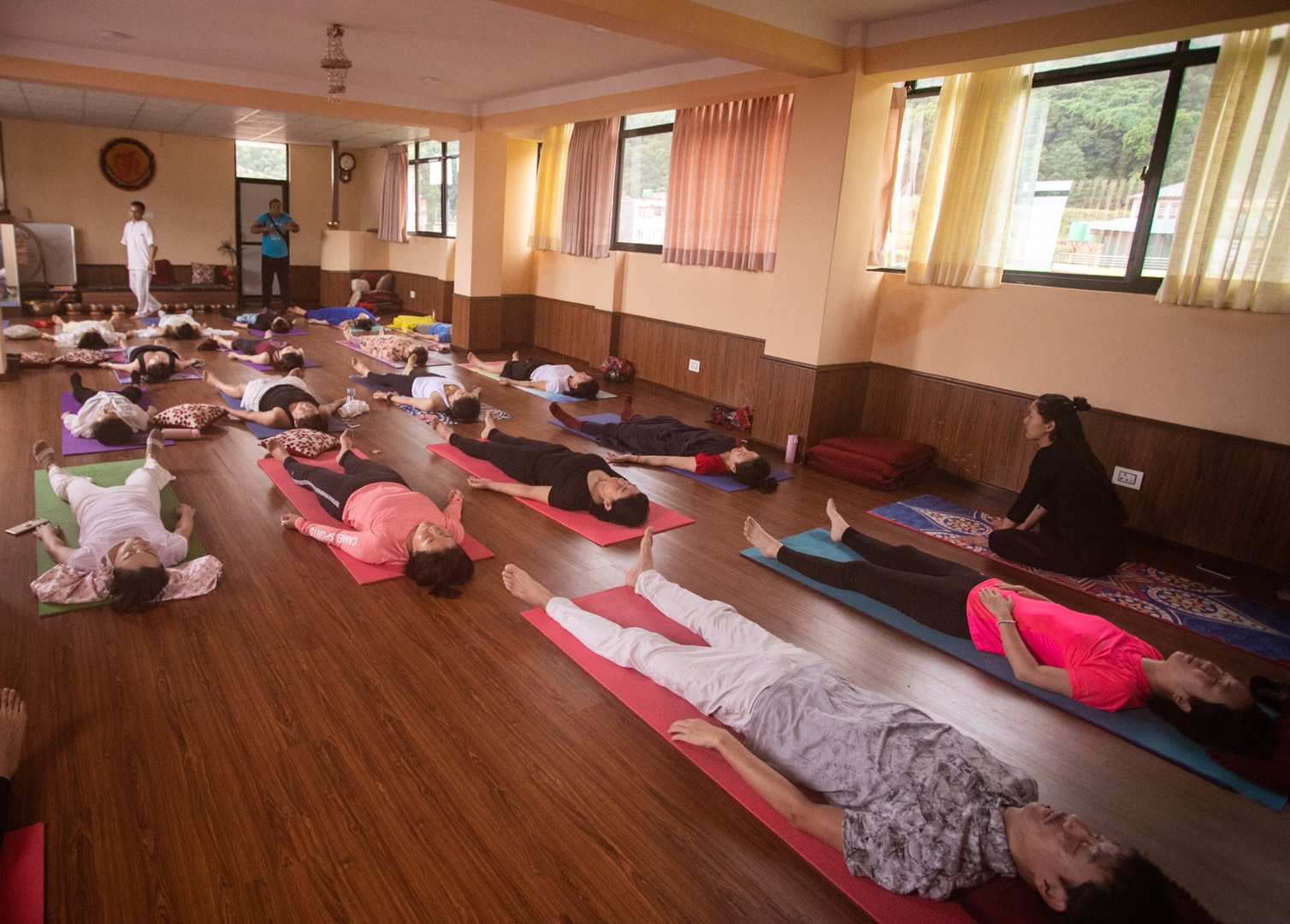
First, Why to do meditation practices?
- Controls Anxiety
- Promotes Emotional Health
- Enhances Self-Awareness
- Reduces Stress
- Slows the aging process.
- A natural way of reducing blood pressure
- May Help Fight Addictions
Now, Comes the Main Part, How to do Meditation Practices?
- Get comfortable
Find yourself something comfy and soft to wear in which you feel relaxed so that you can focus on your inner peace.
- Sit straight
Sit in a most comfortable position with your spine and head as straight as it can be this will not only help you with the breathing, it will keep you alert. You can sit on a mat or a pillow with your legs crossed and rest your palms loosely on your knees. You can also sit on a chair with the spine straight and palms on the knee
- Quiet and regular spot
As a beginner, you need to find yourself a quiet place and a regular spot, where you can only focus on your mind and your body. Practice at the same spot daily to make it a daily habit. Mornings are the best time to practice.
- Set a timer
Set a timer in your mind or on the clock to maintain your practice. As a beginner, you must practice for at least 5 to 10 minutes a day. If you find it short, you can also increase the timing according to your comfort. Try to increase your time after one or two months to uncover more benefits.
- Focus on your breath
As a beginner, you must always start by focusing on the breath. Focus on observing your breath and try not to control it. Follow your breath in through your nostrils, then into your throat, then into your lungs and belly. Observe your inhalation and exhalation process while internally moving your stomach outwards and inwards. If it helps, you can also count the breath to 10 and then start over.
- Let your thoughts float
It is all about directing your thoughts, focusing on your breath, and letting the clouds float behind your head. Even if your mind begins to shift its spotlight away, focus on bringing it back to observing the breath. It can help improve focus and emotional control.
- Observe your surrounding
Once you catch a habit of practicing daily, also try to notice the sounds around you while putting your focus on hearing the background sounds. You can also focus on the energy of the room.
- Make it a habit –
Make a habit of practicing day by day and slowly and steadily increase the sittings and the duration of time. Most likely you will get better with practice. Try to appreciate yourself and be grateful for the time that you had with yourself.
All you need is the instructions and guidance, now get going with your practice. As you quiet the mind, the soul will speak itself.
VISIT NEPAL
In Nepal, through the ages, there have been various efforts by the government of Nepal to increase tourism numbers as Nepal is a perfect destination for adventure and cultural tourism. So after the grand success of Visit Nepal 1998 and Nepal Tourism Year 2011, the Nepal Tourism Board introduced a grand campaign called VISIT NEPAL 2020. They announced this grand campaign in 2015. They planned to complete it in 2018 but later postponed it to 2020.
Several factors impacted Nepal’s tourism image. Mainstream media depicted the country as completely devastated by the 2015 earthquake. The Visit Nepal 2020 campaign, launched in 2018, aimed to promote Nepal as a safe travel destination. It highlighted that only 12 of 75 districts were affected by the earthquake. The crawling upgrading activity of Tribhuvan International Airport delayed construction of Gautam Buddha International Airport in Lumbini and improper transportation infrastructure led the Tourism Board to postpone the campaign to 2020.
WHY SHOULD YOU VISIT NEPAL?
Nepal is fifth among the Top 10 countries to visit in the world and number one in Best Valued Destination in the World. Why wouldn’t they be, Nepal boasts pristine natural beauty, sky-high Himalayas Range, and endless culture and traditions spread out all over the country.
1. TREKKING AND MOUNTAIN CLIMBING
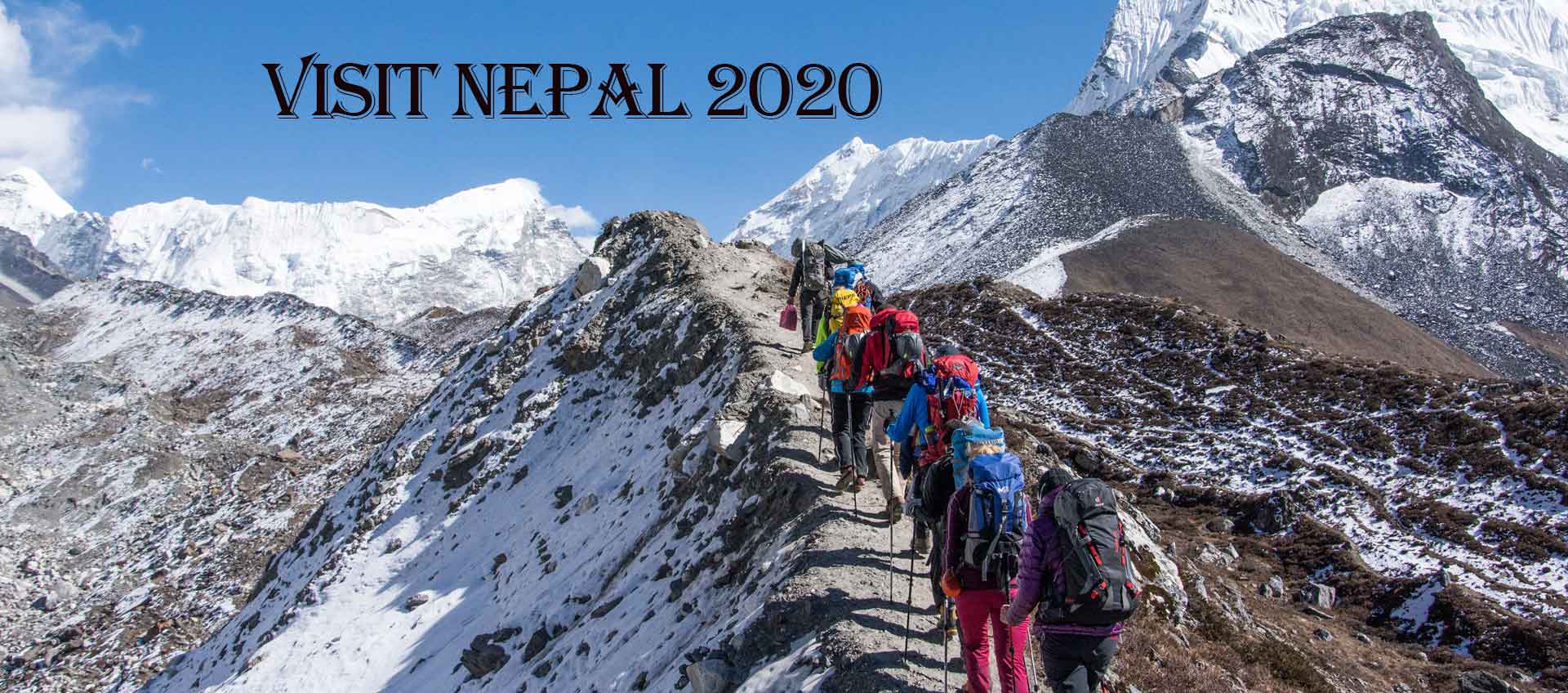
One of the reasons to visit Nepal is for trekking and climbing mountains. You can climb to the top of the World by scaling and conquering Everest, the highest peak in the World. Trekking comes with viewing the natural beauty of the Himalayas and knowing the lifestyle of people living in altitudes above 4000 meters.
2. CULTURAL TRADITION AND UNESCO WORLD HERITAGE SITES
Nepal is also rich in culture and traditions. There are countless ethnic groups each following their distinct art and religions. This diverse tradition and lifestyle is a prominent feature of Nepalese people.
Nepal showcases its cultural diversity through its heritage and temples and Kathmandu has 7 UNESCO World Heritage sites. Such as Pashupatinath, Boudhanath, and Durbar Squares.
3. BIODIVERSITY OF BIRDS AND WATCHING ENDANGERED ANIMALS

Nepal is not only about trekking and mountain climbing. Nepal boasts a wide range of animals and plants, including some found only in the country. With 852 species of birds, birdwatching has become a popular activity for tourists. Nepal is also home to several endangered species such as the Bengal Tiger, One Horned Rhinoceros, Red Panda, and the elusive Snow Leopard.
IS NEPAL SAFE TO TRAVEL AFTER THE 2015 EARTHQUAKE?
Many travelers are still wondering if it’s safe to visit Nepal and the short answer is “yes”. The earthquake caused severe damage in certain regions, but the country is rebuilding and open for travel. Aftershocks have ceased, and most hotels have been repaired, making Nepal safe to visit. Trekking routes are clear, and all lodges, except in the villages of Langtang and Kyangin Gompa, are operational. The earthquake and landslides significantly affected the Langtang and Kyangin villages, so authorities have kept them closed for trekking. However, trekkers can visit these places during their trek.
What are the steps done by the Government to ensure the completion of VISIT NEPAL 2020?
The government of Nepal is working rigorously to ensure a successful tourism period till 2020. The Tourism Board set a target of 2 million tourist arrivals in 2020. The country currently attracts nearly one million tourists annually. It aims to double this number by aggressively promoting the Visit Nepal Campaign. The tourism board is currently running a Visit Nepal Europe campaign with support from Nepal’s ambassadors and diplomats in European countries.
By 2020, the government plans to operate two new International airports, Pokhara, and Lumbini. And introduce the new Airbus 330-200 to provide airline services to a large number of tourists. The government plans to extend Tribhuvan International Airport’s hours by 3, from the regular 18, to ensure services for incoming and departing tourists.
The private hotel sector plans to add 4,000 new rooms in the four and five-star categories in Kathmandu, Chitwan, and Pokhara. Hilton, DoubleTree, and Marriott are set to operate many new international chain hotels in the coming years. The NTB is also expanding its contact with several agencies outside Nepal. Through various Travel Marts like HTM and BITM, several buyers and sellers of tourism products publicize the Nepal attractions.
TIPS FOR MENTAL DETOXIFICATION
TIPS FOR MENTAL DETOXIFICATION
Life is the choice of moment between birth and death. It is a long transit of journey. The body always fulfills the need of life to keep existence but can’t digest desires and expectations. Then it produces toxins that have toxic effects on both body and mind. We love to eat good foods, as fancy as their preparation may look and as delicious as they may be. Once they enter our system, the body digests them, absorbs the nutrients, and eliminates the unwanted waste products within a day. Failing to do so can cause illness.
This is nothing in the world that can quench our things more and make us feel more refreshed than water. Yet if the body doesn’t throw that water out in a couple of hours that retained water can be the cause of illness.
I once saw a very elderly yoga teacher teaching her yoga students breathing techniques. She asked them to breathe in and hold their breath. But elderly as she was, she happened to fall asleep. The students who respect her a lot were unable to hold their breaths any longer but didn’t even want to disobey her, finally, as they were gasping one of them walked up to her and woke her up. As she got up, she said and now breathe out. As funny as this may be should the air we breathe in can be held for no more than a few minutes and it is not thrown out we may die.
Isn’t this principle true for our negative emotions as well? Emotional hurt, envy, greed, jealousy, feelings of hatred, revenge, and anger can make our minds toxic. Yet we continue to hold them in our systems only leading to so many psychological and consequently physical disorders.
The body has a system to remove unwanted food, water, or air without us even being aware of it. How we wish there were an automatic arrangement that could throw negative feelings and emotions out as well. But that is not how it works with the mind we have to consciously work on purging these toxic emotions out of our inner systems.
And here are some ways to get these feelings out.
- Clap with chants.
- Laugh freely and openly.
- Write your feelings on a piece of paper, then tear and burn it.
- Cry and express emotions by jumping.
- Chop all the stressors and enemies dynamically in a half-standing or standing position.
- Open your heart and confide in someone close and trustworthy, sharing our feelings.
- Fulfill natural intrinsic needs and urges.
- Adopting the spiritual practice.
Conclusion:
These ways can help us lighten the heaviness, relieve stress, cleanse our consciousness, and give us the inner strength to fight tendencies. It allows us to express ourselves and release the negative energy. We may also receive support and guidance to deal with our negativities. Always remember that it is not the glass of water which is only a couple of grams in weight that hurts our mind, it is the duration for which we hold it. The quicker we keep it down the better it is for us.
Om Shantih! Shantih !! Shantih!!!
Hari Om Tat Sat!!!
Top 7 Benefits of Yoga Teacher Training in Nepal
Yoga teacher training in Nepal is highly suggested for every beginner in yoga and is a very sensible decision to make. Why? First of all, Nepal is a sitting art piece of nature, compiling the world’s famous mountains, peaks, and ranges. Nepal is not just a trekking or hiking spot, but it is also the home of the ‘authentic’ teachings of Yoga. So, if you are curious about Yoga, and you want to transform your life completely in a better way, then why delay your plans? Learn Benefits of Yoga Teacher Training in Nepal
YTT course can flourish the yogic character in you; it makes you physically, mentally, and spiritually uplifted. With the same zeal, let’s discover the promising benefits of a YTT in Nepal.
Top 7 Benefits of Yoga Teacher Training in Nepal
1. Easy Entry Process
Nepal is a landlocked country in South Asia, with the potential for millennial surprises that you will come across as you step into the boundary, and keep going further and further.
Usually, the entry fee process is a headache comprising a lot of document work. However, Nepal is a savior for foreigners around the world as they have a very smooth VISA system you can get a 1, 2, or 3-month VISA upon arrival. This highly encourages the inflow of tourists from all around the world.
2. In-Budget
With the economic boost in almost every country, it’s hard to find places that can offer more in less. Nepal has done justice to the basic rights a human deserves (along with their pets, some people do travel with their pets!!!) to explore the stunningly elevating views of this calm country.
Cheap and easy travel will help you save for your teacher training program in Nepal. How much can one ask for, when everything fits perfectly here?
3. Landscape and Everest Views
How can you ignore the alluring beauty of Nepal when you are in between the landscapes of the world’s highest peaks like Mount Everest? As much as Nepal is proud of its inheritance, travelers have to make a little bit of an effort to view the panoramic views of a white sheet of snow covering huge mountains.
Hike or trek to the treacherous mountains after you are done with your YTT course, and get ready to be blissed out in the wilderness after gaining spiritual knowledge.
4. Culture and Traditions
Prepare your seat belts to become mentally alert for a good cultural shock. It was not long ago when Nepal finally became a secular country that is in 2006. The religions that are practiced there are Hinduism, Buddhism, Christianity, Jainism, Islam, Bon, Sikhism, worshiping ancestors, or animism. Although the majority of the people are either Hindus or Buddhists, the two have co-existed over the centuries in harmony. Don’t worry, none of the yoga gurus at your YTT program is going to force you to opt for any religion, as Yoga is above any sort of restrictions that limit your idea of thought.
‘Land of Buddha’ has a traditional touch to maintain its ever-lasting peace, and hope amongst the lot.
5. Yoga Den
By now, you will be able to see a clear picture of Yoga in Nepal. Backpackers from all around the world enter this serene land to encounter the hidden treasures that were buried in the faded-out teachings of Yoga. Thanks to the new idea of thought, the younger and older generations have brought forth the magical properties of Yoga.
Youth has given it the importance it deserves, which is why Nepal is hosting countless Yoga teacher training programs to continue the revolution of making enchanting yogis and yoginis.
6. Adventure Land
We are all sailing in the same boat to grab any opportunity that enhances any thrilling experience. Nepal offers the perfect escape from the hustle and bustle, allowing you to prioritize yourself and radiate positive energy. Add Bungee jumping, Everest Base Camp Trek, Safari at Chitwan National Park, Mountain biking, Everest mountain flight, and much more.
If you’re an adventure enthusiast, ditch the mini-plans and start listing the things you want to do in Nepal.
7. Architectural Beauty
While you are at your Yoga studio, and Sunday is ‘no activity’ day, why not stroll around the areas, markets, temples, gompas, etc. to be entertained? You will be encountering the mixed doze of India, Tibet, and China which has highly influenced the structures and intricate monuments. Nepalese architecture or Bastukala is a unique strain of practicality and art that can be seen in Pagodas, Stupas, Summits, and other places.
Gayatri Mantra – Meaning, Significance and Benefits
The Gayatri Mantra is a universal prayer enriched in the Vedas. Sage Viswamitra discovered it and revealed the benefits of chanting the Gayatri mantra. He also gave the Gayatri Mantra, also known as the Savitri Mantra, to address the Immanent and Transcendent Divine given the name “Savita,” meaning that from which all this is born. Learn Gayatri Mantra – Meaning, Significance, and Benefits
The mantra is a significant part of the Upanayana Ceremony for young males in the Hindu Dharma. Dvija men have long chanted it as part of their daily rituals. Modern Hindus refined the movements and spread the practice of the mantra to include women and all castes, making its use prevalent today. People especially regard it for Adoration, Meditation, and Prayer.
The Gayatri Mantra
In English:
Aum
Bhur Bhuvah Svah
Tat Savitur Varenyam
Bhargo Devasya Dheemahi
Dhiyo Yo nah Prachodayat
In Sanskrit
ॐ भूर्भुवः स्वः
तत्सवितुर्वरेण्यम
भर्गो देवस्य धीमहि।
धियो यो नः प्रचोदयात॥
Meaning of Gayatri Mantra
Mantra means:
“O thou existence Absolute, Creator of the three dimensions, we contemplate upon thy divine light. May He stimulate our intellect and bestow upon us true knowledge.”
In Simple Terms
“O Divine mother, our hearts are filled with darkness. Please make this darkness distant from us and promote illumination within us.”
The First Word “OM” – ॐ
It is also called Pranav because the sound of ‘Om’ or ‘AUM’ comes from the Prana (Vital Vibration), which feels the Universe. The scripture says “Aum Iti Ek Akshara Brahman” (Aum that one syllable is Brahman). It is the sum and substance of all the words that can emanate from the human throat. It is the primordial fundamental sound symbolic of the Universal Absolute.
The Vyahrities – Bhur, Bhuvah, Svah
The above three words of the Gayatri, which literally means “past,” “present,” and “future,” are called Vyahrities. Vyahriti is that which gives knowledge of the entire cosmos or “ahriti”. The scripture says: “Visheshenh Aahritih sarva viraat, praahlaanam prakashokaranh vyahritih”. Thus, by uttering these three words, the person who chants it contemplates the Glory of God that illumines the three worlds or the regions of experience.
The Remaining Words
Here is the individual meanings of the rest of the words from the mantra:
- Tat – In simpler term, it means “that”, because it stated description through speech or language, the “Ultimate Reality.”
- Savitur – “Divine Sun” (The ultimate light of wisdom)
- Varenium – “Adore”
- Bhargo – “Illumination”
- Devasya – “Divine Grace”
- Dheemahi – “We Contemplate”
- Dhi – “Intellect”
- Yo – “Who”
- Nah – “Ours”
- Prachodayat – “Requesting/Urging/Praying”
Benefits & Importance of Gayatri Mantra
- Gives people eternal power.
- It is very useful for peace.
- The first step to go to the way of the spiritual road.
- It is correlated with God.
- Strengthens the mind and improves the health condition.
- Improves the rhythmic pattern of breathing.
- Keeps our hearts healthy.
- Protects the devotee from all the dangers and guides towards the Divine by intuition.
- Improves our family life.
- Increases learning power.
- It increases concentration.
- It brings prosperity.
#Gyatri Mantra – Meaning, Significance and Benefits
How to Register with Yoga Alliance After Graduation
How to Register with Yoga Alliance After You Graduate from Your Yoga Teacher Training
Yoga Alliance is an international institution that regulates Yoga schools and yoga teacher certifications. It is important to know that the Yoga Alliance offers a widely recognized accreditation system, but not all yoga teachers register with it. Some countries are developing their accreditation systems, and some yoga communities disagree with Yoga Alliance’s system. However, registering with Yoga Alliance can make things much easier, especially for a new yoga teacher. Below are steps for How to Register with Yoga Alliance After Graduation.
To be able to register with Yoga Alliance as a yoga teacher you first need to do your Yoga Teacher Training with a registered yoga school. You may access the list of registered yoga schools from here: https://www.yogaalliance.org/Directory?Type=School. You can only register with Yoga Alliance after your graduation. And the registration process is quite easy.
Here is step by step guide to registering with Yoga Alliance:
- Go to the https://www.yogaalliance.org/
- Click on the “Join” at the top right corner of the page
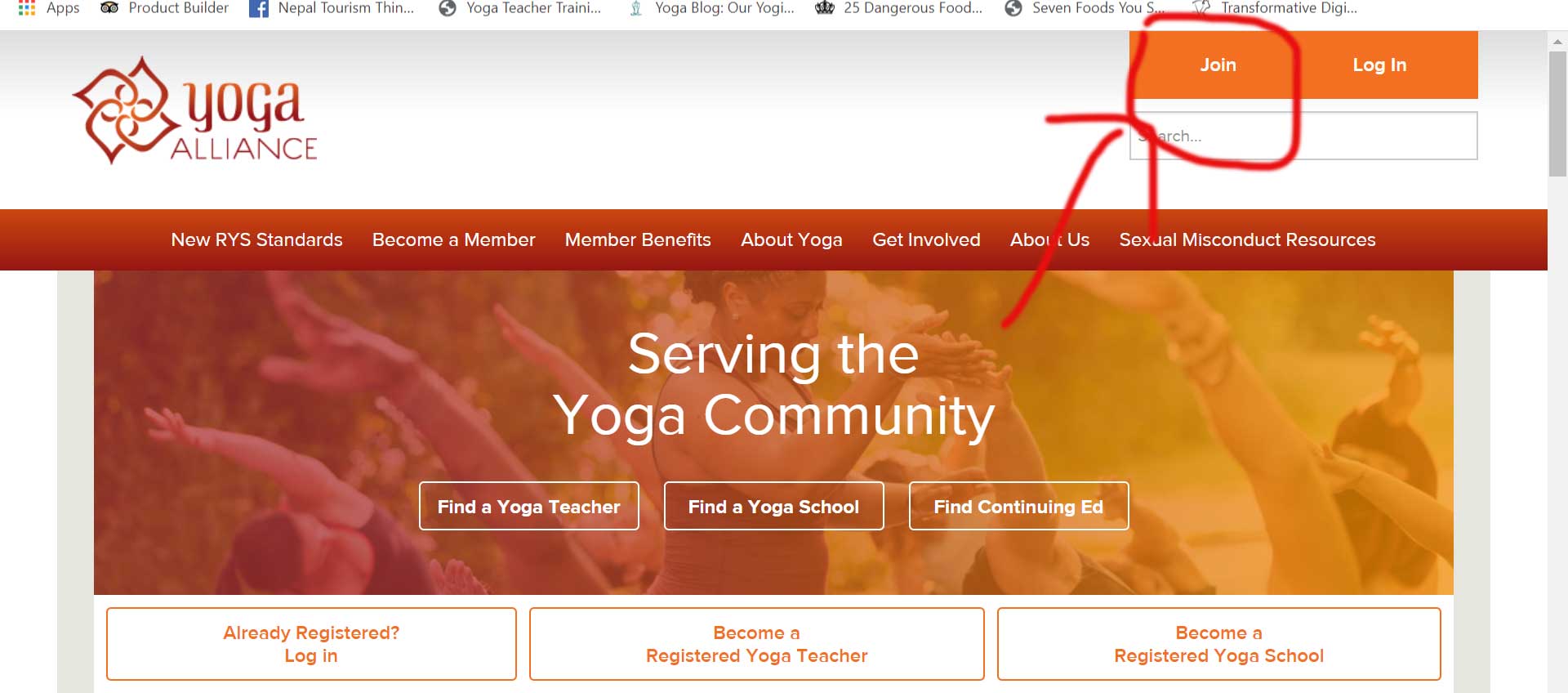
- Fill in the form and make sure that you accept the terms and conditions by clicking the box next to it.

- And click on create an account bottom at the bottom of the page.
- The web page will ask you if you would like to create Account recovery information. It is always a good idea to do that in case you forget your password. If you choose to do that follow the steps. You may also choose to skip this step.
- After you are done go to your basic Dashboard by clicking the link at the top of the page.
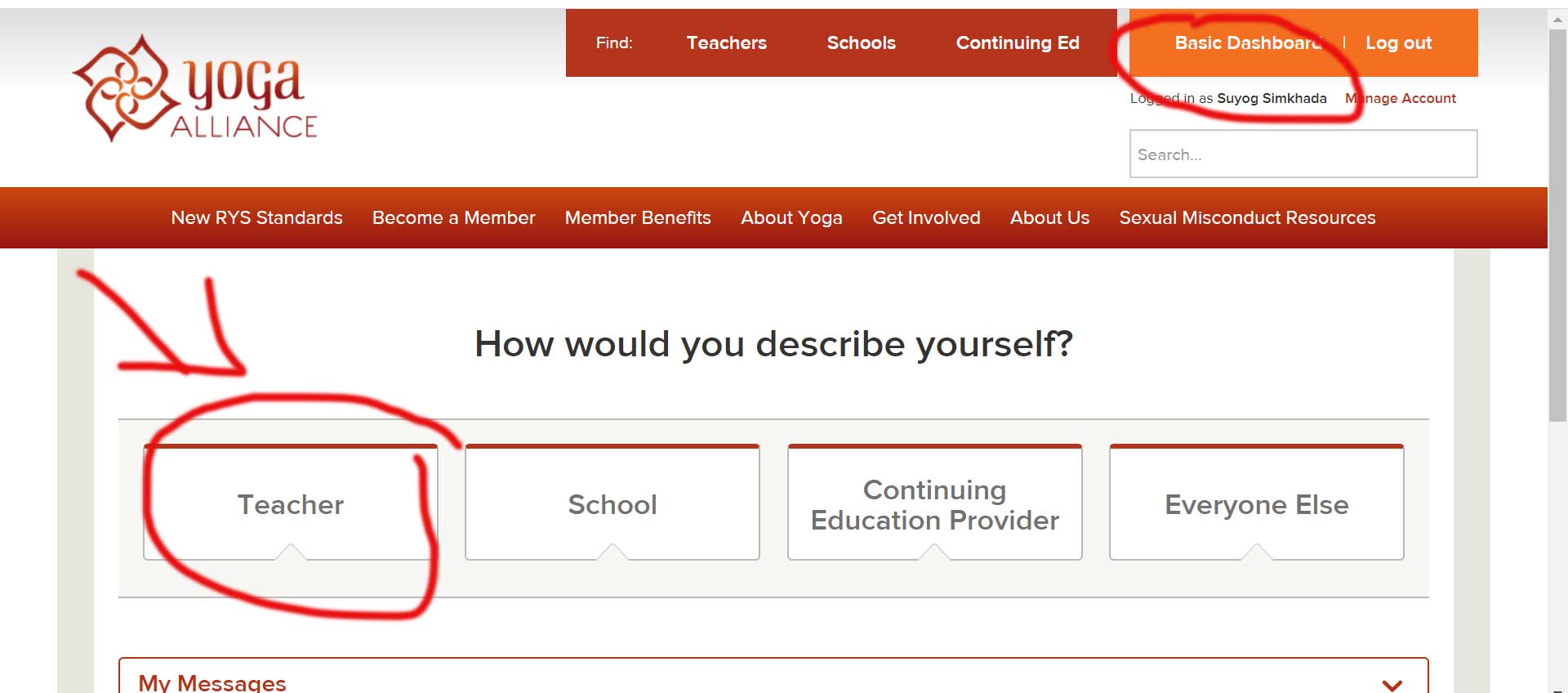
- You will then need to select a designation. If you have just completed your 200-hour teacher training, choose RYT200. If you have completed both 200hrs and 300hrs training, choose RYT500.
- The system will direct you to a screen where you can register for your training, pay for your registration, and leave a review for your teacher training school. As you can see from below the registration cost for RYT is 115 USD. After initial registration, Yoga Alliance will request annual payments of around 50 USD. 155 USD includes your initial registration fee and a yearly membership fee.
- To register as RYT500 you will need 500hrs of training (500hrs or 200hrs+300hrs), and 100 hrs of teaching experience. To put in your teaching experience, you won’t need any confirmation. The teaching experience might include any hours of yoga instruction from private to studio.

Your first step is to add the training program. After you submit the information and the scan (or a clear photo) of your teacher training, Yoga Alliance will confirm your training with your teacher training school and make sure that you have completed all the requirements. So no need to rush and pay the registration cost right now. The best option is to wait until Yoga Alliance sends you an email confirming that your training is approved.
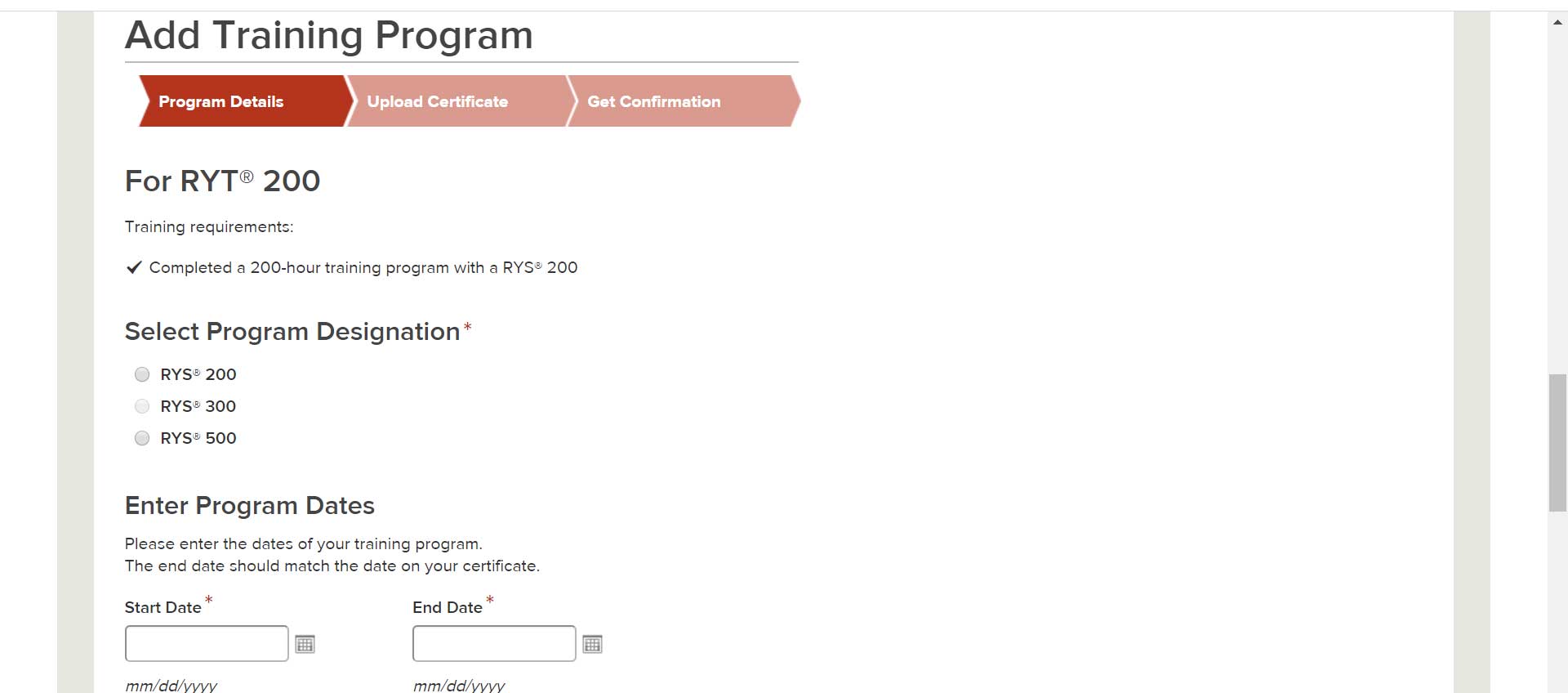
- Once you enter the details of your training, the system will direct you to the next step, where you will upload the image of your certificate to the website.
- After this step you will wait for your yoga school to confirm your training. When it is done you, will get a confirmation email.
- When your training is confirmed the last step is to pay the registration fee and you will be added to the directory of registered teachers.
As you can see the process is quite straight forward and actually, the Yoga Alliance webpage directs you in a pretty user-friendly way. You also don’t need to worry about remembering when to pay the membership fee. Yoga Alliance will remind you through email.
After your registration, you will have a personal page on the Yoga Alliance website. Make sure that you create a page that presents you well as a yoga teacher. Possible employees or students might be checking your profile page out.
What are the Best Seasons to do Yoga Teacher Training in Nepal?
Nepal is the beautiful land of Lord Buddha and Mount Everest which has preached the light of knowledge to the world. A place situated in the lap of nature attracts lots of yoga and meditation lovers from around the globe. Nepal is a country surrounded by Himalayan snow peaks, lush green valleys, lakes, and the Seti River flowing throughout the town. With the availability of natural resources, Nepal promises the best yoga teacher training in Nepal for people who want to learn and explore ancient art. Let’s see the Best Seasons to do Yoga Teacher Training in Nepal.
Best Seasons to Do Yoga Teachers Training in Nepal
Practicing yoga and meditation in the lap of the Himalayas is truly an amazing experience. With lots of rivers flowing in Nepal, it adds a lot to the beauty. But with all these factors, the seasons play a crucial role and make yoga a fun-filled activity along with excitement.
The beautiful country of Nepal witnesses five types of seasons every year, i.e., spring, summer, monsoon, autumn, and winter. The summers are cool, and the winters are severe in the northern part of Nepal while in the southern part, the summers are hot, and the winters are mild.
Summer (May June July)
During this season the maximum temperature is 29.70 C while the minimum temperature is 21.30 C. During the rainy season, there is a rainfall of 829.7 mm. The average annual rainfall in Nepal is 1,600 mm, but it varies according to the eco-climatic zones such as 3,345 mm in Pokhara and below 300 mm in Mustang. Nepal receives eighty percent of its rainfall during the monsoon time, i.e., from June to September.
Winter (Jan Feb Dec)
The winter starts with occasional rainfall, and snow-covered mountains make the place even more beautiful. The clear and sunny weather is a perfect time for practicing yoga and taking yoga practice to another level. The minimum temperature is 7.70 C while the maximum temperature in winter is 20.30 C. During the winter season, there is a rain of 26.3 mm.
Autumn (Sep-Nov)
It is the right time when you can get clear visibility. The fresh air and perfect weather make it the perfect yoga destination in the world.
Spring (March-May)
This is lovely weather when the mountain is covered with beautiful and colorful blooming of flowers. With plenty of flowers and snow, it makes the place even more beautiful. The season is best for yoga practice.
Conclusion
The cool and pleasant weather in Nepal attracts a lot of tourists from all around the globe to learn and explore yoga. The changing season in Nepal invites lots of people to spend their vacations with their loved ones. No matter what the weather condition yoga lovers can explore yoga every season to make their life healthy and happy in Nepal
Which Style of Yoga is best for Weight Loss?
All yoga styles are good for weight loss, as they all give you the building blocks that you need to meet your weight goals. Whether this is through calorie burning, mindfulness, detoxing, or de-stressing, there is a place for yoga in any weight loss regime. Still, some styles do burn more calories than others, which means by practicing these forms of yoga you will get faster results. More intense yoga asana practices are designed to increase your heart rate, promote sweating, and create a movement of lymphatic fluid. These are all vital elements in weight loss. But this doesn’t mean that a slow-paced, less intense practice won’t help you lose weight and keep it off. Here are Which Style of Yoga is Best for Weight Loss?
1. Ashtanga Yoga
One of the classical yoga forms, Ashtanga Yoga is a dynamic and physically demanding practice that was founded by K. Pattabhi Jois. Ashtanga is a Sanskrit word in which ‘Ashta’ means ‘eight’ and ‘Anga’ refers to ‘limbs’, the ‘eightfold path’ of yoga. Ashtanga Yoga syncs the breath with the movements and generates internal heat that cleanses the body, strengthens the muscles and organs, and improves circulation.
While doing Ashtanga, your body will build internal heat and detoxify through the movements and coinciding breathing. As well, the repetition of the practice helps with blood circulation, body awareness, and discipline, which are all great things to learn to lose weight and keep it off. In an Ashtanga class, you can burn anywhere from 350 to 550 calories per hour.
2. Vinyasa Yoga
Vinyasa Yoga stems from Ashtanga, but there is more variety than in an Ashtanga class. A Vinyasa class is a flowing, continuous movement, where you are moving from one pose to the next in a dance-like manner. You will follow the teacher’s sequence, which is carried on from Ashtanga’s Surya Namaskar A & B (Sun Salutations A & B). The pace is different per class and per teacher, ranging from movement in one breath to movement in up to five breaths.
When you practice Vinyasa you are building heat in your body as well as promoting blood circulation and detoxification. You will also develop strength, increase your suppleness and, of course, lose weight.
3. Bikram and Hot Yoga
If you love the heat, then this type of yoga practice may be the best choice for you. People practice these styles of yoga in a room heated to 40°C with a humidity of 40 percent. Bikram Yoga is a set of 26 poses that are done in every class. The design aims to make your heart rate rise and your body sweat. Hot yoga comes from Bikram, though instead of 26 set poses there is much more variety.
Doing Bikram yoga in the hot room increases blood circulation, flexibility, and body heat without the same exertion experienced when practicing other forms of exercise. Hence you will eventually lose weight.
4. Hatha Yoga
With ha meaning “sun” and tha meaning “moon,” we have the common interpretation of Hatha yoga as “a union of the pairs of opposites.” A more technical translation of Hatha yoga is “force’ “determined effort” or “dedicated practice”. Thus hatha yoga, the “yoga of activity,” is the yoga that addresses the body and mind and requires discipline and effort. It is the yoga that we can feel, that we can experience, right here and right now. Hatha yoga is a powerful method of self-transformation.
You will not burn as many calories in a Hatha Yoga class as you would in an Ashtanga, Vinyasa, or Hot Yoga Style class. Still, you can burn up to 300 calories, depending on the intensity of it. Hence you will lose weight.
Science of Mudra – Part 1
The Equinity of Nature is the important rule of the divine in the Universe. There is the balance of Pancha tattva e.g. Aakaasha (space)-6%, Vaayu (Air) – 6%; Agni (Fire) – 4%; Jala ( Water) – 72%; and Prithvi (Earth) – 12%. Of these five elements, ether is the most expansive and pervasive, Air is the most dynamic. In modern times, this balance has been upset too much due to lifestyle disorders. If this is imbalanced, it will spell disaster for mankind. The human body has a very complex networking system. It is a huge chemical factory wherein chemical reactions are taking place every moment. Various types of Bio-energy, magnetic energy, Electrical, Mechanical, and chemical energies are present in our bodies. These energies run the bodies which are the vital force of the body or Prana Shakti. Further about the Science of Mudra
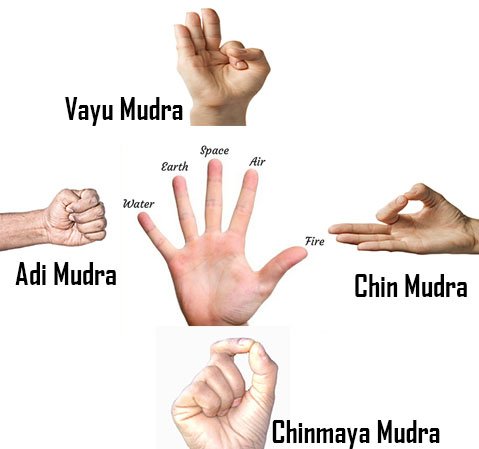
The five fingers of our hands are the depositories of the Prana Shakti. Maximum energy flows in the tips of these fingers but these fingers represent different components of Prana Shakti. The Middle Finger represents AAKAASHA (Ether), the Index finger represents VAAYU (Air), the Thumb represents AGNI (fire), the Little finger represents JALA (Water) and the Ring finger represents PRITHIVI (Earth).
As already mentioned, the five fingers are the storehouse of vital energy or magnetic energy. The tips of fingers have the maximum energy that can balance these five elements. Any imbalances in the five elements affect the vital energy and create sickness. We can restore the balance through these fingers so as to keep healthy.
Yoga is the science of life and also a healing science. Mudras are an integral part of yoga, but unfortunately, the healing aspect of these mudras has not been well-published so far. The science of Mudras provides the safest and the most convenient, easy-to-do hand mudras, both for prevention as well as for the healing of diseases. Five fingers of our hands magically affect the body’s metabolism, growth of the human body and mind, releasing of mental tensions or depression, improving memory and concentration, improving efficiency, gaining height and physical strength, increasing sexual power, improving intuition, and for spiritual advancements.
Tattva Mudras – Fingers & Elements
- Aakaasha (Ether/Space) Tattva – Middle Finger – Aakaasha Mudra
- Vaayu (Air) Tattva – Index Finger – Vaayu Mudra
- Agni (Fire) Tattva – Thumb – Surya Mudra
- Jala (Water) Tattva – Little Finger – Indra Mudra
- Prithvi (Earth) Tattva – Ring Finger – Prithivi Mudra
1.1. Aakaasha Mudra; 1.2. Shunya Mudra 2.1. Vaayu Mudra; 2.2. Gyaana Mudra; 3.1. Surya Mudra; 4.1. Indra Mudra; 4.2. Varuna Mudra; 5.1. Prithvi Mudra
What is Reiki Healing for Beginners?
Reiki is a Japanese technique for stress reduction and relaxation that also promotes healing. It is administered by “laying on hands” and is based on the idea that an unseen “life force energy” flows through us and is what causes us to be alive. If one’s “life force energy” is low, then we are more likely to get sick or feel stressed. And if it is high, we are better able to be happy and healthy. Wanna learn What is Reiki Healing for Beginners? Keep on Going 🙂
While this may sound like voodoo magic to some, even nonbelievers who have spent an hour with a skilled Reiki master (as they’re called) have felt a positive shift of some sort. Many describe Reiki sessions-a combination of light touch and above-the-body energy sweeping—as calming or grounding. And for others, it feels more like an emotional realignment.
Reiki Healing
Many people practice this technique to improve their health through meditation, exercise, and an improved diet. As they do this, they often develop a deeper awareness of the flow of subtle energies in and around the body and their connection to health. This awareness confirms the ancient idea that ‘life force energy’ causes health, and its absence leads to illness.
Our physical body is alive because of the ‘life force energy’ that is flowing through it. If our ‘life force’ is low or blocked, we are more likely to get sick, but if it is high and free flowing, we more easily maintain health and a feeling of well-being. One thing that disrupts and weakens the flow of ‘life force energy’ is stress.
Stress is often caused by conflicting thoughts and feelings that get lodged in one’s subtle energy system. These include fear, worry, doubt, anger, anxiety, etc. Medical research has determined that continual stress can block the body’s natural ability to repair, regenerate, and protect itself. The American Institute of Stress estimates that 75%-95% of all visits to doctors are the result of stress reactions. The effects of unreleased stress range from minor aches to major health concerns, such as heart disease, digestive disorders, and respiratory and skin problems.
Reiki can:
- Accelerate healing
- Assist the body in cleansing toxins
- Balance the flow of subtle energy by releasing blockages
- Help the client contact the ‘healer within.’
A treatment feels like warm, gentle sunshine which flows through you, surrounds you, and comforts you. Reiki treats the person’s body, emotions, mind, and spirit as a whole. It is a simple, natural and safe method of spiritual healing and self-improvement that everyone can use.
Reiki is powerful, yet wonderfully gentle and nurturing. During treatment, the clients remain fully clothed. Reiki is an effective alternative, or complement to massage therapy. It supports any medical, or supplemental healing methods a client may be using and is of growing interest to chiropractors, medical doctors, physiotherapists, psychotherapists, psychologists, and hypnotherapists.
Anyone can learn to tap into an unlimited supply of ‘life force energy’ to improve health and enhance the quality of life by learning Reiki, or by receiving treatments from a Reiki Practitioner or Master.
In the Light of the Creator…We See Only Love.