
What is Samadhi?
Samadhi is a state of consciousness where no doership of performance ever arises.
Swami Padmasattva
The purpose of meditation is to achieve samadhi or absolute bliss. This is pure contemplation, super consciousness, in which you and the universe are one. Those who have achieved samadhi are enlightened. In other words, samadhi means freeing yourself from the cycle of birth and death and merging yourself (your soul) with the almighty.
When it is like that it is samadhi, the highest stage of yoga. In that state, there is a complete departure from the memory and so its power of reminding the self of its contents is nullified completely. The self then becomes freed.
What bothers this state of consciousness?
It is hankering, craving, desiring that obscures the shine of understanding and the darkness of doership becomes rock-like. As much this right of lust for objects is reduced so much the daylight of waking into Atmic reality shines out and night is gone.
Samadhi in Vedanta (school of philosophy)
Samādhi is of two kinds: meditation on Nirguṇa-Brahman results in nirvikalpaka samādhi, while meditation on Saguṇa-Brahman leads to savikalpaka samādhi.
Samadhi in Yoga (school of philosophy)
Samādhi (समाधि, “completion”) is a Sanskrit word referring to “intense self-absorption”. It is one of the eight brances of yoga, also known as the eightfold path (aṣṭānga). Also, see the fifth section of the Varāha-upaniṣad.In yoga philosophy, Samadhi represents the stage where the mediator merges with its object of focus and transcends the self altogether to a higher understanding.
The Gheraṇḍasaṃhitā 7.3-6 teaches that rājayoga encompasses six types of Samādhi:
- dhyāna (prduced by śāmbhavīmudrā),
- nāda (prduced by khecarīmudrā),
- rasānanda (prduced by bhrāmarīmudrā),
- laya (produced by yonimudrā),
- bhakti
- manomūrcchā (‘trance’).
Samadhi in Vaishnavism (Vaishnava dharma)
Samādhi (समाधि).—Total absorption and trance of the mind and senses in the consciousness of the Supreme Godhead and service to Him. The word samādhi also refers to the tomb where a great soul’s body is laid after his departure from this world.
Samadhi in Purana and Itihasa (epic history)
Samādhi (समाधि).—The state when the soul (ātmā) and the mind become one. When the soul and the mind mingle with each other as salt and water, it is Samādhi (contemplation). (For more details see under Yoga.
Samādhi (समाधि) refers to “ecstatic contemplation”, according to the Śivapurāṇa 2.3.5.—Accordingly, as the Goddess (i.e., Durgā) said to Menā:—“O beloved of the mountain, I am delighted by your penance. O chaste lady, tell me what you desire in your mind. O Menā, whatever is desired by you by penance, sacred rites, and ecstatic contemplation [i.e., tapovrata-samādhi] I shall grant you and that too whenever you wish for it. […]”.
Svādhāya, Saṃtoṣa, Śauca, Prāṇāyāma, and Samādhi are described while various kinds of impediments to the practice of Yoga and the means of overcoming them are explained in the thirteenth chapter.
Samadhi in Shaivism (Shaiva philosophy)
Samādhi (समाधि, “absorption”) refers to one of the six members (aṅga) of the Ṣaḍaṅgayoga, as taught in the early Śaiva Siddhānta.—Ṣaḍaṅgayoga is taught as the standard yoga of the Śaivasiddhānta (Siddhānta) a mainstream, Veda congruent dualist tradition. See, for example, the 6th-century texts of Raurava-āgama, Kiraṇa-āgma, Sarvajñānottara-āgama, Svāyambhuvasūtrasaṃgraha, the 7th-century Mālinīvijayottara and the 9th-century Tantrasadbhāva.
Types/Levels of Samadhi
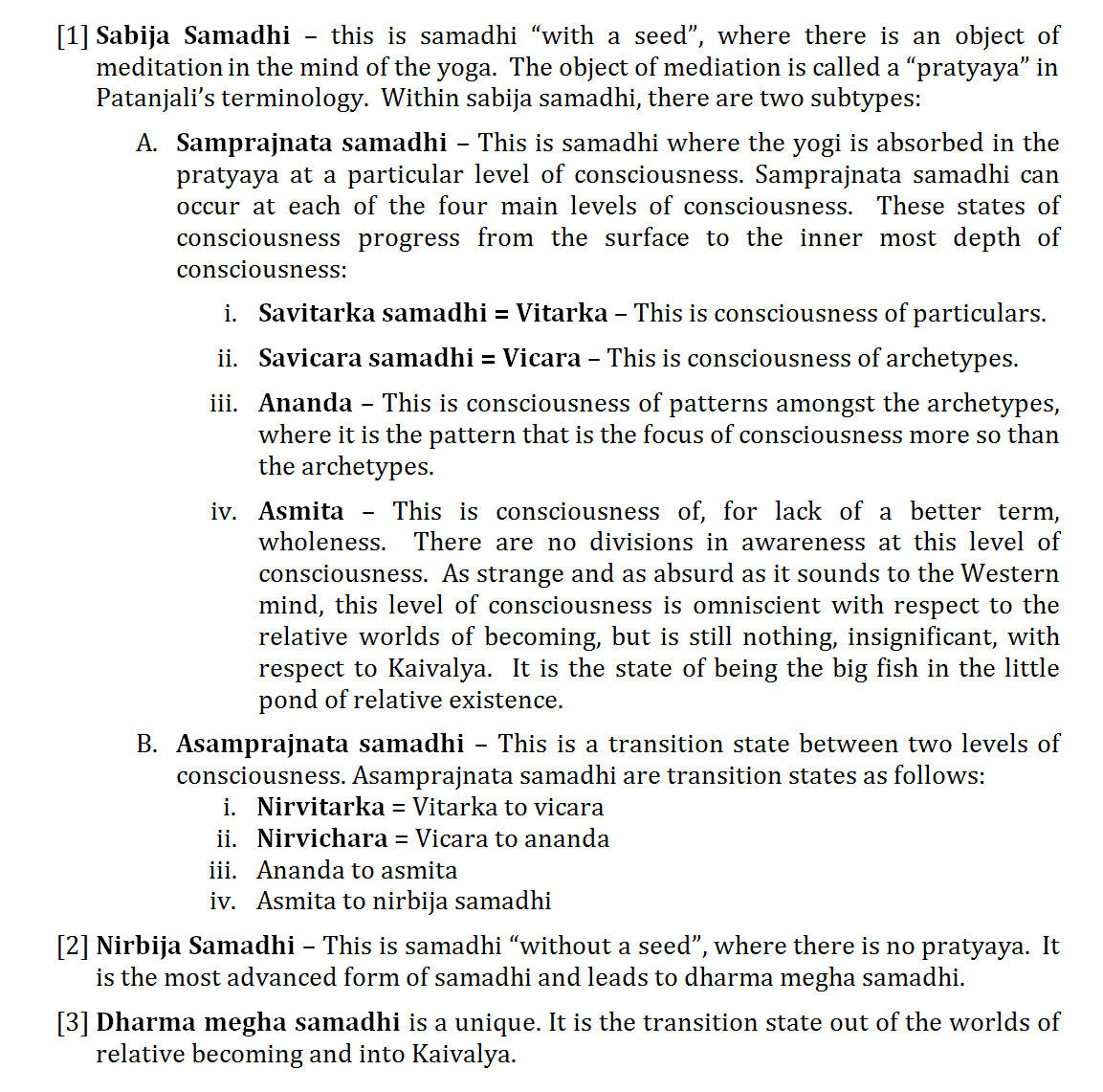
Level 1 : Sabija Samadhi
Stage 1. Sarvitarka Samadhi:
Here the mind totally focuses on the gross aspect of a physical object. This is described as “examination” or learning the “inner secrets” of the object. In this stage, every aspect of the object is understood and you gain full knowledge of the physical object.
Stage 2. Savichara Samadhi:
Now the mind moves beyond the outer layers of the object and the subtle aspects of objects (tanmatras) are contemplated or “discerned.” The abstract qualities such as rednesses, beauty, love or the sound, texture, form, flavor, etc. of the object begin to be understood.
Stage 3. Sa-ananda Samadhi:
Here the mind is devoid of the objective world, you move beyond the intellect. There is no reasoning or reflection, just the tranquility of the settled mind. The sattvic (pure) mind is only aware of its joy. The focus is on the inner powers of perception and within the mind itself. It’s known as a “blissful” Samadhi filled with joyful peace.
Stage 4. Sa-Asmita Samadhi:
Now even the bliss has gone and you are just here. Only the satvic (pure) ego, the I-ness remains, the I AM. Simple awareness of individuality—you are here and aware of nothing else. This is the ego-sense in its elemental form. No fear, no desire. This Samadhi can be likened to what is known in the Shankara Tradition as Cosmic Consciousness. The mind becomes fully Awake, it is a state of witnessing the material world and you become aware of the Divinity (Bliss) within yourself.
In Savikalpa Samadhi, the samskaras (latent tendencies or past impressions that condition your life and desires) have not been dissolved. They remain in seed form. The Great Indian Saint, Ramana Maharshi, described Savikalpa Samadhi as “holding on to reality with effort.” In this Samadhi, the concentrated mind can begin to access some of the “lesser” yogic powers (Siddhis).
However, because the ego is still present, you must be careful how you choose to use these powers. If you use them with a pure motive, you can greatly serve humanity and will progress on your spiritual journey with humility. If you choose to use them for personal greed and ambition, you may cause harm and stall your spiritual progress.
Level 2: Nirvikalpa Samadhi
Nirvikalpa Samadhi is a higher state of awareness where the ego and samskaras have been dissolved and only Consciousness remains.
Patanjali says the material world has become like a shadow from which you are completely free. In Nirvikalpa Samadhi there is no mind as you know it—there is only infinite peace and bliss. Here nature’s dance stops, and the knower and the known become one. Here you enjoy a supremely divine, all-pervading, self-amorous ecstasy. You become the object of enjoyment, the enjoyer, and the enjoyment itself.Now the heart is fully awake. In Nirvikalpa Samadhi, the first thing you feel is that your heart is larger than the universe itself. The universe appears as a tiny dot inside your vast heart. Here, there is infinite bliss and infinite power. You not only feel bliss but become bliss.
This Samadhi is similar to the Divine Consciousness described in the Shankara Tradition, a state of deep love for the world and everything in it, recognizing the Divinity in everything. It is entering a celestial realm. You experience Ritambhara Pragya, where your thoughts spontaneously manifest into reality. The past and future are blended into the eternal present. Everything is now. Everything is here. Time and space have been transcended. The exult blissful state may last for a few hours or a few days. Initially, there is no wish to return from this state and it is said that if one stays at this level for 21 days, there is every possibility that the soul will leave the body for good. However, through continued practice, you can come down from Nirvikalpa Samadhi and immediately function normally in the world.
Both Savikalpa and Nirvikalpa Samadhis are considered temporary states in that you can only fully experience them by withdrawing from normal life. Even the Great Enlightened Yogis closed their eyes to meditate. However, the Yogi’s “normal” life is not as most people experience it. A Yogi is living a life fully supported by the Unbounded Field of Infinite Possibilities. Imagine the whole of manifest creation is touching the front of your body and the unmanifest, Pure Awareness is touching your back. You lean forward and you are in the localized world but the non-local is fully there, supporting your every breath. To quote Maharishi Mahesh Yogi, “It’s living 200 percent of life.”
Level 3: Dharmamegha Samadhi
An even higher level of Samadhi is Dharmamegha or the “Cloud of Virtue” Samadhi.
Patanjali says that this level arises when you have lost even the desire to know God or to be Enlightened. This Samadhi cannot be gained by effort, it reveals itself when all effort has dissolved. It is a Divine Gift, beyond notions of Absolute and relative.
When even the temptations of the Yogic Powers cause no distraction, it is said that Pure Knowledge showers down like a Cloud of Virtue, bringing liberation and the Bliss of the Divine. This is Jivanmukta—liberation while still in a physical body. The afflictions of all karmas have been removed, and the Yogi becomes ever-free and shines in his or her glory. It is said that in this state, the Yogi sees without eyes, tastes without tongue, hears without ears, smells without nose, and touches without skin. His/her mere intention can work miracles. The Yogi simply wills and everything comes into being. After this, the yogi reaches the level of ultimate bliss ( kaivalyam ).

References :
1.https://dondeg.wordpress.com/2014/05/28/patanjalis-ten-types-of-samadhi/
2. https://chopra.com/blogs/meditation/the-3-levels-of-samadhi
Meaning of Meditation in Life
By Swami Padmasattva
What is the meaning of Meditation in Life? We make it difficult by struggling against something which we think is preventing us from being free, or, by searching for something which we presume will give us Freedom. It is found to imply relaxing into who we are, living life from moment to moment.
All over the world people are struggling to be free from something. This struggle does not make us free; it is simply a reaction against something that we were thinking. The freedom of meditation is not a search to find freedom for something, either. Meditation is not something new; you have come with it into the world. Mind is something new, meditation is your nature. It is your nature; it is your very being.
How can it be difficult?
How many of us have dreams of being in some situation or utopia that would allow us just to relax and be ourselves, free from the competition and tension of everyday life? The freedom we are searching for does not depend upon something outside ourselves. So what is the freedom we are longing for? “Just freedom”: living in the here and now, moment to moment, living neither in the memory and oppression of the past nor the dreams of the future.
Eating- simply eat, be with it. Walking- simply walk, be there. Don’t go ahead, don’t jump here and there. The mind always goes ahead or lags. Remain with the moment.
Witnessing simply means a detached observation, unprejudiced; that’s the whole secret of meditation. Nothing needs to be done; just be a witness, an observer a watcher, looking at the traffic of the mind – thoughts passing by, desires, memories, dreams, fantasies. Simply stand aloof, cool, watching it, seeing it, with no judgment” with no condemnation, neither saying ‘This is good,’ nor saying’ This is bad’.
All we learned is the preparation of meditation. Meditation (Dhyana) means actual uninterrupted meditation. The goal of meditation is to achieve heightened awareness and realize oneness with the universe.
What is Spirituality?
What is Spirituality? Start dying each moment to the past. Clean yourself of the past each moment. Due to the known, you become available to the unknown. With dying and being reborn each moment you will be able to live life and you will be able to live death also. And that’s what spirituality is really all about: to live death intensely, live life intensely; to live both so passionately that nothing is left behind unlived, not even death.
If you live life and death totally, you transcend. In that tremendous passion and intensity of life and death, you transcend duality, you transcend the dichotomy and you come to the One. That One is the truth. You can call it God, you can call it life, truth, samadhi, ecstasy, or whatever you choose.
Spirituality is not a question of morality; it is a question of vision. Spirituality is not the practicing of virtues — because if you practice a virtue it is no longer a virtue. A practiced virtue is a dead thing, a dead weight. Virtue is a virtue only when it is spontaneous; only when it is natural, and unpracticed.
And then, what is spiritual?”
To be in a relationship with truth or God is to be spiritual. Remember, to be in a relationship — not to talk about spirituality, not to follow a certain creed, dogma, church, or temple, but to be in a direct immediate relationship with existence is spirituality. To be in tune with the whole, to feel the harmony and the joy and the absolute celebration of being here, that is spirituality.
It has nothing to do with going to the church or the temple, it has nothing to do with reciting the Koran or The Bible or the Gita. It has nothing to do with any kind of worship ritual, it has something to do with communion — communion with the trees, the stars, the rivers, communion with all that is. It is communion with this multidimensional expression of God, it is having a dialogue with the whole. The quality of mad love is needed, and then you are spiritual. Spirituality is not a head trip; it is a heart-to-heart dialogue, and ultimately a being-to-being dialogue.
They escape into loneliness. Their loneliness never becomes aloneness, it remains loneliness. Loneliness is a negative state; it is utterly empty, it is sad. One can be solitary, but that does not bring solitude. Solitariness is just physical aloneness, solitude is spiritual aloneness.
Written By Swami Padmasattva
Kayena Vaca Manasendriyairvaa – In Sanskrit with meaning
From Mukundamala, We have this beautiful verse of Kayena Vaca Shlokam.
Sanskrit Lyrics
कायेन वाचा मनसेन्द्रियैर्वा ।
बुद्ध्यात्मना वा प्रकृतिस्वभावात् ।
करोमि यद्यत्सकलं परस्मै ।
नारायणयेति समर्पयामि ॥
English Lyrics
Kaayena Vaacaa Manase[a-I]ndriyair-Vaa
Buddhy[i]-Aatmanaa Vaa Prakrteh Svabhaavaat |
Karomi Yad-Yat-Sakalam Parasmai
Naaraayannayeti Samarpayaami ||
Meaning of each verse of Kayena Vaca Shlokam :
1: (Whatever I do) with my Body, Speech, Mind or Sense Organs,
2: (Whatever I do) using my Intellect, Feelings of Heart, or (unconsciously) through the natural tendencies of my Mind,
3: Whatever I do, I do all for others (i.e. without the sense of attachment to the results),
4: (And) I Surrender them all at the Lotus Feet of Sri Narayana.
Summary of Kayena Vaca Shlokam
This shloka prays and builds the attitude of complete devotion to the Lord as we move forward each day of our lives. Most of us go through the various activities of life. In our ignorance, we take responsibility for activities, and when the results do not meet our expectations, we become sad and depressed. One of the most powerful ways to achieve spirituality is to perform every action as a doer. If the mindset is that I have to do an activity because it is my duty, I don’t worry about the results.
Just as a soldier, as an agent of the country, kills on the battlefield and is not punished for any action, there are no consequences when we act as a supreme agent. By the way, any action performed with a sense of wonder has a karmic effect with a strong potential for rebirth due to that action. However, any action undertaken with a true feeling that I must serve humanity or that this activity serves a greater purpose beyond my selfishness will have no karmic effects.
Final Conclusion: This shlokam is a great way to reduce our karmic footprint while surrendering to the Lord.
Nirvana Shatkam
Introduction to Nirvana Shatkam
Nirvana Shatkam also known as Atma Shatkam is prakarana granthi consisting of six verses. Prakarana has been defined in the Vishnu Dharmottara Purana thus: Prakarana is a text that explains some particular aspects of the sastra and deals with certain secondary questions arising out of the explanations given.
The instruction empathically conveyed by the six verses of Nirvana Shatkam is that identification with the body, mind, and senses is the root cause of all sorrow and that it should be given up and one should realize one real nature as none other than the supreme Brahman. This realization is what is known as Liberation.“Nirvana” means formless and “Shatkam” refers to the 6 verses of the composition, expressing how the true Self is beyond all definitions; it is “neither this nor that”.
History of the mantra
In these stotras, written in his supreme state of realization, Adi Shankara explains the state of wisdom and truth.
When Adi Shankara was in Kashi, he used to have his daily bath in the Ganga. One day, on his way to the Ganga, his way was blocked by a Chandala (belonging to the untouchable caste) whose job was to burn the dead bodies. Adi Shankara immediately asked him to go away. The man, instead of moving away, asked Adi Shankara `who are you?’
Adi Shankara knew that no ordinary man would ask him this question and he realized that the man in front of him was the Lord Kasinath Shiva himself. Searching for an answer to the question `Who are you?’ Adi Shankara went into a deep state of meditation. And being in the state of highest consciousness, he identified himself with the ultimate truth of life — Shivoham.
Shivoham means `I am Shiva’.
He wrote down his answers then and there and read them out. Adi Shankara mostly answered the question “Who are you” by saying what/who is not he, instead of just saying who is he! . Adi Shankara was no ordinary soul to have attained the state of `Shivoham’ at a very young age. What lies between realities and false identification is the truth. The truth, the ultimate truth is
Nirvana Shatkam in Sanskrit
मनोबुद्ध्यहङ्कार चित्तानि नाहं
न च श्रोत्रजिह्वे न च घ्राणनेत्रे ।
न च व्योम भूमिर्न तेजो न वायुः
चिदानन्दरूपः शिवोऽहम् शिवोऽहम् ॥१॥
न च प्राणसंज्ञो न वै पञ्चवायुः
न वा सप्तधातुः न वा पञ्चकोशः ।
न वाक्पाणिपादं न चोपस्थपायु
चिदानन्दरूपः शिवोऽहम् शिवोऽहम् ॥२॥
न मे द्वेषरागौ न मे लोभमोहौ
मदो नैव मे नैव मात्सर्यभावः ।
न धर्मो न चार्थो न कामो न मोक्षः
चिदानन्दरूपः शिवोऽहम् शिवोऽहम् ॥३॥
न पुण्यं न पापं न सौख्यं न दुःखं
न मन्त्रो न तीर्थं न वेदा न यज्ञाः ।
अहं भोजनं नैव भोज्यं न भोक्ता
चिदानन्दरूपः शिवोऽहम् शिवोऽहम् ॥४॥
न मृत्युर्न शङ्का न मे जातिभेदः
पिता नैव मे नैव माता न जन्मः ।
न बन्धुर्न मित्रं गुरुर्नैव शिष्यं
चिदानन्दरूपः शिवोऽहम् शिवोऽहम् ॥५॥
अहं निर्विकल्पो निराकाररूपो
विभुत्वाच्च सर्वत्र सर्वेन्द्रियाणाम् ।
न चासङ्गतं नैव मुक्तिर्न मेयः
चिदानन्दरूपः शिवोऽहम् शिवोऽहम् ॥६॥
Nirvana Shatkam in English Lyrics
mano buddhi ahankara chittani naaham
na cha shrotravjihve na cha ghraana netre
na cha vyoma bhumir na tejo na vaayuhu
chidananda rupah shivo’ham shivo’ham
na cha prana sangyo na vai pancha vayuhu
na va sapta dhatur na va pancha koshah
na vak pani-padam na chopastha payu
chidananda rupah shivo’ham shivo’ham
na me dvesha ragau na me lobha mohau
na me vai mado naiva matsarya bhavaha
na dharmo na chartho na kamo na mokshaha
chidananda rupah shivo’ham shivo’ham
na punyam na papam na saukhyam na duhkham
na mantro na tirtham na veda na yajnah
aham bhojanam naiva bhojyam na bhokta
chidananda rupah shivo’ham shivo’ham
na me mrtyu shanka na mejati bhedaha
pita naiva me naiva mataa na janmaha
na bandhur na mitram gurur naiva shishyaha
chidananda rupah shivo’ham shivo’ham
aham nirvikalpo nirakara rupo
vibhut vatcha sarvatra sarvendriyanam
na cha sangatham naiva muktir na meyaha
chidananda rupah shivo’ham shivo’ham
Meaning of Each Verse of Nirvana Shatkam
I am not the mind, the intellect, the ego, or the memory. I am not the ears, the skin, the nose, or the eyes. I am neither space, earth, fire, water, nor wind. I am the form of consciousness and bliss. I am the eternal Shiva.
I am not the breath, nor the five elements. I do not matter, nor the five sheaths of consciousness, nor am I the speech, the hands, or the feet. I am the form of consciousness and bliss. I am the eternal Shiva.
There is no like or dislike in me, no greed or delusion. I know not pride or jealousy. I have no duty, no desire for wealth, lust, or liberation. I am the form of consciousness and bliss. I am the eternal Shiva.
No virtue or vice, no pleasure or pain. I need no mantras, no pilgrimage, no scriptures or rituals. I am not the experienced, nor the experience itself. I am the form of consciousness and bliss. I am the eternal Shiva
I have no fear of death, no caste or creed. I have no father, no mother, for I was never born.I am not a relative, a friend, a teacher, or a student. I am the form of consciousness and bliss.I am the eternal Shiva.
I am devoid of duality, my form is formlessness. I exist everywhere, pervading all senses. I am neither attached, neither free nor captive. I am the form of consciousness and bliss. I am the eternal Shiva.
Do Listen to this Beautiful Mantra Nirvana Shatkam
Benefits of Nirvana Shatkam Mantra
- Benefit 1 – Positive vibes
Chanting and listening to Nirvana Shatkam once a day can produce extremely positive vibes around you
- Benefit 2 – Negate anxiety and depression
Recite it to deal with anxiety and depression. It serves as the best medicine to get rid of these negative emotions
- Benefit 3 – Emotional stability
You can achieve an eternal state of calmness even in stressful situations of life
- Benefit 4 – Let go of jealousy and greed
You start getting rid of unwanted attachments
Four Ashoka Stupas of Lalitpur
Here we present an article on the Four Ashoka Stupas of Lalitpur which is briefly described further. Lalitpur District is one of 77 districts of Nepal and is one of the Kathmandu Valley districts which covers an area of 396 square kilometers. Newars are the major habitats of Lalitpur and Newari is their major language of communication. It is best known for its rich cultural heritage, especially its tradition of arts and crafts. Patan or Lalitpur is the city of people accomplished in the arts and professions which is like no other.
Temples, Palaces, bahis, and bahals are steeped in a history that is also present in Patan. The artisans of Patan are bearers of a continuous tradition going back to early times. As a city of fine arts, Lalitpur is more than a collection of monuments; its ancient buildings are lived in, the temple deities are worshipped, and the traditions are yet alive. Patan Durbar Square one of the remarkable places of Patan has been listed as a UNESCO World Heritage site.
What is Stupa?
A stupa is a dome-shaped building erected as a Buddhist shrine, which is typically used for meditation. In common terms, we can say Stupa is a temple of the Buddhist religion. Circumambulation or Pradakshina has been an important ritual and devotional practice in Buddhism since the earliest times, and stupas always have a pradakhshina path around them. According to Buddhist tradition, Emperor Ashoka who ruled from 273 BCE to 232 BCE recovered the relics of the Buddha from the earlier stupas and erected 84,000 stupas across the nation during his tenure.
Who is Ashoka?
Chandragupta Maurya’s grandson Ashoka (Aśoka) (c 304–233 B.C.) took the greatest geographical extent and total power of the Mauryan Empire. However, the astonishing transformation of his kingdom did not occur with the violent violence that characterized the early years of his reign. Rather, it stemmed from his embrace of Buddhism and the message of tolerance and nonviolence that he spread throughout his vast empire.
In addition to his edicts, Ashoka built stupas, monasteries, and other religious buildings at important Buddhist sites such as Sarnath. As a Buddhist emperor, Ashoka believed that Buddhism was beneficial for all people, not just plants and animals, and therefore built several stupas. He also spread Buddhism well to neighboring kingdoms.
The Four Ashoka Stupas of Lalitpur
The four Ashoka Stupas are marked as the four corners of Patan or Lalitpur. It is believed that Emperor Ashoka who expanded Buddhism far and wide came to the valley in the 3rd century BCE and built four Stupas in the four corners of Patan. Those Stupas are a testimony to the ancient culture, tradition, and lifestyle of the Kathmandu Valley.
The Four Ashoka Stupas of Patan are:
- The Lagan Thura (South)
- The Teta Thura (East)
- The Pucho Thura (West)
- The Ibahi Thura (North)
1. LAGAN THURA (SOUTHERN STUPA)
Of the four stupas of Patan, the southern mound is known as Lagan Thura Stupa. It is the largest among the four stupas, measuring 47.40 meters in diameter and 11.80 meters in height. The mound is crowned by a recent structure, a miniature cenotaph added on the top. The shrines of Tathagatas (Buddhas) are believed to have been added in 1878.
This Stupa is located about 200 meters east of Tyagal Tole of Patan near the Ring Road. It is comparatively bigger than the other two Stupas in the perimeter. The perimeter of this Stupa is 75.83 meters and the height is 10.4 meters. It has a fire Vedica (railing) of height 1.6 meters with one Tathagata in each direction. The dome of 4.5m in height is paved with firebricks with a square Harmika on the top. There are three inscriptions which are very difficult to read.
3. PUCHO THURA (WESTERN STUPA):
The Stupa is located on the busy Pulchowk intersection at the western end of Patan. The perimeter of this Stupa is 75.52 meters and it is 12 meters tall. It also has a Vedika of height 1.2 meters with one Tathagata in each direction. The dome is 6.5 meters tall and is paved by firebrick. It does not have Harmika. The thirteen-ring Cakravalis are constructed directly over the dome in a square-shaped pyramid structure. A Yasti caps the top.
4. IBAHI THURA (NORTHERN STUPA):
This Stupa is comparatively more complex and smaller than the other three Stupas. It looks similar to the Swoyambhunath Stupa in Kathmandu. It has a perimeter of 60.62 meters. It has five Buddhas in the Vedika with their consorts except the Tathagata Vairocana. The Vedika is 1.5 tall and the dome is 5.5 meters in height. A square Harmika sits on the top of the dome. We can see a 13-step Cakravali with a Yasti on top of the Harmika.
Bihars and Bahis of Lalitpur
What is Bihar and Bahi?
Bihars and Bahis are where Buddhist monks and nuns stay and carry out different activities like praying, meditation, leering and studying, teaching, and so on. In Lalitpur district people call Mahabihar Bihar. Before Bihars and Bahis emerged, Buddhist monks and nuns were said to be accommodated in the caves and natural forest areas.
Bihar is open for every religion and caste people who follow Buddhism whereas Baha / Bahi is a place only designated for Newari Buddhists. Newar people use Baha and Bahi. Bahal and Bahil are the terms used for Baha and Bahi by the non-newari community (Parbate – out of Nepal Mandal people)
Generally, the word Bahi denotes the same meaning as Bihar indicating the smaller in size in comparison to the Bihar. However, there are distinct differences between a Bihar and Bahi:
- Bahis are supposed to be the earliest places than Bihars,
- Bahis are usually built far away from the residential area, whereas Bihars are made amidst the residential area, and
- Bahis are built over a raised plinth. On the rooftop of the shrine room, a lantern-like structure marks the Bahi.
- Bihars do not usually possess the lantern like structure above the roof top. Bihars do have the quadrangle courtyard usually paved by the stones or bricks. Bihars consist of residence of families.
Bihars and Bahis in Lalitpur
There are one hundred and sixty-seven, Bihars in Lalitpur town. The majority of them have now remained only in name and nothing. According to the historical facts, there were 15 Bihars and 15 Bahis as the major Bihars and Bahis in the early period. During the Malla period the extension of Lalitpur included Chovar and Kirtipur as well. Another Bihar named Shree Vatchha Maha Bihar built by the Malla rulers has also been added to the list. Now, the total number of Bihars has reached 18.
As a major Bahis, there are 24 Bahis including Kirtipur, Bungamati, and Ba Bahis. Among these, the Bihars and Bahis which happen to be in the present Lalitpur town are 16 Bihars and 21 Bahis. These Bihars and Bahis do have names in both Sanskrit and Nepāla Bhāṣā languages.
Sanskrit and Nepāla Bhāṣā names of Bihars of Lalitpur
| S.N. | Sanskrit | Nepāla Bhāṣā |
| 1. | Jestha Barna Maha Bihar | Tanga Bahal |
| 2. | Hiranya Barna Maha Bihar | Kwa Bahal |
| 3. | Dharma Kirti Maha Bihar | Tabahal |
| 4. | Ratnakar Maha Bihar | Hakha Bahal |
| 5. | Yasodhar Maha Bihar | Bubahal |
| 6. | Data Nam Maha Bihar | Daubahal |
| 7. | Guna Laxmi Maha Bihar | Dhumbahal |
| 8. | Chakra Barna Maha Bihar | Chuk Bahal |
| 9. | Bajra Kirti Maha Bihar | Wan Bahal |
| 10. | Jyoti Barna Maha Bihar | Jyo Bahal |
| 11. | Baisya Barna Maha Bihar | Guji Bahal |
| 12. | Mayur Barna Maha Bihar | Bhinchhe Bahal |
| 13. | Rudra Barna Maha Bihar | Uku Bahal |
| 14. | Jaya Manohar Maha Bihar | Subahal |
| 15. | Baladhar Gyupta Maha Bihar | Yachhu Bahal |
| 16. | Shree Batchha Maha BIhar | Sibahal |
Bihars are not similar to one another in several terms e.g. area, Sangha members, art and architecture, branch Bihars, and others. Among these, Yashodhar Maha Bihar possesses the largest area (5 Ropanies) and Chakra Barna Maha Bihar holds the smallest area (3 Ana 2 Paisa). Hiranya Barna Maha Bihar commands the largest number of Sangha members (more than 5,000) and Jyoti Barna Maha Bihar consists of only 22 Sangha members.
The Bihars which have only Bajracharya Sangha include Guna Laxmi Maha Bihar, Chakra Barna Maha Bihar, Dharma Kirti Maha Bihar, Dat Nam Maha Bihar, and Ratnakar Maha Bihar. Four Bihars namely Yasodhar Barna Maha Bihar, Bajrakirti Maha Bihar, Mayur Barna Maha Bihar, and Hiranya Barna Maha Bihar have both Shakya and Bajracharya in their Sangha. The remaining seven Bihars have supported only the Shakya community.
Most of these Bihars have branch Bihars. There is variation in number of branches by Bihars. Rudra Barna Mahavir has earned 33 branch Bihars, Hiranya Barna Maha Bihar has 25 branch Bihars and Yasodhar Maha Bihar has 15 branch Bihars. Besides, three Bihars namely Hiranya Barna Maha Bihar, Rudra Barna Maha Bihar, and Ratnakar Maha Bihar do hold the exact outlook of Bihar as such being bounded by the total complex of own buildings whereas others have been surrounded by the residential houses of the Sangha members and others.
Short Description of few Bihars
Hiranya Barna Maha Bihar (Kwa Bahal)
Hiranya Barna Maha Bihar also known as Kwa Bahal is a historical, Golden colored, pagoda-style monastery of Shakyamuni Buddha. It was built in the 12th century by King Bhaskar Varma and gold-plated with donations offered by the local merchants who traded with Tibet. According to a legend, Hiranyavarna Mahabihar was built at a location where a rat chased a cat. Rats are still being fed at the site. The chaitya in the middle of the courtyard is worshipped as the lineage deity by the locals.
Ratnakar Mahabihar
Ratnakar Mahabihar also known as Hakha Bahal, is located on the way to the Patan palace. Its current building was established during the reign of the Malla dynasty. The site houses the living goddess Kumari, who is the royal goddess of the Malla Kings. Thus, widely worshipped by the Hindus too. Kumari is believed to be the embodiment of the Hindu goddess Taleju and is a significant figure in Newar culture.
Yashodhar Mahabihar (Bubahal)
Yashodhar Mahabihar also known as Bubahal is the ancient Buddhist monastery built by a converted Brahman called Vidhyadhar. Bubahal is situated in Gabahal area. There is a beautiful temple housing the Buddha’s icon which is facing north in the large courtyard.
Their Hindu relatives are still residing near the Agnishala area helping each other in religious and social matters. This is a good example of religious harmony in Nepal, between the two great religions, Hindu and Buddhist. The clan tree called Varuna brikshya of both clans is still preserved in their respective monasteries.
Padmavati Mahabihar (Na Bahal)
Na Bahal also known as Padmavati Mahabihar is a significant cultural and historical site. This monastery constructed in the 17th century is known for its unique wooden carved sculptures, a hallmark of Newari craftsmanship. The big bell in front of the Patan palace was made by the artisans of this monastery. The architecture of the temple is typical of the Newari style with intricate wood carvings and elaborate roof structures. One of the most notable features of Na Bahal is its wooden carvings and bell-making.
Nagbahal
Nagbahal is a vibrant and historic Buddhist area in Lalitpur. The large courtyard of Nagbahal serves as a gathering place for the large icons of Bipankara Buddha during the Samyaka festival which is held every five years. This Bihar is associated with the Golden Temple or Hiranyavarna Mahabihar. It has a stone spout that dates back to ancient times and a large bronze image of a bull very much like a Nandi. According to the local legend, once Dipankar Buddha visited here and at that time the bull roared.
Nakabahil
Nakabahil also known as Lokakirti Bihar is an ancient Buddhist monastery and until recent times it was a well-preserved bihar structure. The Bihar organizes the Astamatrika dance, which begins during Ghatasthapana the first day of the Dashain festival. No violence or sacrifices are performed at Nakabahil, as the monastery follows the principles of nonviolence and compassion.
Jagamadu Pukhu, Pimbahal
According to the local legend, the pond was built by Lakhey or demi god by piling up stones one after another without any mortar or clay to please his wife. It is thus called Jagmadu Pukhu, the pond was used to irrigate the agricultural land nearby. The locals believe if the pond gets dry and the magical stone lying in the northeastern corner of the pond is exposed to the sun it will rain soon.
Mahaboudha Temple
Mahaboudha temple is dedicated to lord Buddha. The temple is often called the Temple of a Thousand Buddhas because a Buddha image is engraved on every branch. The temple dates back to 1585 and it was rebuilt after the 1934 earthquake. Mahaboudha’s design is based on the Mahabodhi temple of Bodh Gaya, as the founder of the temple Abhayaraj visited there. The Mahabodhi temple in Bodh Gaya has long been an inspiration to the Buddhist community all over the world.
Baisya Barna Mahabihar (Guji Bahal)
Guji bahal also known as Vaisha Barna Mahabihar is a historic Buddhist temple located near Sundhara of Patan. The temple was built in the medieval period. The temple features a pagoda style structure. The main shrine is dedicated to Shakyamuni Buddha and there are several smaller shrines and prayer halls within the temple complex. Trailokya Bijayadevi brought from Tibet is one of the important icons of this monastery.
Jestha Varna Mahabihar (Minnath temple)
Jestha Varna Mahabihar is commonly known as Tanga Baha. Its Sanskrit name Jestha Varna Mahabihar indicates its reputation as one of the oldest and principal vihars in Patan. This vihar was founded by Balarchana Deva at Tangal Tol, which is situated on the east of the road leading south from Mangal Bazaar. It is located just opposite Ta Baha of Karunamaya or Rato Machhindranath Temple. The principal deity of the Tanga Baha is a small and remarkable red image of Padmapani Lokesvara which is also revered as Jatadhari Lokesvar. Newar Buddhists call this deity Caku-baha-dya and Hindus call him Minnath.
Ta Baha of Karunamaya or Rato Machhindranath Temple
The Rato Machhindranath Temple stands about 400 meters south of Patan Durbar Square in a large courtyard known as Ta Baha, built in 1673. The temple is a tall Newar-style Pagoda with three tiers of diminishing roofs. It honors Machhindranath also known as Matsyendranath, an influential early 10th-century yogi who credited the god Shiva as his teacher.
In Nepal, in particular, Matsyendranath has come to be known as a god of rain. Buddhists see the deity as an incarnation of Avalokitesvara, and Hindus as an incarnation of Shiva. In Lalitpur in particular the temple is one of two focal points of the Rato Machindranath Jatra, a ceremony that honors the role of the deity also called Bungadya in bringing an end to droughts, the image of Bungadya is pulled in a tall chariot in April-May, built on Pulchowk Road.
Haugal Bahal
Haugal Bahal is a historic community located near Patan Durbar Square. It is home to the Rajkarnikar clan, who are believed to have been brought from Kannauj, India by the Malla kings to make sweets for them. The Rajkarnikars have a rich culinary tradition and their sweets and snacks are still popular throughout Nepal. The bahal has a Buddha shrine. The inner chowk is dedicated to Harati, a goddess worshipped in both Hindu and Buddhist traditions. The icon is from the early Licchavi period.
Rudra Varna Mahabihar
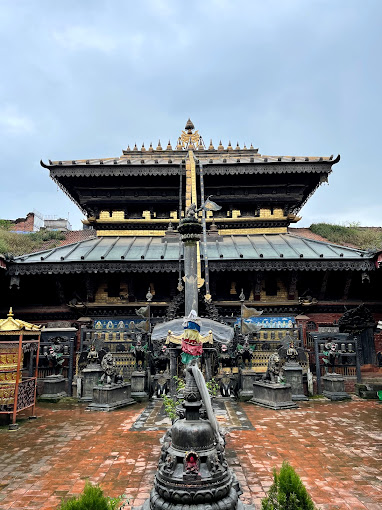
Rudra Varna Mahabihar is a historic landmark in Patan. It was built in the 7th century by Lichhavi King Shiva Dev and was completed by Rudra Dev. It is said that the Rudra Varna Mahabihar once served as a royal courtyard for King Rudra Dev.
One of the most unique aspects of the Rudra Varna Mahabihar is its association with the recitation of the Namasangiti. This ancient prayer is said to have the power to remove the eight great fears or Asta Maha Bhaya, from the minds of those who recite it. Rudra Varna Mahabihar remains a vibrant and active center of Nepalese culture and spirituality.
Guita
Guita Buddhist monastery is in Patan. The temple which is said to be named after the number nine is a fascinating place that is shrouded in mystery and symbolism. It is said that nine nagas or serpent deities performed their sadhana or spiritual practice here. This is why, the temple is considered to be a powerful place of worship. There are nine chaityas or Buddhist stupas surrounding the temple. Another interesting feature of the temple is the nine water spouts that are located near the entrance. These spouts are believed to have been built during the Malla period and are said to represent the nine planets of the solar system.
Mayur Varna Mahabihar (Bhinchhe Bahal)
Bhinchhe Bahal, also known as Mayur Varna Mahabihar, is a Buddhist Monastery on the eastern side of Patan Durbar Square. This ancient monastery is known for its stunning architecture, intricate wood carvings, and ancient artifacts. The name Mayur Varna translates to Peacock-colored in Sanskrit. The monastery houses several rare texts and teachings, including the Prajnaparamita. It is one of the most important Buddhist texts, which dates back to the 12th century. It is the home to many stone carvers who have made stone sculptures in the past. Visitors still can witness the stone carvers at work.
Jaya Manohar Mahabihar (Su Bahal)
Su Bahal, also known as Jaya Manohar Mahabihar was built over 1000 years ago by King Indra Dev. The temple of the monastery was said to have been constructed by removing a cremation ground that previously stood in the area. Thus, on the ninth day of Dashain a main Hindu festival, people offer a tiny piece of their flesh to Mahakal. A deity believed to reside in the cremation ground to pay homage to the deity and ask for blessing.
Yempi Bihar (Ibahil)
Yempi Bihar, locally known as Ibahil is a heritage site near the Kumbeshwar Temple. It is said that the Bihar was once visited by Guru Padmasambhava, who is believed to have stayed there for six months and went to Tibet to spread the teachings of Buddhism.
Yempi Bihar also plays a vital role in the annual Rato Machhindranath Jatra, a popular festival that takes place in Patan. The Jatra is believed to bring good luck and prosperity to the city, and it is said that any work related to the Jatra must first begin at Yempi Bihar.
Sanskrit and Newari names of Bahis of Lalitpur
| S. N. | Sanskrit | Nepāla Bhāṣā |
| 1. | Yampi Maha Bihar | Ibahil |
| 2. | Lalit Barna Maha Bihar | Konti Bahil |
| 3. | Napi Chandra Maha Bihar | Duntu Bahil |
| 4. | Gopi Chandra Maha Bihar | Pintu Bahil |
| 5. | Askchheswar Maha Bihar | Upper Pucho Bahil |
| 6. | Raskchheswar Maha Bihar | Lower Pucho Bahil |
| 7. | Lokakirti Maha Bihar | Nabahil |
| 8. | Mani Mandap Maha Bihar | Dhapagal Bahil |
| 9. | Saptapur Maha Bihar | Chink Bahil |
| 10. | Jestha Barna Maha Bihar | Jyaba Bahil |
| 11. | Raja Shree Maha Bihar | Ibaha Bahil |
| 12. | Lokkirti Maha Bihar | Kinu Bahil |
| 13. | Chandra Surya Maha Bihar | Nhyanka Bahil |
| 14. | Kamuk Nam Maha Bihar | Larger Khwaya Bahil |
| 15. | Kamuk Nam Maha Bihar | Smaller Khwaya Bahil |
| 16. | Gustal Maha Bihar | Main Guita Bahil |
| 17. | Pratham Shree Maha Bihar | Larger Guita Bahil |
| 18. | Basucha Shil Maha Bihar | Smaller Guita Bahil |
| 19. | Iti Raj Maha Bihar | Ilaya Bahil |
| 20. | Jaya Shree Maha Bihar | Uba Bahil |
| 21. | Sthabir Patra Maha Bihar | Thapa Bahil |
The functions of Bahis are systematic but vary by Bahis. The Bahis have Sangha perform the same activities as in Bihar. The largest Saptapur Bihar has 156 Sangha members whereas, the smallest one i.e. Jesth Barna Bihar has only one member. Now seven Bahis have no Sangha members. Some Bahis has own branch while in Saptapur Bihar there are 4 branch of Bihars.
Lokakirti Bahi possesses only Bajracharya Sangha and the remaining are captured by the Shakya community. The condition of Bahis is not well. Except few, all Bahis have been badly damaged in the absence of regular care and maintenance. Furthermore, there are some Bihars in Lalitpur town which do not happen in any group but these Bihars have been performing similar activities like in Bihars and Bahis through Sangha as usual. The number of these Bihars is eight.
The existence of Bihars and Bahis in Lalitpur town has witnessed a great prolonged period to come at the present condition by crossing several ruling periods. The location of these Bihars and Bahis was certainly controlled by the then environment of Lalitpur town. Therefore, a good deal of understanding of the present spatial distribution of Bihars and Bahis in Lalitpur town could provide the probable true situation of that time and the existing relationship at the present moment with the changing spatial landscape of Lalitpur town.
Additional Bihars of Lalitpur
| S.N. | Sanskrit | Nepāla Bhāṣā |
| 1. | Layan Chaitya Bimba Maha Bihar | Henu Bahal |
| 2. | Yonkuli Maha Bihar | Yoku Bahal |
| 3. | Chakrawarti Maha Bihar | Khwakha Nabahal |
| 4. | Gawarma Pinth Maha Bihar | Mubahal |
| 5. | Shree Watsa Maha Bihar | Atha Bahal |
| 6. | Subarna Maha Bihar | Ikha Chhen Bahal |
| 7. | Chaitya Barna Maha Bihar | Michchhu Bahal |
| 8. | Dwarik Bihar | Dwarika Bahal |
Advaita Vedanta
Advaita Vedanta refers to the non-dualistic school of Hindu philosophy, which is derived mostly from the Upanishads and elaborated in detail by eminent scholars like Gaudapada and Sri Adi Shankaracharya. Dvaita means duality, and Advaita means nonduality. In simple terms, Advaita means the absence of the duality between subject and object. In our wakeful consciousness, we experience duality, but in deep sleep only nonduality.
Advaita school believes that Brahman is the only reality and everything else is a mere appearance, projection, formation, or illusion. One of the most common examples used to describe the state is momentarily seeing a snake in a rope when it is lying in the darkness. The snake is an illusion, and the rope is the reality. In the same manner, the world appears in the mind as a formation over the Self. The school also believes that Atman, the individual self, has no separate existence of its own. It is but a projection or reflection of Brahman only in each being. Jiva is a deluded soul by egoism, desires, and other impurities and thereby experiences duality and separation. Because of it each being is bound to the cycle of births and deaths and the laws of karma as long and remains so until liberation is achieved.
Brahman is real, but the world in which we live is a mere illusion, like a mirage. It appears in our consciousness because of the activity of the mind and the senses. Since we depend upon them, we do not perceive Brahman, the ultimate reality, who is hidden in all. When they are fully withdrawn and made silent through detachment, purity, and renunciation, one can see the Supreme Self hidden in all and attain liberation.
Advaita Vedanta believes that an enlightened guru, knowing both the scriptures and Brahman, is indispensable for anyone seeking salvation. Mandukya Karika of Gaudapada is considered to be the first available treatise on Advaita Vedanta, while the monumental works of Shankaracharya constitute its core literature. Successive generations of scholars enriched the school of Advaita through their teachings and scholarly works. Advaita school also forms part of Vaishnavism, Saivism, and Shaktism under different names.
Main Points of Advaita Vedanta – Non-Dualistic Vedanta
- Brahman alone is real.
- The Jiva is not different from Brahman, He is Brahman.
- Hence, the Jiva is eternal, pure, awakened, and free.
- Jiva appears as a doer (Karta) and experiencer (Bhokta) due to ignorance.
- The major cause of the ignorance is Antahkarana ( Instruments of Mind ) .
- Antahkaranas are the inner instruments of the mind (Manas, Buddhi, Chitta, and Ahankara)
- This world is only illusory appearance.
A few important concepts of Advaita Vedanta are presented below.
The Four States of Consciousness
Shankara’s philosophy of Advaita Vedanta also includes the idea of the four states of consciousness, which are waking, dreaming, deep sleep, and transcendental consciousness ( jagrat, sawpna, susupti & turiya). According to this philosophy, the ultimate reality is experienced in the fourth state of consciousness, which is characterized by pure awareness and the absence of thoughts or perceptions.
This philosophy of the four states of consciousness has been influential in the development of meditation and spiritual practices in the Eastern school tradition, as well as in other spiritual traditions around the world.
Sadhana Chatushtayam
Sadhana Chatushtayam means the tetrad which is imperative for spiritual practice and liberation. The following four sets of qualifications are considered essential to achieve salvation, which each aspirant is expected to cultivate.
- Nityanitya vastu viveka: The ability to discriminate between what is eternal (nitya) and what is temporary (anitya). The absence of it is responsible for the delusion.
- Ihamutrartha phala bhoga viraga: Disinterestedness in enjoying the fruit of one’s actions and sense objects here and hereafter. This will arrest the continuation and formation of karma.
- Sama adi satka sampatti: Qualities such as sama (control of internal sense organs), dama (control of external sense organs), uparati (abstinence), titiksha (quietness), sraddha (sincerity and faith) and samadhana. They are important for self-transformation and the predominance of sattva, without which one cannot be free from the triple impurities of egoism, attachments, and delusion.
- Mumukhatva: Intense aspiration for salvation. It arises mainly due to the good works (karma) in the past. According to the Bhagavadgita only after repeated births, a person feels a strong drive to achieve salvation and turn to the path of salvation.
Pramanas
They are the standards of ascertaining the right knowledge, truth, or valid knowledge. In this world of duality, it is very difficult to know which is the right knowledge and which is reliable for salvation or for ascertaining truth. Advaita Vedanta recognizes six Pramanas, of which three were proposed by Shankaracharya and three by his followers. They are as stated below.
- Pratyaksha: The knowledge that comes through perception. This is objective knowledge that is experienced directly either through the senses or in deeper states of consciousness.
- Anumana: The knowledge that comes using inference. This is speculative knowledge based upon supposition or belief.
- Upamana: The knowledge that comes using analogy, comparison, and contrast. This is relational knowledge.
- Arthapatti: The knowledge obtained by meaningful assumptions based on common sense and previous experience. This is hypothetical knowledge.
- Anupalabdhi: The knowledge gained through negation.
- Agama: The knowledge that comes through the study of scriptures. This is pure theoretical knowledge.
Theory of Causation
Advaita Vedanta recognizes two forms of causation, the material cause and the instrumental cause. According to the school, Brahman is both the material and instrumental cause of creation. In other words, Brahman provides not only the will and direction but also the material and energy needed to manifest the things, beings, and worlds. Brahman is both Purusha (Self) and Prakriti (Nature).This is in contrast to some schools of Hindu philosophy, which argue that Brahman is the instrumental cause while Prakriti or nature is the material cause.
Cause and Effect:
Adi Shankaracharya proposed that each cause was hidden in its every effect, whereas the opposite was not true. In other words, the seed is hidden in the tree that produces it. While a cause is not different from the effect it produces, the same cannot be argued in the case of an effect about its cause. A cause is always part of the effect, hidden within it and so is not different from it. Brahman is the cause of all creation. So the world is real only because Brahman, who is its cause, is hidden and inseparable from it.
From this perspective, the world becomes an illusion because it disappears when the Self or Brahman is withdrawn from it. The world exists when you, the cause, are present in your mind. When you, the cause, withdraw from it, the world disappears. Shankaracharya propounded the theory of causation (vivartavada). According to it, an effect is an outward projection of cause and hence not real. This is in contrast to the parinamavada concept according to which an effect is an evolution or transformation of cause and hence as real as the cause itself.
Maya (Illusion)
According to Advaita Vedanta, the world is an illusion or Maya, which is caused by the veiling power of Brahman. It is unreal or illusory in an absolute sense. Since it is a projection of God’s consciousness, it disappears when it is withdrawn. The veiling is called avarna and the projection viksepa. Followers of Advaita argue that Maya is neither real nor unreal, but indeterminate or indescribably (anirvachaniyam) because it cannot be both at the same time.
Brahman and Atman (Universal & Individual)
Brahman is the supreme, absolute, and eternal reality. It is the only truth, the cause of all, and the only stable and permanent reality. Atman is Brahman, perceived as the individual self, the hidden reality, in all aspects of creation. There is no difference between the two. When the Self overcomes its veiling, it experiences non-duality (Advaita anubhava) of existence and realizes its non-difference from the Absolute. Brahman in his absolute state is without qualities and attributes. However, in our relative state we perceive him to be having certain attributes and refer to him as Isvara, the lord of the universe. In the ultimate sense, Isvara is also not the cause, but only an effect or a reflection of Brahman in the quality of Sattva.
The World
According to Advaita, the world is unreal, not because it does not exist, but because it exists only so long as the Self is present in the awareness as the subject. When the Self is withdrawn from the consciousness, the world disappears. Besides it is ever-changing, unstable, impermanent, and subject to destruction and decay. It is an appearance, a projection of God, like a mirage, or a mistaken reality. Our senses take it for granted whereby we mistakenly consider it real and permanent. The world exists because of our perception of duality and will disappear when we enter the state of non-duality or pure subjectivity, which is the state of the Self. When we overcome the illusion and develop detachment from the sense objects we enter that state of pure awareness where the duality between subject and object, or the knower and known simply vanishes and the Self alone remains.
References :
- https://www.hinduwebsite.com/hinduism/concepts/advaitaconcept.asp
- Research Materials from Suman Bista
Top 10 Yoga Mantras / Yoga Prayers
Mantra chanting may be a deeply rooted spiritual and religious practice that has positive effects on one’s physical, mental, and spiritual well-being. Mantra chanting could be an awesome way to enter a thoughtful state of intellect since it gives your intellect something to concentrate on, which calms other thoughts. Practicing mantras all through life can be supportive to keep you focused, but they have to be especially supportive during your yoga and dhyana practices. After you keep your mind focused on your breath and a mantra during practice, it can assist in reducing your chitta vritti, or mind thoughts. We present you with the Top 10 Yoga Mantras/Yoga Prayers below with their meaning.
- GURU MANTRA
- PRANAVA MANTRA: Omkaaram Bindu-Samyuktam
- GAAYATREE MANTRA: Om Bhoor-Bhuvah Svah
- GURU MANTRA: Tvameva Mata
- GURU MANTRA: Dhyanamulam Gururmurti
- KAMANA MANTRA: Om Sarve Bhavantu Sukhinah
- LIGHT MANTRA: Om Asato Ma Satgamaya
- OM SAHANA VAVATU
- KARPURA GAURAM KARUNAVATARAM
- OM PURNAMADAH PURNAMIDAM
1. GURU MANTRA:
OM Namo Guru Dev Namo!
ॐ नमो गुरु देव् नमो
Meaning: I bow, or salutations to the divine Master.
2. PRANAVA MANTRA: Omkaaram Bindu-Samyuktam
Omkaaram Bindu-Samyuktam, Nityam Dhyaayanti Yoginah |
Kaamadam Mokshadam Chaiva Omkaaraaya Namo Namah |1|
ॐकारं बिंदुसंयुक्तं नित्यं ध्यायंति योगिनः ।
कामदं मोक्षदं चैव ॐकाराय नमो नमः ॥१॥
Meaning:
Salutations to Him, Who resides In the Spiritual Heart Center as Omkaara, On Whom the Yogis Constantly Meditate, Who Grants All Desires and also Liberation to the Devotees. Salutations to “Om”
3. GAAYATREE MANTRA: Om Bhoor-Bhuvah Svah
Om Bhoor-Bhuvah Svah, Tat-Savitur-Varenyam, Bhargo Devasya Dheemahi, Dhiyo Yo Nah Prachodayaat
ॐ भूर्भुवः स्वः तत्सवितुर्वरेण्यं, भर्गो देवस्य धीमहि, धियो यो नः प्रचोदयात् ॥ ऋग वेद ३। ६२। १०।
Meaning:
Om, Pervading the Bhu Loka (Earth, Consciousness of the Physical Plane), Bhuvah Loka (Antariksha, the Intermediate Space, Consciousness of Prana) and Svah Loka (Sky, Heaven, Consciousness of the Divine Mind), that Savitur (Savitri, Divine Essence of the Sun) which is the most Adorable (fit to be worshiped), I Meditate on that Divine Effulgence (divine light), may that awakens our Intelligence (Spiritual Consciousness).
4. GURU MANTRA: Tvameva Mata
Tvam-Eva Maataa Cha Pitaa Tvam-Eva | Tvam-Eva Bandhush-Cha Sakhaa Tvam-Eva |
Tvam-Eva Vidhyaa Dravinnam Tvam-Eva |Tvam-Eva Sarvam Mama Deva Deva ||
त्वमेव माता च पिता त्वमेव । त्वमेव बन्धुश्च सखा त्वमेव ।
त्वमेव विद्या द्रविणम् त्वमेव । त्वमेव सर्वम् मम देव देव ॥
Meaning:
You truly are my mother and you truly are my father. You truly are my Sibling and you truly are my Friend. You truly are my knowledge and you truly are my Wealth. You truly are my All, My God of Gods; to me as my almighty.
5. GURU MANTRA: Dhyanamulam Gururmurti
Dhyaana-Moolam Gurur-Moortih; Poojaa-Moolam Gurur-Padam |
Mantra-Moolam Gurur-Vaakyam ; Moksha-Moolam Gurur-Kripaa ||
ध्यानमूलं गुरुर्मूर्तिः पूजामूलं गुरुर्पदम् ।
मन्त्रमूलं गुरुर्वाक्यं, मोक्षमूलं गुरूर्कृपा ॥
Meaning:
The Root of Meditation is the Form of the Guru; The Root of Worship is the Feet of the Guru,
The Root of Mantra is the Word of the Guru; The Root of Liberation is the Grace of the Guru.
6. KAMANA MANTRA: Om Sarve Bhavantu Sukhinah
Om Sarve Bhavantu Sukhinah; Sarve Santu Niraamayaah |
Sarve Bhadraanni Pashyantu; Maa Kashchid-Duhkha-Bhaag-Bhavet |
ॐ सर्वे भवन्तु सुखिनः, सर्वे सन्तु निरामयाः ।
सर्वे भद्राणि पश्यन्तु, मा कश्चिद्दुःखभाग्भवेत् ।
Meaning:
Om, May All be Happy, May All be Free from Illness. May All See what is Auspicious, May no one Suffer.
7. LIGHT MANTRA: Om Asato Ma Satgamaya
Om Asato Maa Sat-Gamaya |Tamaso Maa Jyotir-Gamaya | Mrtyor-Maa Amrtam Gamaya | Om Shaantih Shaantih Shaantih ||
ॐ असतो मा सद्गमय । तमसो मा ज्योतिर्गमय । मृत्योर्मा अमृतं गमय । ॐ शान्तिः शान्तिः शान्तिः ॥
Meaning:
Om, (O Lord / Paramatma)! Keep me not in (the Phenomenal World of) Unreality, but make me go towards the Reality (of Eternal Self); Keep me not in (the Ignorant State of) Darkness, but make me go towards the Light (of Spiritual Knowledge), Keep me not in (the World of) Mortality, but make me go towards the World of Immortality (of Self-Realization). Om Peace, Peace, Peace!
8. OM SAHANA VAVATU
Om Saha Naav[au]-Avatu | Saha Nau Bhunaktu | Saha Viiryam Karavaavahai | Tejasvi Naav[au]-Adhiitam-Astu Maa Vidvissaavahai | Om Shaantih Shaantih Shaantih ||
ॐ सह नाववतु । सह नौ भुनक्तु । सह वीर्यं करवावहै । तेजस्वि नावधीतमस्तु मा विद्विषावहै । ॐ शान्तिः शान्तिः शान्तिः ॥
Meaning:
Om, Together may we two Move (in our Studies, the Teacher and the Student), May he protect. Together may we two Relish (our Studies, the Teacher and the Student) or be nourished. Together may we perform (our Studies) with Vigour (with deep Concentration). May what has been studied by us be filled with the Brilliance (of Understanding, leading to Knowledge). May it not give rise to Hostility (due to lack of Understanding). Om Peace, Peace, Peace. Guru Strotam
9. KARPURA GAURAM KARUNAVATARAM
Karpuura-Gauram Karunna-Avataaram, Samsaara-Saaram Bhujagendra-Haaram |
Sadaa-Vasantam Hrdaya-Aravinde, Bhavam Bhavaanii-Sahitam Namaami |
कर्पूरगौरं करुणावतारं, संसारसारम् भुजगेन्द्रहारम् ।
सदावसन्तं हृदयारविन्दे, भवं भवानीसहितं नमामि ॥
Meaning:
Pure White like Camphor, an Incarnation of Compassion. The Essence of Worldly Existence, Whose Garland is the King of Serpents. Always Dwelling inside the Lotus of the Heart. I Bow to Shiva and Shakti Together.
10. OM PURNAMADAH PURNAMIDAM
Om Puurnnam-Adah Puurnnam-Idam, Puurnnaat-Puurnnam-Udacyate |
Puurnnasya Puurnnam-Aadaaya, Puurnnam-Eva-Avashissyate |
Om Shaantih Shaantih Shaantih ||
ॐ पूर्णमदः पूर्णमिदं, पूर्णात्पूर्णमुदच्यते ।
पूर्णस्य पूर्णमादाय, पूर्णमेवावशिष्यते ॥
ॐ शान्तिः शान्तिः शान्तिः ॥
Meaning:
Om, That (Outer World) is Purna (Full with Divine Consciousness); This (Inner World) is also Purna (Full with Divine Consciousness); From Purna is manifested Purna (From the Fullness of Divine Consciousness the World is manifested). Taking Purna from Purna, Purna indeed remains (Because Divine Consciousness is Non-Dual and Infinite), Om, Peace, Peace, Peace.
Why Should Young Groups Try Ashtanga Yoga Primary Series?
What is the Ashtanga Yoga Primary Series?
Yoga is the union of the inner self and cosmic intelligence. Yoga is for getting good health, happiness, and harmony. It is a completely experimental science that uncovers inner peace, purity, rest, and relaxation, then links to groom the entire potency. Yoga is the complete science of being. Dhyana (Meditation) is the final key in yoga Practice. Physical practice or Asanas is one of the major pillars of the whole yogic mission. Ashtanga Vinyasa Yoga is the complete Asana series for intense physical fitness; it strong ground for Yoga Sadhana. It combines some of the means of Yoga like Prayer, Asana, Breath, Bandha, and Focus (drishti) for optimum merits.
Yoga asanas cleanse and strengthen the body. Ashtanga yoga Indian asanas are divided into six series. This elementary school is called Yoga Chikitsa because it detoxifies and harmonizes the body. How to improve your physical and mental health. This energetic and stimulating yoga practice is especially suitable for people between 15 and 30. It brings various benefits.
The Ashtanga Yoga Primary Series primarily focuses on the major organs of the body such as the gastrointestinal system, liver, gallbladder, and kidneys. It also balances the parasympathetic and sympathetic nervous systems. This practice involves Ujjayi Pranayama breathing techniques, where you take deep breaths while listening to sounds for effect.
Why Should Young Groups Try Ashtanga Yoga Primary Series?
Build strength and endurance – The Ashtanga Yoga Primary Series offers physical benefits and is a good option for young adults. A series of postures targets different muscle groups and increases recovery throughout the body. Choosing to exercise regularly can help you build a strong and toned body.
Improve Flexibility and Balance – Featuring dynamic stretches and balanced poses, the Ashtanga Yoga Primary Series increases your range of motion and challenges your sense of balance. Improves physical performance and reduces injuries in daily life. Improved mental clarity and concentration – Adolescents need mental clarity. The Ashtanga Yoga Primary Series helps promote mental clarity and focus. This form of yoga helps you calm your mind and find inner peace by creating a meditative flow. Additionally, regular practice increases productivity and reduces stress levels.
Promotes the mind-body connection – This can be achieved by promoting the mind-body connection and focusing on the sensations and coordination of each pose. This connection fosters self-awareness and increases levels of understanding.
Create healthy habits – Consider adopting healthy habits for your long-term health. Consistently practicing the Ashtanga Yoga Primary Series will help you become more disciplined and organized. It guarantees long-term happiness and success.
Ashtanga Yoga Primary Series Benefits in the Human Body :
- Strengthen your body and increase your hidden strength.
- Each Asana in Ashtanga Vinyasa has unique properties for curing physical ailments. Therefore, it brings health.
- Prepare for advanced-level asanas. Advanced asanas require the body to become stronger and more flexible, which can be achieved through the regular practice of Ashtanga Vinyasa. Ashtanga Vinyasa Yoga is very helpful in strengthening your arms, hands, shoulders, and core. This will help you perform various headstands, handstands, and hand balance asanas.
- Stay active and fit.
- Helps you recharge your body and perform your daily tasks better.
- Continuously practicing Vinyasa after almost every pose increases body temperature and improves flexibility during asanas. Likewise, this is a very powerful flow that energizes the body.
Wanna practice or train asthanga yoga teacher training in Nepal? Here we provide training in Ashtanga Vinyasa Yoga, Yin Yoga, Hatha Yoga, and many more. We specialize in 200-hour yoga teacher training 200hrs yoga teacher training and 300-hour yoga teacher training in Nepal.