
Benefits of Rudrakshya Mala
Introduction of Rudrakshya Mala
Rudrakshya is a seed traditionally used for prayer beads in Hinduism. It is associated with the Hindu deity Lord Shiva. Here, “Rudra” stands for Lord Shiva, and “Akshya “ stands for Shiva’s tears. The question that always comes to yoga and meditation practitioners about Rudrakhsya that Why it is so called tears of Lord Shiva. Actually when Sati who is called `Dakshyani ‘ – Daughter of Dakshya. Also, the first wife of Shiva, Parvati, Sati’s reincarnation after Sati’s death. More about the Benefits of Rudrakshya Mala.
When Dakshya insulted Sati in front of all the guests during a fire ceremony, calling Lord Shiva a disgusting and terrible person, Sati felt humiliated and jumped into the fire pit (Agni Kunda). When Lord Shiva learned of this incident, he became furious, plucked a lock of his hair, and struck it on the ground. From that strike, two deities, Virbhadra and Bhadrakali, were born. Shiva ordered them to destroy the fire ceremony and kill Dakshya immediately.
After Sati’s death, Shiva carried her lifeless body in his hands and flew toward Kailasha, his home. During this time, Shiva was overcome with deep sorrow, and some of his tears fell to the earth, where they transformed into Rudrakshya. Grief-stricken after Sati’s death, Shiva meditated for many years. When he finally opened his eyes, his tears, born from years of deep sadness and attachment, began to fall. This is how Rudrakshya was formed.
People primarily use the seeds in Nepal and India as beads for organic jewelry or malas, valuing them similarly to semi-precious stones. Rudrakshya malas are available in different combinations, ranging from one mukhi to 21 mukhi beads, each carrying significant meaning and value.
Scientific benefits of Rudrakshya
1) Rudrakshya mala protects the wearer from negative energies like ghosts, evil spirits, and other such malefic components of our world.
2) Rudrakshya Mala creates a cocoon on their own energy helping the wearer sleep easily and make other adjustments smoothly .
3) It is known for its mystic healing properties that can help cure various physical and emotional disorders.
4) Rudrakhsya beads can increase focus and concentration.
5) It is also useful for water purification purposes.
6) It also helps to improves our physical health .
7) Rudrakhsya brings peace, tranquility, and calmness to the person wearing it.
Spiritual benefits of Rudrakshya
1) Increases devotion as its origin is related with the Hindu deity Lord Shiva .
2) Safeguards its wearer from negative energy.
3) A Rudrakshya is supportive for the certain practices like chanting of mantra .
4) Rudrakshya beads increase thinking capacity, concentration power, and wisdom.
5) Remove the fear of death and feelings of detachment.
6) It creates positive aura.
7) Also gives the blessings of Shiva.
8) Helps to balance water elements.
Benefits of Avocado
Avocados are nutrient rich
An official serving of avocado is one-fifth of the fruit (approximately 40 grams) contains:
- 64 calories
- Almost 6 grams of fat
- 3.4 grams of carbohydrate
- Almost 3 grams of fibre
- Less than a gram of sugar
Avocado is a type of fruit. Most fruit consists of carbohydrates. Avocados are instead high in good fat and beneficial fats that help to keep you full and satiated. When you consume fat, your brain receives a signal to turn off your appetite. Eating fat slows the breakdown of carbohydrates, which helps to keep sugar levels in the blood stable. Fat is essential for every single cell in the body. Eating healthy fats supports skin health and even boosts the immune system.
Benefits of Avocado
1. Heart Healthy
Research shows that avocados are good for the heart. Avocado contains 25 milligrams per ounce of a natural plant sterol called beta-sitosterol. Regular consumption of beta-sitosterol and other plant sterols has been seen to help maintain healthy cholesterol levels.
Cardiovascular diseases is a leading health problem around the globe. Accumulating studies show that consuming fruits such as avocado reduces the risk of heart disease. Researcher believe that avocado can help through the following steps:
- Protects the function of the interior lining of blood vessels
- Regulates metabolism of fats
- Inhibits function of the platelets
- Alleviates ischemia and reperfusion injury
- Reduces oxidative stress
- Attenuates inflammation
- Lowers lipid levels
- Lowers BP
- Fight against diabetes
- Fight against obesity
- Prevents blood clots
- Prevents thickening and hardening of arteries
- Protects the heart
2. Great for vision
Avocados contain lutein and zeaxanthin, two phytochemicals that are especially concentrated in the tissues of the eyes where they provide antioxidant protection to help minimize damage including from ultraviolet light. Avocados can keep your eyes healthy as you age.
3. Healthy Babies
Folate is extremely important for healthy pregnancy. Avocados contains folate which must be consumed at the time of pregnancy.
4. Improved digestion
Avocados are high in fiber with approximately 6-7 grams per half fruit. Eating foods with natural fiber can help prevent constipation, maintain a healthy digestive tract, and lower the risk of colon cancer.
5. Protection from chronic diseases
High fiber intakes are associated with significantly lower risks of developing coronary heart disease, stroke, hypertension, diabetes, obesity and certain gastrointestinal diseases. Also it lowers blood pressure and cholesterol levels.
6. Boost brain health and memory
The fruit is rich in oleic acid, an omega-9 fatty acid that is linked to improved cognition. A 2009 study published in the Proceedings of the National Academy of Sciences of the United States of America found that these types of acids can enhance memory.
7. Lower risk of depression
Avocados are monosaturated fats. Eating monosaturated fats reduces depression. The high amount of folate helps maintain the brain’s feel-good chemicals, dopamine, and serotonin.
Any down sides to avocados
1. Avocados are high in fat and calories. So if excess weight is a concern, you may want to create some limits on how you may eat. A small amount can go a long way.
2. And if you are suffering from migraines, certain foods, circumstances, or environmental factors can trigger.
3. In addition, avocados have some of the same allergens found in latex. So if you have a latex allergy, you may want to watch out to see if avocados trigger any of the same symptoms.
TOP SUPPLEMENTS FOR YOGA PRACTITIONERS
We present an article on Top supplements for Yoga Practitioners for health benefits. Yoga is essentially a spiritual discipline based on an extremely subtle science that focuses on bringing harmony between mind and body. It is an art and science of healthy living. Generally, yoga is explained as a way of living. But, it can also be very challenging both physically and mentally. There will be days when you can`t seem to focus and lay on matt properly or your muscles could be tight and aching. Thus, this article will give you some ideas on Yogic food and lifestyle and what might be the best supplements for yoga practitioners.
A diet that is conducive to the practice of yoga and spiritual progress is called a yogic diet. It purifies the body, calms the mind, and explores the spirit. It is also called natural food. The food which purifies the body and calms the mind is necessary for yoga practitioners. When we practice asanas, we are asking body to do something for us, in return we need to acknowledge what our body needs to be healthy and active to enjoy doing yoga without any physical discomfort.
Even the most advanced practitioners struggle with their performance time to time. So, what can we do to reduce such physical pain and mental nagging thoughts as well as improve the quality of our yoga or practice?
Supplements for yoga can be a great place to start. We should pay great attention to food to attain good health and life. Here is a look at the best yoga supplements and what they can do to help you get the most out of your practice.
Top supplements for Yoga practitioners
1) Protein
Add a scoop of soy protein powder to your favorite smoothie to ensure daily protein intake. Or, if you are vegan you can`t have soy so you can simply have pea protein powder .
Protein is essential for the support of lean muscle mass, immune function, energy levels, and weight control. It is the basis for all the enzyme activity for basic body maintenance and detoxification.
High protein foods are very important to keep your muscles from being too sore after your yoga workout. It also helps you to build strength and boost stamina if you prefer practicing astanga vinyasa series.
Boosting your protein intake speeds up the healing process and helps build new muscle over time, which means next time you won`t be quite as sore.
2) Multi – Vitamins
In-taking a daily multivitamin can be most beneficial for Yoga practitioners. A good multivitamin will provide antioxidants like vitamins A, C, and E. The nutritional vitamins fight free radicals, which cause premature ageing and damage over time.
A complete multivitamin also provide a full range of other vitamins and minerals that are essential for the physical health and mental wellbeing. These includes magnesium as an anti-inflammatory beneficial for yogis who are having flexibility issues or joint issues. Also vitamin A boosts the immune system and zinc to regulate hormones.
Maintaining proper nutrition is the key to maintaining your energy levels.
3) Turmeric
Another great natural supplements is turmeric, which is great for those suffering with chronic pain or inflammation. Turmeric has become incredibly popular recently and with good reason. Long, before its fame, turmeric was used as a remedy for sprains, strains, asthma, digestive problems and any other inflammatory issues.
The active compound in turmeric, called curcumin, has anti-inflammatory properties. So, its very useful for yogis who are dealing with muscle or joint pain. As an additional benefit, curcumin is also an antioxidant with antiviral, anti-bacterial, and anti-carcinogenic properties.
4) Green tea
Yogic green tea is a super Anti oxidant tea that is purposefully formulated to supply Anti Oxidants which means it can help repair muscle damage after vigorous practice and support overall health. Green tea provides many benefits such as calming the mind and body, regulating mood, and boosting energy. Also, Green tea contains L-theanine, which promotes focus and calm to help you get the most out of your yoga class.
How Supplements can help you get the most out of your yoga practice ?
You will want to do your best to maintain a healthy diet, but natural, supplements and vitamins from organic ingredients can also be beneficial in number of ways. Here are the top reasons to add supplements in your yogic lifestyle.
1. Prevent nutrients deficiency
The body requires vitamins and minerals that are crucial for the body development and preventing diseases. Being deficient in certain nutrients can have a major impact on your daily performances as well as on your yogic practices. Deficiencies can lead to chronic issues like headaches, fatigue, mood swings, brain fog, and many more illness and diseases.
Our modern fast food diet, and irresponsible agricultural practices make it much more difficulty to get all of the nutrients from food alone than it ever has been before. A high quality daily vitamin and mineral supplement is a smart wellness way for preventing nutrient deficiency and improving heath.
2. Boost energy and speedy recovery
When you have required nutrients in your body, it helps you to be active and boost your energy levels, which will motivate you to practice more and more. Many supplements are required for the healing process and reducing inflammation caused during practice.
3. Improves your sleep
The right supplement will help you to fall asleep and stay asleep. It helps to soothe your mind and body naturally by stimulating the release of important neurotransmitters.
4. Make your mood better
Elevated cortisol level keeps your body and mind in a tense state (stressful state) that makes it difficult to focus. The right yoga supplements will reduce cortisol levels and make you feel better, improve your mood, making you easier to stay calm and focus in your yoga practice.
10 Deities You Should Know as a Yoga Teacher
You are likely come to know some of the mantras or depiction about popular Hindu gods and goddesses basically 10 Deities You Should Know as a Yoga Teacher if you are a yoga teacher, or a yoga student. So you might be wondering about why it is important to know who or what they are.
Including Myths and Mantras into your practice whether teaching or simply deepening as a student ,can help bring you deeper clarity, heart-opening, support, and insight of your journey .
Yoga is the ancient spiritual science of human beings and an awakening system that draws from a wide range of inspirations including religions like Hinduism, Buddhism, Jainism, and also Western science and psychology.
Divinity of Hindu Gods is vast. There are said to be 33 million Hindu deities each related with a variety of stories, parables, iconographies, and mantras that teach about the values and aims of human life and path to awakening.
In Nepal and India, you can observe worshippers offering different gods with offerings which includes mantra, incense, prayer, flowers, and other precious items.
Deities or gods are the supernatural being considered divine or sacred. Simply, they can considered as archetypes that depicts patterns of thoughts and habits that are individually present in Universal Psyches.
In short, reciting mantras and practicing deity meditation in your yoga practice can not only help you to know about ancient traditions, cultures and values but also help you to realize your inner self and take you to deeper journey towards liberation.
“There can be as many gods as there are devotees to suit the mood, feelings, emotions, and emotional and social background of the devotees.”
~ Shree Rama Krishna
Three supreme Gods in Hinduism: Brahma, Bishnu, Shiva
1) Brahma
Brahma is considered as the creator of the world. He is also referred to as Swoyambhu which means self born and is associated with creation, knowledge, and Vedas. Brahma is the first of the Trimurti –the supreme trinity of gods along with Vishnu and Shiva.
Symbolism-Brahma symbolizes the mind and intelligence as he is the source of knowledge .
Iconography – Artistic renditions of Brahma show him with four heads, which symbolize the four Vedas, or holy books, and the four castes.
Also, the four hands symbolize the aspects of the human personality –mind, intellect, ego, and consciousness.
Divine consort – His divine consort is Saraswati and she represents his creative energy (shakti) as well as knowledge he possesses.
Mantra- We invoke Brahma to greet our great creator and great teacher.
2) Vishnu
The glorious Vishnu is the sole refuge of mortals. He is infinite light, love, and wisdom. He resides in the hearts of all beings. His grace is invincible. He is the highest truth and infinite bliss. He is the protector, preserver, and savior.
~ Swami Sivananda
Vishnu is the protector and preserver and sustainer of the Universe. Some of his avatars are Narayana, Vasudeva, Narasimha, Krishna.
Symbolizes the moral justice values and order to restore the balance of evil. He is powerful, wise, and encourages kindness.
Iconography-Vishnu is portrayed as having blue skin and four arms, and as dressed with extensive jewelry, flower garlands, large crown. In the four hands, Vishnu carries a conch shell, a ‘chakra’ – war disc symbolizing that which restores dharma and cosmic equilibrium with war if necessary. A club-like mace- symbolizes authority and power of knowledge and a lotus flower symbolizes purity and superiority.
Divine consort –Lakshmi, the Goddess of wealth and happiness.
Mantra – we invoke Vishnu and his avatars for removing negative energy and preservation and sustainability of life. Also, helps with patience, liberation, compassion, and prosperity.
3) Shiva
“The greatest power in existence is Shiva. Shiva means nothingness. Nothingness, the very basis of Everything.” – Sadhguru
Shiva is known as ‘the destroyer’ within the Trimurti. Shiva is the supreme god who creates, protects, and transforms the Universe.
Symbolism –Shiva is known as the protector and destroyer .he is also known as Adiguru. He is the inner self of all beings.
Iconography –The iconographical attributes of Shiva are the serpent around his neck which represent ego which has no place in his body, the adorning crescent moon to represent infinite cycles, holy river Ganges flowing from his mattered hair, the third eye on his forehead, the Trishula or Trident as his weapon, and the damaru drum. He is worshipped in the form of lingam .
Family –Shiva is the divine consort of Shakti, father of Ganesha, and Skanda-God of war.
Mantra – We invoke Shiva to help us destroy ego, greed, lust, anger, illusion, and ignorance. It creates hardship and challenges in the way of peace and enlightenment. Also to align with the heart of Yoga as Shiva is the first yoga guru (Adi Guru ).
Trinity of Supreme Goddesses of Hinduism: Saraswati, Lakshmi, Kali
These trine goddesses are the manifestations of Shakti. The three goddesses are a concept in Hinduism joining a triad of eminent goddesses either as feminine version or as a consorts of masculine Trimurti, depending on the denomination.
4) Saraswati
Knowledge destroys the darkness of ignorance . ~Rig Veda
Saraswati is the Hindu goddess of knowledge, music, art, speech, wisdom, and learning.
Divine consort of Brahman
Iconography – The goddess Saraswati is often depicted as a beautiful women dressed in a pure white saree, often seated in a white lotus which symbolizes light, knowledge, and truth .
Saraswati is depicted with four hands, which symbolically mirror her husband Brahma’s four heads, representing mind, intellect, alertness, and ego. The four hands hold items with symbolic meaning – a pustaka (book or script) which symbolizes the Vedas representing the Universal, divine, eternal, and true knowledge as well as a form of learning. A malaa (rosary, garland) represents the power of meditation, inner reflection, and spirituality. A water pot represents the purifying power to separate right from wrong, the clean from the unclean, and a musical instrument called veena, represents all creative arts and sciences, and her holding it symbolizes expressing knowledge that creates harmony.
Mantra –We invoke Saraswati to help us with our studies, communication, expression, and creative flow as well as to move towards the path of enlightenment.
5) Lakshmi
Knowledge increases his thinking capabilites and helps him in getting new and innovative ideas .After implementing those ideas successfully he earns wealth ~Rig Veda
Lakshmi is the Goddess of wealth , fertility ,auspiciousness , light , material ,and spiritual fulfillment .
Symbolism – Lakshmi reminds us to be grateful for the material , spiritual and emotional abundance that we have already have within ourselves-rather than what we lack .
Family – She is divine consort to Vishnu.
Iconography –Lakshmi typically wears a red saree embroidered with golden threads, which symbolizes fortune and wealth.
She is either sitting or standing in the lotus and typically carrying lotus in one or two hands. The lotus symbolizes knowledge, self-realization, and liberation in the Vedic context. Also represents reality, consciousness and karma in tantra context.
Also, Lakshmi is very often shown with one or two elephants and occasionally with an owl. Elephant symbolizes work, strength, and activity for abundant prosperity whereas owl signifies the importance of economic activity in the maintenance of life, the ability to move, work, and prevail in confusing darkness.
Mantra –We invoke Lakshmi to help support our success and prosperity and also help us to appreciate gratitude towards the abundance we already have.
6) Kali
When the power comes from within us and we claim it as our own, then we no longer have to affirm ourselves by dominating others. The irony is that we are afraid of our power.
Kali, or Parbati is the Goddess of power, war, beauty, and love.
Symbolizes – Kali symbolizes the death of the ego and reminds worshippers that the human body is a temporary condition only.
Divine Consort – Kali is the divine consort of Shiva.
Iconography –Kali is often depicted as a terrifying force ,with blood dropping from her mouth, a protruding tongue, a garland of humans heads, a skirt made up of bones and a sword that cuts away fear, greed, and ignorance –the delusions that keep us from finding peace and joy within our lives.
Mantra –We invoke kali for protection, and help to cut away that no longer serves us.
7) Durga
“O Queen of all, you who exist in the form of all, and possess every might, save us from error, O Devi, salutation to you Devi Durga“
~Devi Mahatmyan
Durga is known as warrior Goddess also Divine Mother associated with protection, strength, motherhood, destruction, and wars.
Symbolizes –Her legend centers around combating evils and demonic forces that threaten, prosperity and Dharma – the power of good over evils. Durga is believed to unleash her divine wrath against the wicked for the liberation of the oppressed and entails destruction to empower creation.
Iconography –Durga is depicted riding a tiger, and with each of her eight arms holding a myriad of weapons to destroy and create. She is imagined to be terrifying and destructive when she has to be, but benevolent and nurturing when she needs to be.
Family –Divine consort of Shiva .
Mantra –We invoke Durga for protection, wisdom, strength, and blessings to help us rise as a leader.
8) Ganesha
“Man learns through experience, and the spiritual path is full of different kinds of experiences. He will encounter many difficulties and obstacles. They are the very experiences he needs to encourage and complete the cleansing process.”
Ganesha is most worshipped elephant headed God. He is known as the god of good fortune who provides prosperity, fortune, and success.
Symbolism – Ganesha represents wisdom and good fortune being a remover of obstacles and the patron of arts and science. Ganesha has a permanent abode in every being at the Muladhara (first chakra). Ganesha holds, supports, and guides all other chakras, thereby “governing the forces that propel the wheel of life “.
Family – Son of Shiva and Parvati
Iconography –Ganesha is represented as having an elephant’s head. He may be portrayed standing, dancing, heroically taking action against demons, playing with his family as a boy, or engaging in a range of contemporary situations. Also, Ganesha is depicted riding in a mouse or shrewd.
Mantra –We invoke Ganesha at the beginning of anything – a practice, a day, a new journey, a new business, for the new beginning and to remove any obstacle in the life.
9) Hanuman
Whenever I am stuck, when I need to go there,’ I sing the Chalisa and that connects me to Maharaj ji, to human, to that powerful presence that’s deeper than any of that stuff. And, by touching that, I’m able to overcome whatever I’m stuck in at least for 10 minutes.
~ Krishna Das
God of wisdom, strength, courage, Devotion and self discipline. He is the great warrior monkey God, and the original of Bhakti Yoga.
Symbolism – Hanuman symbolizes the human excellences of inner – self control, faith, and service to a cause, hidden behind the first impressions of being who looks like a Ape man as well as the he is the symbol of devotion, strength, and preservation like us. Hanuman often forgets his divinity, and reminds himself by chanting ram`s name over and over again to help him remember and bring him back to the path .
Family – He is the faithful and devoted servant to Ram. An avatar or incarnation of lord Vishnu.
Iconography – Hanuman is often depicted as bowing or kneeling with devotion next to Sita and Ram.
Mantra – We invoke Hanuman to help with physical strength, devotion, power, and stamina.
10) Krishna
The key to Happiness is the reduction of desires ~ Lord Krishna
Lord Krishna is known as the lord of protection, compassion, tenderness, and love and the Lord of Yoga or Yogis.
Symbolism – Krishna is the essence and symbol of the divine love. Krishna is the beloved main hero of the Bhagavad Gita. He is creator of wisdom and ignorance of light and darkness, of time and space, a forgiver, and a punisher, a friend, teacher, and leader.
Family –Avatar of Vishnu, also popularly known as Govinda or Gopal.
Iconography – His iconography typically depicts him with blue skin like Vishnu which symbolizes the immeasurable and all pervading reality such as sky and ocean appear to mortal eye as color blue. He is often depicted wearing a peacock-feather crown, and playing the basuri (flute). He is sometimes accompanied by cow or a calf, which symbolize the divine herdsman Govinda.
Mantra –We invoke Krishna for purification, solace, and bliss. It is said that Krishna is the savior of humanity and remover of all sufferings.
Written By Sulakshana Simkhada
Affordable Yoga Teacher Training in Nepal
The first step towards becoming a proficient yoga teacher is to hitch the great and residential yoga teacher training in Nepal. Himalayan Yoga Academy presents affordable Yoga teacher training in Nepal. A destination like Nepal serves to be the simplest destination for practicing yoga. This is often because practicing yoga within the midst of enlightened saints and an ethereal environment is sort of a dream come true for each yogi.
Yoga teacher training in Nepal is the gateway to achieving the simplest possible learning of yoga utilizing yoga training. Nepal isn’t only acclaimed for being a holy country but it’s also documented for its temples, and pilgrimages while being referred to as the land for yoga and meditation. It’s considered to be the native for several spiritual masters who are firmly affixed to their roots and need to form a change with their knowledge of yoga. Nepal is, therefore, the simplest place to find the soul-enriching and empowering yoga certification of yoga teacher training.
Highlights of Our Yoga Teacher Training in Nepal:
- The yoga teacher training provides you with the best yoga training in Nepal under the guidance of experienced yoga teachers in Nepal.
- It takes you through an in-depth understanding of human anatomy and physiology with an addition of the energy anatomy (the study of nerves and chakras) by the science of yoga.
- The yoga teacher training course helps to know the internal and external layers of this divine practice by making you identify the effects of yoga postures and forms on human physiology in different pathological states.
- Staying affixed to our roots is extremely important for us and thus, we teach and impart the yogic philosophy within the sort of ancient scriptures like the Yoga Sutra, yoga Pradipika, or the Bhagavad Gita.
- The yoga teacher training course also imparts ethics and principles from these classic and ancient scriptures to assist you to adopt yoga as a discipline and how of life.
What you will Learn in Our Yoga Teacher Training in Nepal
You will learn group Asana Practice, Standing and Balancing Postures, Sitting Postures, Twisting Postures, Forward Bending and Backward Bending Postures, Arm Balancing Postures, Stabilizing Postures, Hip Opening Postures, Inverted Postures, Restorative Postures, Classic Sun Salutations, Shatkarma kriya, Introduction to Mudras, Mantra and Meditation, Yoga Nidra, Bandhas, Pranayama, and Drishti. Through these techniques, training, and practice you will learn how to teach and practice the techniques.
Why Yoga With Himalayan Yoga Academy?
Our Mission is to bring the very best quality yoga teacher training in Nepal to students everywhere around the globe. We believe that the practice of yoga can benefit not only yourself but the planet around you then we are committed to facilitating and sharing the practice of yoga as a lifestyle. We are very enthusiastic to
ASANA
Asana, or postures, are a physical help for concentration. They are often associated with gymnastics, keeping fit, or body-building techniques, but this is completely wrong. Asanas bring about physiological changes within the body so they should be practiced with care and not as gymnastic exercises.
Asana means a state of being in which you can remain steadily, calm, quiet and comfortable with your physical body and mind totally aware. In the classical yoga text by Sage Patanjali called Raja Yoga Sutras or Ashtanga Yoga, yogasana is clearly defined: Sthiram sukham asanam or ‘asana is that position which is comfortable and steady’.
Other classical yoga texts, such as the Gheranda Samhita and Hatha Yoga Pradipika, describe many asanas for curative or preventive health reasons. The gentle stretching of muscles, massaging of internal organs, toning of nerves, and increase in glandular secretions throughout the body ensure the physical well-being of the practitioner.
History of Asana
Yogasanas are mentioned in the oldest known literature of mankind, The Vedas, but it is believed by some that the science of yoga is older than Vedas.
In the archaeological excavations made at Harappa and Mohenjo-Daro, which is now Pakistan, many statues found depict Lord Shiva and Parvati (his spiritual wife) in different yogasanas. These civilizations were from the pre-Vedic age, before the Aryan civilization in the Indus subcontinent.
According to ancient Indian legends and scriptures, Lord Shiva created all the 84,000 asanas and taught them to his first disciple, Parvati, for maintaining human health and attaining a higher degree of self-knowledge.
Throughout the centuries, the great rishis and yogis modified and reduced the number of asanas, so that today only a few hundred are known. Among these, eighty-four are discussed in detail, and about thirty are commonly taught and practiced as being useful to modern man.
The first historically recorded exponent of yogasana was the great yogi Gorakhnath. During his time the science of yoga was not popular so he taught the asanas to his close disciples, far away from society in the mountains and forests, where they led a life of seclusion and austerity.
Animals were great teachers for the yogis because they lived natural lives, free from disease and worldly problems. Animals don’t rely on doctors or drugs to cure ailments; nature is their only helper. By observing and imitating these animals, yogis developed many natural and effective techniques for curing disease. Children, starting around the age of eight, were taught practices like Surya Namaskar (a salute to the sun), nadi shodhana pranayama (alternate nostril breathing), and the Gayatri mantra (an invocation for light and brilliance).
Yogasanas are performed slowly, with relaxation and concentration, influencing both the external and internal systems. This encourages the nervous system, endocrine glands, internal organs, and muscles to function properly. Asanas have physical and psychosomatic effects that are highly beneficial in curing infirmities. Both healthy and unhealthy individuals, young and old, can practice them. They are also especially useful for concentration and meditation. Unlike other physical culture systems, which increase toxins in the body, yogasanas help reduce toxin levels.
General benefits
Physically, asanas control and regulate the important endocrinal system, ensuring the correct secretion of hormones from all the glands in the body. This impacts both our physical well-being and our mental attitude towards life. Even if one gland malfunctions, a noticeable decline in health can occur. For this reason, maintaining this system in peak condition is crucial. Diseased organs can be repaired, rejuvenated, and encouraged to perform their normal functions. The muscles, bones, glandular system, nervous system, respiratory, excretory, and circulatory systems are coordinated to support each other rather than oppose one another.
Asanas make the body flexible, allowing it to adjust easily to changes in the environment. They stimulate digestive functions, ensuring the correct amount of digestive juices flow. The sympathetic and parasympathetic systems are balanced, so the organs under their control remain neither too active nor underactive. Asanas maintain the physical body in its optimum condition and help an unhealthy body become healthy.
Asanas strengthen the mind, making it capable of enduring pain and unhappiness. They develop determination and concentration, while equilibrium and vitality become the normal state of mind after regular practice. With this practice, you can face sorrow, anxieties, and problems with peace, without being disturbed. Asana practice develops stability of mind, making life easier and turning difficulties into stepping stones for perfect mental health. It releases dormant potential, allowing a person to radiate confidence and inspire others through speech, behavior, and actions.
Introduction To Mudra
The Sanskrit word mudra is translated as `gesture’ and `attitude’. It is used to signify a psychic, emotional, devotional, and aesthetic gesture like a mystic position of the hands, a seal, or even a symbol. However, there are eye positions, body postures, and breathing techniques that are called mudras. These symbolic fingers, eyes, and bodies can vividly depict certain states or processes of consciousness. Yogis have experienced; gestures as attitudes of energy flow, intended to link individual pranic force with universal or cosmic force.
These are a combination of subtle physical movements which alter mood, attitude, and perception, and which deepen awareness and concentration. It may involve the whole body in combination of asana, pranayama, bandha, and visualization techniques or it may be simple hand position. These are higher practice which can lead to awakening of the pranas, chakra, kundalini, and which can below major siddhis, physic powers, on the advanced practitioner.
Mudra and prana
The attitudes and postures adopted during gestures practices establish a direct link between Anamaya kosha, the physical body), manomaya kosha, the mental body, pranayama kosha, the energy body. Initially, this enables the practitioner to develop awareness of the flow of prana in the body. Ultimately, it establishes pranic balance within the koshas and enables the redirection of subtle energy to the upper chakras ,inducing higher states of consciousness .
Five Groups Of Yoga Gestures
In Hatha yoga, there are 25 gestures or attitudes. These includes eye and body positions (asana) and locks (bandhas). The yoga mudras can be categorized into five groups .
1) Hasta (hand mudras)
They are meditative gestures that redirect the prana emitted by the hands back into the body. Mudra which join the thumb and index finger engage the motor cortex at a very subtle level. They generate a loop of energy which moves from the brain down to the hand and then back again. Conscious awareness of this process rapidly leads to internalization. Techniques included in this category are:
- Jnana mudra
- Chin mudra
- Yoni mudra
- Bhairava mudra
- Hridaya mudra
2) Mana (Head Gesture)
These practices form an integral part of kundalini yoga and many are meditation techniques in their own right. They utilize the eyes, ears, nose, tongue, and lips. Techniques includes in this category are:
- Shambhavi
- Nasikagra drishti
- Khechari
- Kaki
- Bhujangini
- Akashi
- Shanmukhi
- Unmani
3) Kaya (postural Gesture)
These practice utilize physical postures combined with breathing and concentration. Techniques included in this category are:
- Vipereeta karani
- Pashinee
- Prana
- Yoga
- Manduki
- Tadagi mudra
4) Bandha (lock gestures)
These practices combine mudra and bandha. They charge the system with prana and prepare it for kundalini awakening. Techniques included in this category are:
- Maha Bandha
- Maha bheda
- Maha vedha
5) Adhara (perineal gestures)
These techniques redirect prana from them lower centers to the brain. Mudras concerned with the sublimating sexual energy are in this group. Techniques included in this category are:
- Ashwini mudra
- Vajroli/sahajoli mudra
Yoga Tourism
The increase in demand for travel has created new marketing opportunities in Yoga tourism. Since Asia region covers a great diversity of cultures, lifestyles, and preferences, more innovative and creative marketing strategies have to be designed for each market segment of visitors. With the increasing sophistication, the Asian visitors also require travel products to offer quality, comfort, convenience, relaxation independence and unique learning experiences that maximizes the value of the their leisure time.
In the modern world, we have achieved success through powerful technologies and accumulated wealth, power, and possessions. Yet, we still lack individual and social peace, wisdom, and happiness. Our weapons’ destructiveness, the emptiness of our pleasures, the misuse of resources, and the growing disparities between rich and poor highlight that, despite our achievements, we have created a life of little value. These problems can’t be solved by technology alone. True resolution comes when we discover what all of humanity seeks—inner peace, tranquility, and wisdom. Yoga, as a practical science, helps us realize our true nature.
It is essential to convey the beautiful message of yogic science to people around the world, with the aim of fusing Eastern wisdom and Western technology to promote peace, harmony, and happiness. This can only be achieved through global efforts, and Nepal stands as the finest destination to make this vision a reality. While modern science and technology have made life easier, faster, and more luxurious, yoga will effectively manage and balance these advancements.
Thirdly, people from all over the world visit Nepal for trekking tours and to explore Nepali culture, traditions, the lives of Nepalese, the beauty of nature, and philosophies like the Vedas, yoga, and other sacred texts. However, they often have limited time and budgets. Through yoga tourism, they can explore all these aspects together, offering tourists a multi-dimensional experience.
Fourthly, many people come to Nepal and India to learn yoga, either academically or non-academically, with the aim of becoming yoga professionals and running a yoga business. In America, 10% of daily income is generated from yoga, making it a major public business.
Lastly, by embracing yoga tourism, one can achieve a deep sense of spirituality and wellness, and Nepal, the land of the Himalayas, is the perfect destination for yoga travel and immersion. If Nepal taps into the potential of yoga and spiritual tourism, it can significantly benefit the country’s prosperity. This new dimension in Nepal’s tourism sector will play a vital role in boosting the industry and contributing to the national economy. In return, tourists will experience the harmony of the mind, body, and soul in the Himalayas. Yoga and wellness are beneficial not only for the country but also for the travelers.
Tourism in Nepal
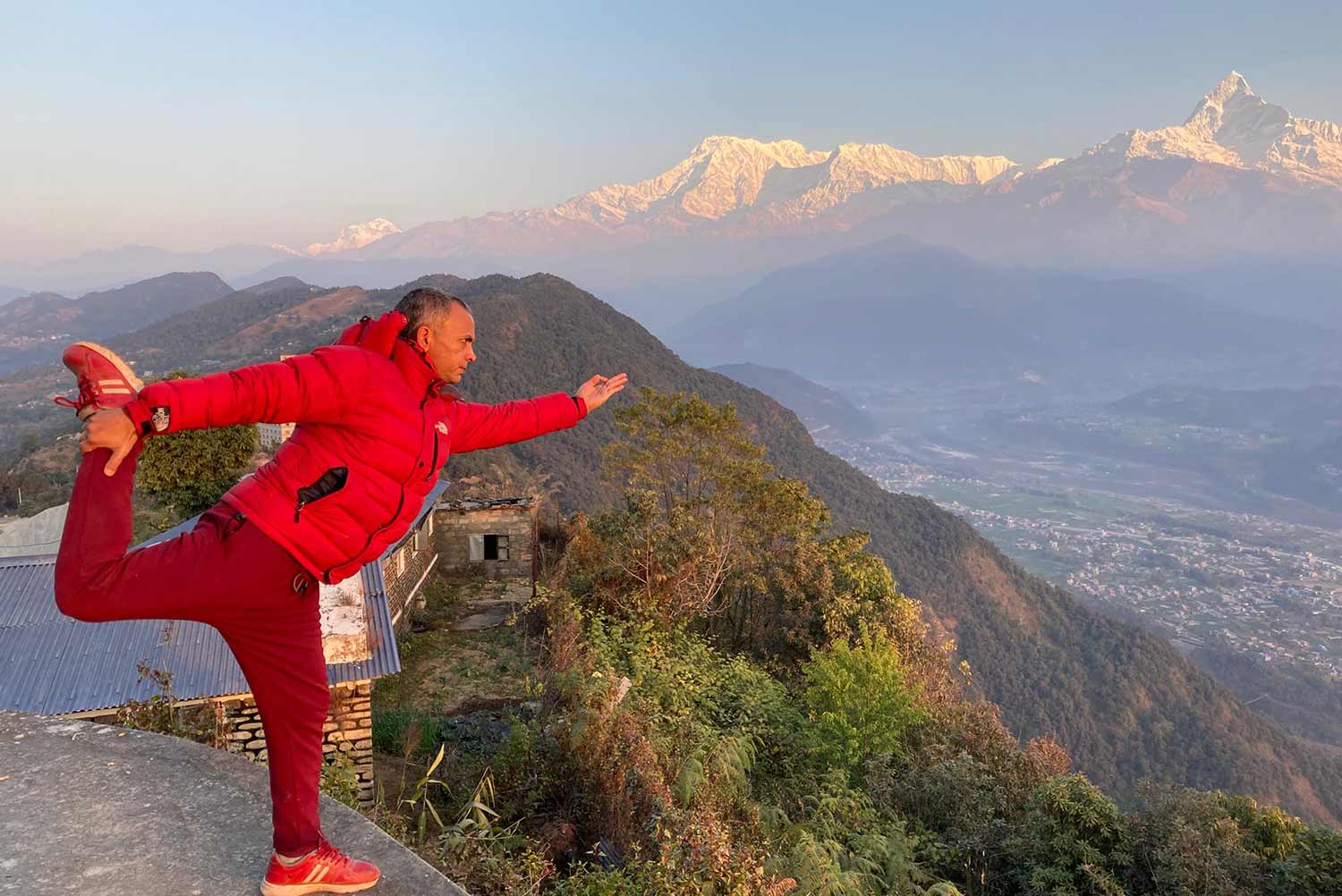
Nepal, the Himavat kshetra, holds a prime spot in world tourism, with immense potential due to its position as a major part of the Himalayan range and its high altitudes, home to some of the tallest peaks on Earth, including Mt. Everest. The Himalayas have always been known as the abode of gods, the land of sages and seers, rich in cultural and spiritual beauty, and surrounded by stunning natural scenery. Since ancient times, the mighty Himalayas have been regarded as a source of mystical energy and immense spirituality, leading people to enlightenment. It is often said that enlightenment can be achieved through yoga sadhana. Historically, Lord Shiva himself, along with various yogis and sages, practiced yoga in and around the Himalayas and attained liberation.
The trend of yoga and wellness travel is growing rapidly worldwide. In this context, Himalayan countries like Nepal can tap into this promising market for very good reasons. In addition to the activities offered to visitors in Nepal, travelers can also gain the added benefits of yoga, spirituality, and wellness. By introducing yoga and spiritual tourism, Nepal can add a new and highly potential dimension to its tourism sector, helping to elevate the tourism industry in Himalayan countries like Nepal and parts of India to a prosperous level.
Since the first ascent of Mount Everest in 1953, most people have come to Nepal for trekking or climbing. However, wellness and spiritual tourism can be another potential area to develop as an attraction, helping to boost the economy. Today, many established fashion brands produce yoga mats, clothing, and other gear. Taking this as an example, Nepal should also prioritize yoga and wellness tourism, as the country is rich in natural beauty and spiritual surroundings along the Himalayas and hills. According to the Global Wellness Tourism Economy report in 2013, “wellness tourists” spend 130 percent more than regular tourists. Elements of spirituality and its practice in the East have always gained popularity in the Western world. Yoga studios are mushrooming globally, along with a growing number of yoga practitioners.
Seeing the immense potential in yoga and spiritual tourism, some tourism enterprises are working to attract high-end tourists to a country that has long been popular among budget travelers and adventure enthusiasts. Tourism entrepreneurs believe that foreigners traveling to Nepal for wellness and spiritual journeys will spend significant time experiencing and learning about yoga and spirituality, thus increasing their average expenditure.
Gautam Buddha
Gautam Buddha (Light of Asia) was born in Kapilvastu Lumbini (Nepal) in 563 BC as the prince Siddhartha Gautam. He showed the whole world the path of peace and non-violence. Gautam Buddha has laid the foundation of Buddhism. When Gautam was born, there was a general prediction which said ,` The baby would become a great king, teacher, or a great saint.
Gautam Buddha was very kind since childhood. As a prince, he was brought up in a palace with all the comforts and luxuries possible though he realized that these things could not provide lasting happiness or protection from sufferings so, he always worried about the cause of this suffering and its solution. His father tried his best to keep his young son away from the miseries of the world. When Siddhartha was 16, his father arranged his marriage with Yasodhara. After marriage, they had a son named Rahul. Even this did not make him happy.
Suddenly, at age 29, he was confronted with the impermanence and suffering. On a rare outing from his luxurious palace, he saw somebody desperately sick. The next day, he saw a decrepit old man, and finally a dead person. He was very sad that sickness, ageing, and death will come to everyone he cared. Gautam wanted to find the truth and ultimate knowledge.
The next morning the prince walked path the meditator who sat in deep absorption. He realized that the perfection he had been seeking outside must be within the mind itself. Meeting that man gave the future Buddha, a first and enticing taste of mind, true and lasting refuge, which he knew he had to experience himself for the good of all.
Siddhartha left his palace and family to lead an ascetic life. He thought living the life of self-denial will provide him with the answers he was looking for. He travelled around looking for teachers to discover the reality of life and nature. But their teaching did not satisfy him so he set his own path.
Finally, at a place called Bodhgaya, the future Buddha decided to remain in meditation until he knew mind’s true nature and could benefit all beings. Siddhartha was calmed and relaxed. As he sat, his concentration depend and wisdom grew brighter. He looked deeply into himself and began to examine true nature of life where he discovered we born, live, and die not one time. He saw that death is only the separation of the mind from its body. After death, the importance of karma is central to the next journey. It was then he got pure enlighten. And at the moment of enlightenment, Siddhartha Gautam became a Buddha which means –“Awakened one “ or “The enlightened one .
Siddhartha Gautam gained complete insight into the cause of suffering and the steps necessary to eliminate it. He called these steps the “Four Noble Truths”. He understood the miseries of the life and death. The search of six long years has ended. It was a day when the full moon shone, casting a bright silver light on the whole countryside, a day in the month of Baisakhi (May). Then, he decided to share his knowledge with the world. Throughout his life, Buddha encouraged his students to question his teachings and confirm them through their own experience.
- He taught the world non-violence .
- He also told the people that desires of man were the root cause of all the troubles .
- In his serman he focused on Four Noble Truths –suffering, cause of suffering ,state of mind free from suffering and way to end suffering .
- He gave the message of truth ,peace ,humanity and equality .
When Gautam Buddha passed away in 483 BCE (aged 80), his followers began to organize a religious moments. Buddha’s teaching became the foundation for which later on developed into Buddhism.
Learn Yoga in Kathmandu | Best Yoga School in Nepal
Himalayan Yoga Academy (HYA) is located at one of the best locations in Kathmandu which combines the best of the city’s landscapes and provides you with the perfect ambiance for learning the fine nuances of yoga. To Learn Yoga in Kathmandu
In our academy, during our yoga courses and retreats, we teach the students traditional yoga which will bring out the perfect balance in the student’s body and mind. Students are encouraged to ask questions about themselves, what they want to achieve out of practicing yoga, and how they want to take it forward.
HYA makes sure that the best yoga with the best teachers reaches its students so that they can derive maximum benefit for self-improvisation and progress in their yogic journey faster.
We provide yoga teacher training courses, retreats, singing bowl healings and training, reiki healing, and training at HYA and are getting popular among people who get benefited from these programs. The courses are available for yoga enthusiasts who aim to deepen their knowledge of ancient practice, connect with themselves, and share their knowledge with the world.
Also, We have been training students and producing successful teachers for the past 10 years. Our school has been on the top ever since its establishment.
Join Our Yoga Teacher Training Courses
200-Hour Yoga Teacher Training in Nepal
300-Hour Yoga Teacher Training in Nepal
Join Our Yoga Retreats
Special Days/Nights Yoga Retreat
Why Yoga in Nepal?
Nepal is the land where Hindu and Buddhist philosophies merge. The nation offers a blend of yoga, meditation, and these ancient practices. The country is mountainous, filled with lakes, forests, jungles, caves, rivers, waterfalls, and other natural wonders. It provides an ideal environment for yoga and meditation. A rich culture and history of yogic meditation have been established here by thousands of Yoga Rishis. They reflected nature through their asanas since ancient times. Additionally, as a Himalayan country, Nepal is believed to be the birthplace of yogic disciplines like Hatha, Mantra, Tantra, and Shiva. It is said to have emerged from conversations held in the lap of the Himalayas between Lord Shiva (the true ‘Transformer’) and Parvati, the Hindu Goddess of fertility, love, and devotion.
Visit Nepal to Learn Yoga and fulfill your dreams in life. We will guide you in the best way possible. Your satisfaction and learning are our happiness. Join the Best Yoga School in Nepal.