
Concepts of Tourism
Different people undertands tourism from different aspects and they define tourism from their own perspectives. Some of the very common concepts of tourism are discussed below.
Tourism as a Social System
The approach tries to study tourism from a social perspective. Although tourism is an individual human experience, it is usually shared with other people. A tourist is a person from another culture who does not belong to the visiting society. They come in contact with local people and social institutions. The socialization process may be short, informal to intense interpersonal interaction. Friendship may be formed or conflicts may be created.
Tourism as Resource
Many communities, local governments, and even the central government prefer to define tourism as a resource. The most common saying is that ”a tourist brings money”. Their tourism management is related to revenue management. Local bodies and communities are interested in adding tourism to their system, because of its potential to bring money from other regions with minimal effort and environmental impact. Tourism can also be a positive force for the preservation of local sites, festivals, traditional skills, and cultural activities.
Tourism as a Business
This is the most popular approach among businessmen and people who work in the tourism industry. Under this approach is treated as business. According to this approach, tourism is related to improving business efficiency, marketing, and improving manpower.
Tourism as an Industry
This approach believes that tourism is not just several thousand businesses. It is an industry. It is a group of several related industries: transportation, accommodation, food service, attractions and events, and many retail activities.
HATHA YOGA PART 2
GHERANDA SAMHITA BY MAHARSHI GHERANDA (HATHA YOGA/ SAPTANGA YOGA / GHATASTHA YOGA): –
Further about HATHA YOGA PART 2 The Yoga taught in Gheranda Samhita is called Saptanga Yoga; Sapta + Anga = Sapta- 7 and Anga – Parts/ Steps/ Limbs, whereas in Goraksha Ashtakam taught by Gorakhnath is called Shashtanga Yoga, six limbs of yoga.
EkadaaChandrakaapaalirgatvaagherandakuttiram! PranamyaVinayaadbhaktyagherandampariprichchhati!! –
Meaning: Once, king Chandrakaapali went to the hermitage of sage Gheranda and, after prostrating before him with due humility and devotion, ask him a question.
CHAPTER-1: SHODHANAM (SHATAKARMA)- purification
“shatakarmananshodhanam” – a state of purification is achieved
*Neti *Dhauti *Nauli
*Basti *Kapalbhati *Trataka
CHAPTER-2: DRIDHATA (ASANA)- unshaken
“asanenabhaveddridham” – firmness is achieved by practicing Postures
1.Siddhasana 2. Padmasana 3.Bhadrasana 4.Muktasana 5.Vajrasana 6.Swastikasana 7.Simhasana 8.Gomukhasana 9.Veerasana 10.Dhanurasana 11.Mritasana 12.Guptasana 13.Matsyasana 14.Matsyendrasana 15.Gorakshasana 16.Paschimottanasana 17.Utkatasana 18.Sankatasana 19.Mayurasana 20.Kukutasana 21.Koormasana 22.Uttan-kurmasana 23.Mandukasana 24.Uttan-mandukasana 25.Vrikshasana 26.Garudasana 27.Vrishasana 28.Shalbhasana 29.Makarasana 30.Ushtrasana 31.Bhujangasana 32.Yogasana
CHAPTER-3: STHAIRYAM (MUDRA)- steadiness
“mudrayaasthirataachaiva”- stability is achieved
Bandha (Locks)-4- MOOLA BANDA; JALANDHARA BANDHA; UDDIYANA BANDA; MAHA BANDHA
PanchaDharana (Five Concentration practice)-ParthiviDharana(concentration on earth), AmbhasiDharana (Concentration on Water), AgneyiDharana (Concentration on fire), VayviyeDharana( Concentration on Air), AkashiDharana ( Concemtration on Space);
Mudras-16
MahaMudra; NabhoMudra KhechariMudra
MahaBhedaMudra VipareetkaraniMudra YoniMudra
VajroniMudra ShaktiMudra TadagiMudra
Manduki Mudra Shambhavi Mudra Ashwini Mudra
Pashinee Mudra Kaki Mudra Matangini MudraBhujanginiMudra
CHAPTER-4: DHIARYAM (PRATYAAHAARA)- patience or unaffected by situations
“pratyaahaarenadheerata” – patience is achieved(Withdrawal of senses / mind Ethics):
*Yoga Nidra (Yogic sleep):- 15-30 minutes – It is an art of physical, mental and emotional preparation.
*Use of six senses: Mind-restless under self; Eyes-looks- under soul; Ears– words- under control; Skin– cold-heat- under control; Nose-fragrant-under control; Tongue– tastes- under control.
CHAPTER-5: LAGHAVAM (PRANAYAMA) – lightness
“praanaayaamaallaaghavam“ – lightness is achieved*Sahit *Suryabhedi *Ujjayi *Sheetakar
*Bhashtrika *Bhramari *Moorchha *Kevali
CHAPTER-6: PRATYAKSHAM (DHYANA)- to see inner experience
“dhyaanaatpratyakshamaatmanah” – self realization is achieved
One pointed awareness, ekagrata, of an object without any obstruction is dhyana.
*Sthula Dhyana (Gross Meditation) – Dhyana Moolam Guru Murti; Image; Symbols; Chakra
*JyotirDhyana(meditation full of light) – TejoDhyana; PranavaDhyana
*Sukshma Dhyana (subtle Meditation) – it is extremely secret and true meditation
CHAPTER-7: NIRLIPTAM (SAMADHI)- a state of being unattached
“samaadhinaanirliptam” – a state of non-involvement is achieved
*Dhyana YogaSamadhi-shambhavimudra
*Nada YogaSamadhi – BhramariMudra
*Rasa YogaSamadhi – KhechariMudra
*Laya YogaSamadhi– YoniMudra
*BhaktiYogaSamadhi – Deity
*Mano-murchhaSamadhi – Mano-moorchhamudra
Staying Hydrated
Why our Body Needs Water
Improving health and wellness can take many different forms. For example, you might start a new workout regimen, take up meditation, go vegan, or give up alcohol. But smaller changes can be equally important, and one habit that impacts the body in big ways is staying hydrated.
Why is it so critical? Severe dehydration can cause kidney and brain damage (and is even fatal), though it’s unlikely outside of extreme circumstances. However, even mild dehydration can lead to lethargy, headaches, moodiness, poor concentration, and inhibited physical performance, among other problems. Let’s take a look at the specific roles of water in the body.
Cardiovascular Health
Blood, which is over 90 percent water, is used to transport oxygen and nutrients to different parts of the body. But when you’re dehydrated, your blood volume is lower. Your heart then has to work harder to pump blood through the body, increasing your heart rate. Not only do oxygen and minerals not reach different parts of the body efficiently, but this puts strain on your heart as well. It’s also part of why dehydration makes physical activity more difficult.
Muscular Performance
Dehydration also impairs physical activity through its effect on muscle cells. When these (and other) cells aren’t sufficiently hydrated, they don’t work as well. As a result, you’ll experience muscle fatigue sooner and won’t be able to exercise as long or as hard as you can when hydrated.
Temperature Regulation
When the body heats up, due to either exercise or weather, blood vessels near the skin expand and water stored in the body is released as sweat. Without sufficient water, the blood vessels expand less and you sweat less, meaning your body won’t cool down.
Waste Removal
The kidneys and liver need sufficient water to filter waste from the blood and excrete it through urine. The digestive system also requires adequate fluids to process food, and staying hydrated helps prevent constipation. If you get dehydrated, your body won’t be able to cleanse itself or flush out bacteria.
Headache Prevention
For some people, dehydration can trigger or exacerbate headaches. When the body is dehydrated, the brain temporarily contracts and pulls away from the skull, causing a headache. Dehydration headaches can be dull and mild, but they can also take the form of intense migraines. If you’re prone to headaches, staying hydrated is especially important.
How to Stay Hydrated
Even if you’re aware of the many benefits of hydration, getting enough water can still be a challenge. Commit to drinking a full glass of water with each meal or snack, and drink a glass of water for each other beverage you drink. To drink more throughout the day, try keeping a cup or bottle of water in your workspace and carrying a water bottle whenever you go out. If you don’t like the taste of water, infusing it with fresh fruit or herbs will give it some flavor. The easier and more convenient it is for you to drink water, the more likely you’ll be to get enough of it.
Mohare Danda Community Eco Lodge Trek
Mohare Danda Community Eco Lodge Trek, which is 3300 m high lies in the gorge between the Dhaulagiri & Annapurna mountains of Myagdi district. It is termed the best destination for tourists. This trek is the alternate destination for Ghorepani Poon Hill. It is 3 km far from the popular trekking destination the Mohare Danda Trek. Moreover, the difficulty level of this trek is moderate. So, ordinary people could experience its trekking trails and can enjoy it with a group of friends as well as family.
Mohare Danda itself is situated along the world’s deepest gorge at an elevation of 3300m. It offers the trekkers incredible panoramic views of the Annapurna and Dhaulagiri ranges respectively. From this trek, anyone can enjoy the closest view of the sunrise and sunset, which definitely will be an enjoyable experience to grab. This trek is the opposite of the Poon Hill Trek, as there are fewer crowds compared to Poon Hill Massive Crowds.
Mohare Danda community eco-lodge trek is one of the newly discovered trekking trails in Nepal. This trek offers scenic beauty, a serene environment, and tons of adventures. ‘Eco Lodge Community Trek’ and ‘Myagdi Community Eco Trek” are the names with which Mohare Danda can be recognized worldwide. You will be exposed to remote villages filled with orange trees, bamboo, rice terraces, and many more along with passing by yak herders, and goats.
Best Time to Visit Mohare Danda Community Eco Lodge Trek
Spring season (Mar-May) and autumn season (Sept-Nov) are the best time of the year for trekking in Nepal. These times of year have moderate and comfortable temperatures, clear skies with no clouds, and pretty low chances of rain. Photography will be best in these seasons.
However, each month of the year portrays peculiar Landscape and pleasant environment. Spring undoubtedly is Nepal’s first peak season for heading towards trek and known to be attracting more number of tourists. The Mohare Danda trail passes through the laps of hills, mountains, forests, rivers and much more. Spring season will expose you to the variety of Green vegetation as it is known as ‘Blooming Season’. February to April is the time where the forest is decorated with colorful rhododendron and depicts an eye-catching view to the visitor. This time can be marked as Rhododendron trekking.
Trek Highlights :
- Opportunity to observe the place, Mixed with Traditional and Modern facilities.
- You can observe the two nearest viewpoints in 1 trek Mohare Hill and Poon Hill.
- Best Community Lodge and peaceful Homestay accommodation trek.
- Mohare Danda Trek is also known as ‘Eco Lodge Community Trek’ and ‘Myagdi Community Eco Trek.”
- You can enjoy the sweet fragrance of different species of flowers
- Experience Scenic drive along the bank of Trishuli and Kali Gandi river.
- Best Eco Community lodges trek with a friendly environment with great hospitality and experience
- Walking on paved trails and through dense, colorful Rhododendron forest
HATHA YOGA Part 1
Hatha Yoga means “Power of Body” or “Harmony of Body” or “Discipline of Body”
Major Texts of Hatha Yoga are:
1. Hatha Pradipika By Yogi Swatmaram
2. Goraksha Samhita By Yogi Gorakhanatha
3. Gheranda Samhita By Maharshi Gheranda
4. Hatharatnavali By Srinivasabhatta Mahayogindra
Initially, the discipline of Hatha Yoga —the physical aspect of yoga—was developed as a vehicle for meditation. The repertoire of Hatha yoga prepared the body, and particularly the nervous system, for stillness, creating the necessary physical strength and stamina that allowed the mind to remain calm. The word Hatha also has several translations.
With ha meaning “sun” and tha meaning “moon,” we have the common interpretation of Hatha yoga as “a union of the pairs of opposites.” A more technical translation of Hatha yoga is “force’ “determined effort.” or “dedicated practice”. Thus hatha yoga, the “yoga of activity,” is the yoga that addresses the body and mind and requires discipline and effort. It is the yoga that we can feel, that we can experience, right here and right now. Hatha yoga is a powerful method of self-transformation.
It is the most practical of the yogas, and sages have recommended its practice in some form for millennia as preparation for all the other yogas in beginning levels to higher levels.
Lineage of Hatha Yoga / Natha Cult:
Aadinatha Shiva Hiranyagarva Jalandhar Matsyendranath Gorakhanath Gherandnath Gopi Chandra Bhartuhari Swatmaram
MAJOR FOUR TEXTS OF HATHA YOGA
HATHA PRADIPIKA –BY YOGI SWATMARAM
Chapter-1:- ASANA: 15 1.Swastikasana 2.Gomukhasana 3.Veerasana 4.Koormasana 5.Kukutasana 6.Uttan-kurmasana 7.Dhanurasana 8.Matsyendrasana 9.Paschimottanasana 10.Mayurasana 11.Savasana 12.Siddhasana 13.Padmasana 14.Simhasana 15.Bhadrasana
Chapter-2:-SHATAKARMA and PRANAYAMA:-
Shatakarma (Six cleansing Acts) as a Preparatory Phase of Pranayam:
*Neti *Dhauti *Nauli *Basti *Kapalbhati *Trataka
Pranayama: – 8
1. Suryabhedi 2.Ujjayi 3.Seetali 4.Sheetakari
5.Bhashtrika 6.Bhramari 7.Moorchha 8.Plavini
Chapter-3:- BANDHA AND MUDRA: 10
1. Mahamudra 2.Mahabandha 3.Mahabheda 4.Khechari 5.Udddiyana Bandha 6.Moola Bandha 7. JalandharaBandha 8.Viparit-karani 9. Bajroli 10.Shaktichalana
Chapter-4:- NADANUSANDHANA (Stage of Dhyana and Samadhi):
1. Aarambhavastha (beginninhttps://himalayanyoganepal.com/200hr-yoga-teacher-training-course-nepal/g stage) 2.Ghatavastha (Vessel stage)
3.Parichayavastha(stage of increase) 4.Nispattivastha (stage of consummation)
Kundalini Yoga Part I
INFO: KUNDALINI YOGA
Kundalini Yoga is an ancient art and science compiled by Shiva in Tantra Yoga dealing with the transformation and expansion of consciousness, the awakening and raising of Kundalini power up the spine through energy centers called Chakras.
Kundalini has many root words. The word “Kunda” in Sanskrit literally means a pit in which to burn trash. This could be interpreted symbolically as a fire used to burn up one’s attachments, helping the mind to become more pure. “Kundalin” means serpent is identified as a goddess named Kundalini Shakti. Shiva and Shakti that means Shiva stands for consciousness and Shakti stands for goddess power of divine.
The Sanskrit word “Shakti” means divine energy. So Kundalini is the power, the feminine aspect of the divine. Kundalini Shakti is said to uncoil herself to move upward through the chakras and stir up dormant energy within the aspirants.
Many people understand that Kundalini yoga is a type of yoga. But, Kundalini Yoga is itself a totality of yoga, not a type of yoga. Any means of yogic kriyas activates for generating prana (Life force) through Nadis (energy channels) and Chakras (Energy Centers), that life force as feminine power is called Kundalini. However, the spiritual aspects of asanas and other physical acts are associated with Chakras, which is also called kundalini Yoga. Some dynamic physical acts or breath activates the Chakras also called Kundalini but it does not have wholesome meaning. Eventually, the final stage of yogic transformation through all types of yoga is called Kundalini.
Kundalini yoga is practiced through:
1. Physical practices like some dynamic, surya namaskar, and asanas practices
2. Bandha, mudras and pranayama
3. Deviya mantras as bhakti yoga,
4. Divya or beej mantra as Mantra dhyana yoga,
5. Sound/singing bowl healing
6. Chakra elements
7. Chakra colours
8. Pranava Mantra
9. Unmani -rotation of awareness via chakras
10. Symbol concentration
By any means or any keys, physiological changes are as:
1. Inner rest, relaxation, peace, and purity
2. Deep concentration
3. Activation of chakras
4. Awakening kundalini
5. Expansion of consciousness
6. Liberation cum isolation.
The activation, balancing of the chakras and awakening kundalini is accomplished by the mixing and uniting of Prana (cosmic energy) with Apana (eliminating energy) which generates pressure to force Kundalini to rise, by means Asans (postures), Pranayama (breathing exercises), Bandhas (body locks), in kriyas (exercise sets), , mudras (gestures), and Mantras (sacred sounds) and different keys for meditation.
Why consider Yoga Teacher Training?
The world is a mysterious place. We live and continue living until we become fatigued. But according to yoga we should live a life where we go on living and living but never fatigued, we should enjoy every moment that we live. This type of thing is the morals or gist that we learn through the path of Yoga. Hence Yoga Teacher Training provides us with a deeper meaning of life and helps us attain enlightenment in the sense of health and happiness. So like why get this training or Why consider Yoga teacher training?
1. Learn about Healthy Yogic Alignment:
The Yoga Teacher Training offers you great opportunities and chances to learn different techniques over and beyond what you learn in the regular yoga sessions in the world. This type of training is the stage for you to learn how to tune in with your body. You will not only learn how to make a stronger body but also develop and sharpen your body and mind connection pairing them to work together in every action.
2. Self-Esteem & Self-Confidence Development:
Learning new things in this world challenges you in an inspiring way. Many people are highly afraid of challenges and as such will rather not want to exert themselves in it. However, if you take up the challenge and face your fears, you open yourself up to new experiences and a new yourself. The Yoga Teacher Training creates an environment where you can stand up to your fear, knowing that fear is a normal sensation that can be tuned. The training helps you discover your inherent or hidden strength that can rise above your fears.
3. Discover new and exciting things about yourself:
The Yoga Teacher Training creates the needed environment for self-awareness and self-reflection. Self-awareness is very powerful for understanding yourself in a better way. When you are in tune with your body and inner self, you are able to make the positive changes you need to reflect your true self.
#YogaTeacherTraininginNepal #YogaRetreats
# YogaTeacherTraininginNepal
#YogainNepal #VisitNepal2020
Hotels around Annapurna Base Camp to be re opened from August 18
Himalayan Yoga Academy shares essential information on Hotels around Annapurna Base Camp to be re opened from August 18.
The tourism entrepreneurs have informed us that the construction work of the hotels around Annapurna Base Camp has been completed and they will re-open on August 18 of this year.
All the hotels of the Hotels were shut down due to the heavy snowfall which had destructed the hotel and after its construction it will be operated from 18th of August. Hotel entrepreneur of Annapurna Base Camp JB Gurung said that there was delay in the construction work as there was difficulty in bringing the materials required and they had to bring the necessary materials through donkeys, helicopters and potters.
All hotels in the area had been shut down since March this year following heavy snowfall, which destroyed four hotels in the area beyond repair, said Gopal Shrestha, a spokesperson for the Trekking Agencies’ Association of Nepal (TAAN). Around 4 million rupees have been invested while re-constructing the hotels.
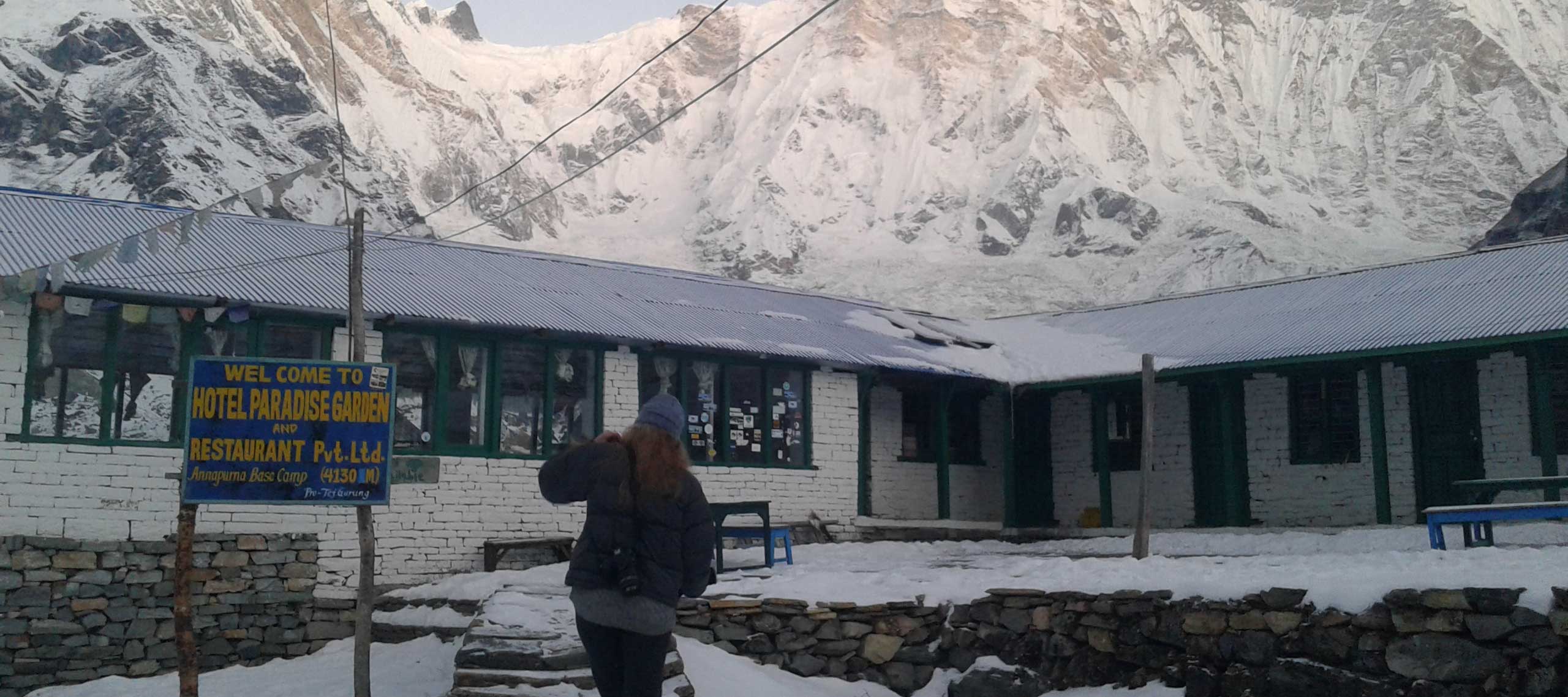
According to TAAN, trekkers had to find accommodation and food at Machhapuchhre Basecamp before heading to Annapurna. With the opening of the hotels, trekkers can directly go to Annapurna Base Camp. A hotel in the area can accommodate up to 50 people during the peak season.
Foundations for Yoga Teacher Training Course in HYA
Introduction: Foundations for Yoga Teacher Training Course in HYA
Yogah, a Sanskrit word is a state of no mind level. “Yoga is gaining popularity in all parts of the world but the understanding levels of the public is different. It is considered a modern physical exercise, and even Yoga practitioners and Instructors misunderstand the truth. Yoga is not done but is achieved after dedicated practice regularly.
Yoga normally represents different means or techniques, known as yogic kriyas. Yoga is saadya, achieved from sadhana (Spiritual Practice) of Saadhaka (Practitioner). Saadhaka uses sadhana (Means) for union or harmony which is one level of the goal of the yogic journey. On the yogic level, it is the boon of sickness. It is the fashion of the day for fitness for common people. A restless mind converts into solace. It is the intelligence project for memory, creativity, and consciousness for some levels of people. It is the spiritual sadhana for yoga or Samadhi.
Objectives of the Yoga Course :
Understanding of Yoga
Definitions of Yoga
Application of Yoga
The Root of Yoga:
The term Yogah has its verbal root is ‘Yuj’ in Sanskrit. Yuj means to join. Yujyate anena iti yogah”. Yoga is that which joins more than two issues, two energies, and two existences for oneness. In the spiritual sense, it is the joining of Jivatma (Lower self/ individual self) and Paramatma (Higher self /Universal self). It is an expansion of the narrow constricted egoistic personality to an all-pervasive, eternal, and blissful state of truth.
Paatajala Yoga Darshana is one among the six systems of Eastern philosophy known as Shatadarshanas. One of the great Rishis/ Seer named Patanjali compiled the essential features and principles of yoga in the form of sutras (aphorisms) and made a great contribution to the field of Yoga and spiritualism. According to Patanjali, Yoga is the union of conscious processes of gaining mastery over the mind.
The first reference sacred text of Yoga is Rig Veda which is the first sacred text of the World. Bhagavad Geeta and Upanishads portrayed the scope of yoga as a more comprehensive approach. Generally, there is a growth process due to interactions with nature in all creations. Man, endowed with discrimination power, conscious thinking faculty, the mind, wisdom, and well-developed voluntary control systems, aspires to accelerate his growth in his entirety. Yoga is that systematic conscious process that can compress the process of man’s growth greatly.
Definitions: Foundations for Yoga Teacher Training Course
The only authentic and common definition in Yoga Darshana by Patanjali is “Yogashchittavrittinirodhah”, and the cessation of mind fluctuations in chitta is Yoga. The easy way to understand yoga is a state of processing of gaining control over the mind. By so controlling the mind we reach our original state and then the seers establish themselves in their causal state. These are the techniques of mind control prescribed by Maharshi Patanjali.
In action, Yoga is a special skill that makes the mind deepen its subtler state: “Yogah Karmashu Kaushalam” –B.G.-2.50.Yoga is the dexterity in action. The dexterity is in maintaining the process of body and mind relaxation and awareness in action. Efficiency in action is its outcome. Yoga is a skillful science of gaining mastery over the mind.
Application of Yoga:
Yoga is a completely experimental science, but not a physical approach. Physically just 10% is a practical approach and the rest ethical, literal and entirety experiment and also acknowledging experiment, self-realizing process, etc.
The traditional paths for Yoga experiments are Hatha yoga, Mantra Yoga, Laya Yoga, and Raja Yoga; similarly Karma Yoga, Bhakti Yoga, Jnana Yoga, and Dhyana Yoga. Ashtanga and Kundalini are their modified and integrated versions. Ultimately Ashtanga is itself the totality of Yoga; it is not one path or type of yoga.
Various Highlights of the Yoga teacher training in Nepal :
- Alignment correction
- Prayer as chants in Bhakti yoga, ethical ways of yoga
- Warm-up exercise
- Stretching phase
- Postures,
- Bandhas as physical discipline
- Pranayamas, Mudras
- Yoga Nidra, for ethical mind as a bridge to enter
- Meditation as Dhyana yoga with hundreds of techniques
Janai Purnima
Janai Purnima is a Hindu festival celebrated on the full moon day in the month of Bhadra according to the Hindu lunar calendar. On this day, Hindu men from the Brahmin and Chhetri communities take their annual ritual bath and change their “Janai” or sacred thread while people throng Shiva temples in different parts of the country. This day is also celebrated as Raksha Bandhan with people from different communities tying “Doro”, a sacred thread, around their wrist to protect themselves from disease and fear.

The Newar community, meanwhile, celebrates the day as Gunhi Punhi where they have family gatherings. They prepare a special dish called Kwati (a soup made from a mix of nine different types of sprouted beans) and other delicacies.
It is also a great opportunity to observe the ancient shaman culture of Nepal. The shamans of the Kathmandu Valley and other parts of Nepal gather to perform their ancient rites in places like Kumbeshwar in Patan, Gosainkunda in Langtang, and Charikot in Dolakha.
#VisitNepal2020 #NepalNOW #LifeTimeExperience #OnceIsNotEnough #JanaiPurnima #rakshyabandhan #Nepal #Festival #Culture #Nepaltradition #YogainNepal #YogaTeacherTrainingNepal #YogainHimalayas