
ALL ABOUT GOMUKHASANA
Gomukhasana is a seated yoga posture that stretches several parts of the body simultaneously, including the ankles, hips, thighs, shoulders, underarms, triceps, and chest. The name comes from the Sanskrit, ‘Go ’ means “cow,” mukha means “face,” and asana, meaning “pose.” It gives good cross-stretch in chest muscles.
Gomukhasana is one of the classical yoga poses explained in Hatha Pradipika. The concept of static stretching in the practice of asanas in the Curriculum of Classical Hatha Yoga is helpful for the stabilization of the muscles without creating strong forces of resistance by the joints in the body because of the use of isometric contractions.
The asana, whose name literally translates into Cow Face Pose, has helped a lot of people who are fighting a variety of conditions such as diabetes, back and shoulder issues, and sexual disorders. This is one of the best asanas to restore symmetry and postural health. It is wise to have this in your practical Yoga Training Session. The final position of the pose assumes the shape of the face of the cow, hence it is called as Cow face pose.
How To Do Gomukhasana
- Sit in Samasthithi. Even though Gomukhasana is a beginner’s and easy yoga pose, it’s better to do it step by step. So, the steps of Gomukhasana are: Exhaling, bend the right knee and place it on the left knee so that the right sole touches the left hip, Inhale. Exhaling bend the left knee so that, left sole touches the right hip.
- Inhaling raises the right arm and interlocks the fingers with the left hand from a backside.
- Sit straight and keep your back straight, and legs forward.
- Now bend your left leg gently and place it under your right hip.
- Then gently bend your right leg and cross it over your left leg. Your knees should be placed close and on top of each other.
- Keep your head and back straight while practicing it.
- Now bend your left hand and slowly place it behind your back from downwards.
- Then bend your right hand and also place it at your back from upwards (over your right shoulder).
- Then stretch your right hand downwards until it reaches your left hand. This might not be easy for people who are not flexible, but you’ll learn to do it gradually.
- Now hold this pose for 30 to 60 seconds.
Anatomy
Gomukhasana benefits the following muscles and hence can be included in yoga sequences with the corresponding muscle(s) focus: Arms and Shoulders, Middle Back, Upper Back, Biceps and Triceps, Hamstrings, Hips, Knees, Pelvic Quadriceps.
Benefits of Gomukhasana
- Gomukhasana can relieve your anxiety and stress and make you a better, healthy person. The rhythmic breathing patterns that are associated with this asana can offer you great mental and emotional benefits.
- Stretches your shoulders, thorax, ankles, triceps, and thighs.
- Makes your back flexible.
- Relaxes your body and mind.
- Helps people with diabetes by enhancing your kidneys.
- Reduces anxiety and stress if practiced regularly.
- Helps in pressure relief. Performing Gomukhasana regularly can help the practitioner attain the perfect posture. This asana can stimulate the spine, chest muscles, and shoulders to improve the body’s natural posture.
- Gomukhasana can prove to be extremely helpful in curing sexual ailments by stimulating blood flow and easing stiffness from lower parts of the body. It also helps in relieving stress.
- Makes your shoulders loosen up, cures stiff shoulders. This asana induces a deep state of relaxation.
- Brings the peace of mind and serenity, concentration.
- Helps in relieving the stress and the tendencies of the anxiety.
- Good for improving the strength and flexibility of the shoulder joints through the actions of deltoids and rotator cuffs. This helps in preventing the drooping and frozen shoulders.
- Strengthens the spinal column and relieves back and neck pain.
- Expansion of the chest enhances the lung capacity.
- Stimulates the peristalsis and relieves the digestive disorders. Promotes the range of motion of the hips joints and the flexibility of the muscles in the pelvic girdle.
- Promotes the health of the reproductive organs.
- Brings good postural health.
- The neck and the lower back are the prominent sites of the parasympathetic nervous system. This pose particularly brings the elasticity in these two regions, which helps bring the deep state of relaxation, and hence it is helpful in the reduction of blood pressure. It makes the preparation of the mind for the practice of meditation.
Contraindications and limitations
- It is not advised for people with chronic injuries of the knees and shoulder joints.
- Release your hands, and unfold and straighten your legs to come back to the starting position.
Preparatory poses for Gomukhasana
Try practicing these yoga poses before doing Gomukhasana to prepare your body for Gomukhasana.
- Virasana
- Baddha Konasana
- Supta Baddha Konasana
- Supta Virasana
- Upavistha Konasana
- Supta Padangusthasana
- Badha Konasana (Bound Angle Pose)
- Upvistha Konasana (Wide-angle seated forward bend)
- Supta Virasana (Reclining hero pose)
- Virasana (Hero Pose)
- Supta Padangusthasana (Reclined Big Toe Pose)
- Supta Baddha Konasana (Reclined Bound Angle Pose)
Gomukhasana Precautions
Please take care of these things before and while doing Gomukhasana.
- Avoid practicing Gomukhasana if you’ve back injury.
- You should always practice yoga on an empty stomach only.
- If you’ve knee pain, neck pain, or shoulder pain, then don’t practice it.
- If you can’t clasp your fingers then just stretch your hands at the back. With time, you’ll become flexible enough to practice Gomukhasana perfectly.
- You should practice this yoga pose under the guidance of a yoga instructor.
So, guys, this was all you needed to know about Gomukhasana. It is very beneficial and a great yoga pose for everyone if practiced daily.
DISTANCE REIKI HEALING FOR COVID-19
Here we present an insightful article on DISTANCE REIKI HEALING FOR COVID-19. Reiki is a universal healing system initiated with the existence. This healing system is now a world-renowned Japanese healing technique that promotes the body’s relaxation response and natural healing ability, and is accepted globally. Reiki practitioners use a technique called palm healing or hands-on healing through which a “universal energy” is said to be transferred through the palms of the practitioner to the patient to encourage emotional or physical healing, and also distance reiki healing through symbols, mantras, vibes, and aura energy to far away as well.
Reiki channels positive energy into a person, pet, place, relationship, or situation. It can be directed to the past, present, and future: surgery, test, meeting, interview, audition, court case, etc. Reiki doesn’t depend on belief and will work whether you believe in it or not. Many people have connected with us for their long withstanding health, financial, emotional issues, and have got immense relief.
A spiritual check-in might include releasing old energy, realigning with your purpose, or just taking a beat to be instead of do. If you need some spiritual support, many of our favorite intuitive and energy healers are currently offering distant sessions by phone. And there’s no need to worry that you’re getting a truncated version of their abilities; most good healers can connect without being with you in person and are used to working virtually with their clients. But always ask questions if you need more clarity.
An unseen power in the universe is working for universal existence. As the appearance or creation of the world, something energetic is working around us. Each creature or being is directly or indirectly, this way or that way, less or more connected to universal power. The application of this supreme power or universal power was considered as spiritual saadhanaa (Practice) in ancient times, latterly was also used for spiritual healing and Pranic Healing. They used this power to save righteousness and to destroy the devils or unrighteousness. It was also used for blessing and empowering devotees.
Reiki system: Second level for Distance Healing
Second Degree: This Distance Reiki Healing technique includes practicing telepathy, third eye activation, hypnosis, and advanced mind technologies. It also involves working with lights, colors, visions, and auras, as well as chanting mantras, using psychic symbols, and engaging with Vajra-van. All physical, mental, and emotional forces are actively harnessed and developed throughout the practice.
Healing Health & Spiritual Benefits of Distance Reiki Healing
- Increase energy flow throughout the body, enhancing personal health and aliveness
- Promote one’s ability to be present in the moment
- Strengthen energetic, psychic, and intuitive awareness while facilitating spiritual growth
- Handle stress better
- Improve relationships
- Heal faster, relieve side effects
- Build a deeper understanding of communication and connection by means of touch
- Facilitate energetic healing on a physical, emotional, psychological, and karmic level
- Receive powerful, healing Reiki energy continuously, 24 hours/day
- Feel better physically, mentally, emotionally, spiritually, energetically
- Weight loss, Build Confidence, Improve relaxation, and Sleep Quality
- Aids in coping with grief, trauma
- Assist with peaceful passing for someone dying
- Feelings of peace, security, well-being
- Increase clarity, purpose, joy, health, happiness, abundance
- Relieves pain and discomfort
- Reduces Stress and anxiety and Overcome depression/emotional healing
- Strengthens the immune system and Balances energy and chakras
- Relationship healing and financial healing
Nothing needs to be “wrong” for you to receive Reiki. It can help you feel good and stay well when you’re already fit and healthy.
You may make the session your own, consult Swami Yog Subodh, an advanced Source Point Therapy practitioner. It is an approach to healing that uses a body-scanning technique to release energetic blockages found in our field. Swami does energy work using her blueprint for human health. He works on releasing blocks in your system to restore order and balance, and helps you create more space for yourself. Be as interactive as you want—ask questions, or let you sit back and enjoy the experience. (You can even take a nap, if that’s what your body craves.) At this time, Guru’s sessions are pro bono for anyone working on the front lines and for people who have been diagnosed with COVID-19.
During this pandemic, COVID-19 has affected everyone, forcing people into lockdown at home. As a result, they feel mentally weak and fearful of the situation. They lose their immunity moment by moment and struggle to find effective solutions or ways to get relief. In these difficult times, people actively seek emotional, mental, spiritual, and even physical support to overcome this global crisis.
Send full name of person who’ll receive Reiki. I’ll send Reiki as general, overall healing to any/all areas requiring healing; OR to a specific issue or area of concern, if you request.
Day time, evening and weekend sessions available
NOTE: Your order delivery will be when the Reiki starts, not when it ends.
Psychological And Yogic Counseling for COVID-19 Infected Ones
Here is a useful blog on Psychological and Yogic Counseling for COVID-19 Infected Ones. Corona viruses are a large family of respiratory viruses, appears as seasonal flu, known to cause illness ranging from the common cold to more severe illnesses such as Middle East Respiratory Syndrome (MERS) and also Severe Acute Respiratory Syndrome (SARS) mostly suffer to those who have poor immunity, poor mentality, poor activity, and chronic illness one.
What is COVID-19?
The COVID-19 pandemic is an unprecedented health crisis on a global scale. Since early 2020, it has put tremendous strain on healthcare systems, disrupted economies, and halted large parts of social life in many countries around the world. In a race against the fast spreading virus and rapidly increasing patient numbers seems like swine flu.
Symptoms of the Coronavirus
The common human coronavirus causes symptoms similar to the common cold. Coronavirus symptoms (very common flu-like) are:
- Coughing/Sore throat
- Runny nose
- Headache, sometimes vomiting, sensation of tastelessness
- A general feeling of being unwell and tiredness
- High temperature, body ache
- Breathing difficulties, heaviness
Human coronaviruses can sometimes cause lower-respiratory tract illnesses, such as pneumonia or bronchitis. This is more common in people with cardiopulmonary disease, people with weakened immune systems, infants, and older adults. Symptoms usually appear between 2 and 10 days after contracting the virus.
COVID-19: Transmission Mode
Human coronavirus is most commonly spread from an infected person to others through:
- The air is spread by coughing and sneezing
- Close personal contact, such as touching or shaking hands
- Touching an object or surface with the virus on it, then touching your mouth, nose, or eyes before washing your hands
- Rarely, fecal contamination
Most people will get infected with one or more of the common human coronaviruses in their lifetime. It is a kind of seasonal flu, but sometimes it will be dangerous to the people who have no natural immunity, i.e. immune. Young children are most likely to get infected. However, people can have multiple infections in their lifetime.
COVID-19 Protective Measures
There are currently no vaccines available to help protect against human corona virus infection. But remember everybody has most powerful vaccine within the body that is the natural immune.
Measures to Apply
- Wash your hands often with soap and water for at least 20 seconds, and also wash your face, including your ears.
- Cough or sneeze into your bent elbow, not your hands.
- Avoid touching your eyes, nose, or mouth with unwashed hands.
- Limit social gatherings and time spent in crowded places.
- Avoid close contact with someone who is sick.
- Clean and disinfect frequently touched objects and surfaces.
- If you have cold-like symptoms, you should stay home while you are sick.
- Cover your mouth and nose with a tissue when you cough or sneeze, then throw the tissue in the trash and wash your hands. Reduce your Mask wearing duration if possible, don’t use in house and when you walking in nature, while playing, or doing exercises.
- Be especially careful in busy public transport systems about touching things and then touching your face.
- Do not share snacks from packets or bowls that others are dipping their fingers into.
- Avoid shaking hands or cheek kissing.
- Regularly clean commonly used surfaces/devices you use (cell phone/keyboard).
- Do regular exercises, especially Yogic means and kriyas. Once break, sweat if possible, 12 minutes to 48 minutes walk. If possible 12 minutes ladder or steps up-down like in hills.
- Do Yogasana, Pranayama and Dhyana.
Recovery time for the coronavirus disease
Using available preliminary data, the median time from onset to clinical recovery for mild cases is approximately 1- 2 weeks. However, it depends on their immunity, activity, and food rules, and it is 3-6 weeks for patients with severe or critical disease.
Does heat kill the coronavirus?
Heat at 56°C kills the SARS corona virus at around 10000 units per 15 min (quick reduction).
Does drinking lots of water help flush out COVID-19?
No evidence that drinking lots of water flushes out the new coronavirus, or that Stomach acid kills the virus. However, for good health in general, it is recommended that people should have adequate water every day for good health and to prevent dehydration.
How to keep healthy while in isolation or quarantine (COVID-19)?
Whether you are in quarantine or self-isolation due to COVID-19, you will inevitably be spending more time at home. Following general healthy living advice, such as eating a balanced diet, staying hydrated, being physically active, getting enough sleep, and managing stress, is the best recommendation for staying healthy during quarantine or self-isolation. If you are interested in food-related issues with COVID-19, read Food and coronavirus (COVID-19):
What you should know
- Eat a balanced diet and a varied diet – a healthy diet and healthy eating
- Establish a routine and practice mindful eating
- Stay hydrated
- Practice safe food hygiene and a balanced diet
- Stay active and safe at home – Ideas for physical activity during self-isolation
- Get information from trustworthy sources
Good nutrition is crucial for health, particularly in times when the immune system might need to fight back. Limited access to fresh foods may compromise opportunities to continue eating a healthy and varied diet. It can also potentially lead to an increased consumption of highly processed foods, which tend to be high in fats, sugars and salt. Nonetheless, even with few and limited ingredients, one can continue eating a diet that supports good health.
Prepare home-cooked meals
During regular daily life, many individuals often do not have the time to prepare home-cooked meals. Spending longer periods of time at home may now offer the possibility to make those recipes you previously did not have time to make. Many healthy and delicious recipes can be found online. Take advantage of the wealth of freely available information, and experiment with the ingredients you can access, but remember to keep in mind the principles for healthy eating offered in this guidance. Some examples of healthy recipes with accessible ingredients may also be found below.
Treatment and Healing of COVID-19
There are no specific treatments for illnesses caused by the human coronavirus. Most people with common coronavirus will recover on their own. However, medical protocol says you can:
- Take pain and fever medications. (Caution: do not give Aspirin to children)
- Use a room humidifier or take a hot shower to help ease a sore throat and cough.
- Drink warm water on every half an hour. Gargle few times in morning, day time when coming back from outsides and before beds.
- Do Jala Neti (Nasal Cleansing ) with salty warm water and then Kapalbhati Kriya under guidance.
- Do Vaman Dhauti twice a week under guidance.
- Perform specific Yogasanas and Breathing Kriyas, and Pranayama as well, under guidance.
- If you are mildly sick, you should drink plenty of liquids, Soups.
- Natural and satvik foods, herbal tea like Tulsi, lemon grass, and lemon water.
- Eat natural spices like white pepper, Turmeric powder, cinnamon, garlic, chilly,
- Take Ayurvedic Medications under the guidance.
- Reiki Healing, Guided relaxation practice, and meditation.
- Take sauna and steam alone.
- Get enough quality sleep and rest.
- Stay home and rest.
Please Consult our Guru for counseling and practice and take an online appointment few days to few weeks.
Also you may appoint for Pranayama session (4 sessions-6 hours) and Meditation session (6 sessions – 9 hours)
Nepal is Open Now
Namaste from Himalayan Yoga Academy! Nepal is Open now. We have had many exciting changes in the last year and would like to share them with you, including moving into an all-inclusive retreat center location, with a spa-like setting and offerings, bordered on the edge of the Nepalese jungle in Kathmandu, Nepal.
Travel and tourism has resumed to Nepal at this time, and we are booking onsite training and retreat packages again! Please visit www.himalayanyoganepal.com to see our beautiful new facility and, also, we are now offering ONLINE Healing Meditation, regular yoga classes with counseling and Yoga Instructor training for those who are limited in their ability to travel, this is new!
We are aware that many people in this world are going through stressful and hopeless times currently, and/or may be in a transition phase in their life looking for new opportunities. The world needs more love, light and healing energy – now more than ever – Are you being called to your healing path? And, more importantly, will you answer? I cannot respond, you must listen with your heart.
In response to this, and especially for our past guests and students, we would like to invite you to find respite or new skills during this time. In one of our program offerings, or to gain additional certifications in Advanced Yoga Instructor Training, Yoga Continuing Education Training, Reiki, Singing Bowl, or other certifications.
We do offer and facilitate both educational and relaxation retreats, including trekking to sites such as Everest Base Camp, the Annapurna Mountains, and relaxation, all set in the warmth and beautiful climate of Nepal.
Do not worry, our retreat center is inclusive, secure, healthy, and safe – the health and safety of our guests is our number one priority. We are a sanctuary during these times and welcome any and everyone who may benefit from our offerings. Additionally, we are offering special pricing for returning guests and students. Please reach out to learn more.
Please, reach out to learn more, or, just to check in – we miss, care and love you deeply and still.
Hari Om!
Guru: Swami Yog Subodh – Himalayan Yoga Academy
Here are the packages currently being offered.
- Pikey Peak Yoga Trek
- Everest Base Camp Yoga Trek
- 6 Nights 7 Days Yoga Tour and Trek in Valley Rim
- 10 Days 9 Nights Ghorepani Poon Hill Yoga Trek
- 10 Days 9 Nights Nepal Yoga Tour Package
- 9 Days/8 Nights Valley Rim Yoga Hiking & Trek
Yoga Teacher Training and Certifications in Nepal
200 Hour Yoga Teacher Training – 26 Days
300 Hour Yoga Teacher Training Course (YTT) – 36 Days
Introduction Course- 1 day (8 Hours)
Advance Course- 8 Days 7 Nights
Professional Course- 5 Days 4 Nights
First Degree
Second Degree
Third Degree
Yoga Ayurveda & Panchakarma
Ayurveda Lifestyle – 42 Days 41 Nights
Ayurveda & Panchakarma – Course 28 Days 27 Nights
Introduction of Ayurveda – 7 Days 6 Nights
Many more offerings! Please check our website.
Bhadrasana (The Auspicious Pose)
In Sanskrit, ‘Bhadra’ means ‘auspicious’ and ‘asana’ means ‘pose’; thus, Bhadrasana means the destroyer of diseases. It also says that the yogi can get rid of fatigue by sitting in this asana. It is an excellent meditative pose. This pose helps to activate the mooladhara chakra. This pose is also described by Sage Gheranda. This is a physical culture asana – a sitting posture that especially improves the lumbar region strength. It also helps in opening out the hip flexors and stretching the muscles in your thighs/hamstrings.
Method of Bhadrasana
- Sit on the ground with legs stretched.
- Fold both the legs and convey them on the brink of one another. Feet must touch one another .
- Use the hands to carry the toes of the feet. Pull the legs towards the groin. The legs should rest on the bottom, touching the ground. This may require an honest amount of flexibility at the beginning.
- Keep the spine straight and relax the shoulders.
- Maintain this final pose for as long as comfortable. The breathing is often slow and rhythmic.
Breathing: The breath should be slow and rhythmic, with awareness of the breath at the nose tip.
Awareness: For physical practice, awareness of the natural breath at the nose tip. For spiritual benefits, awareness of mooladhara chakra is practiced.
Bhadrasana Benefits
- Knees, Ankles, hip joints become flexible, helps in preventing arthritis and Sciatica.
- Cures general problems like white discharge in women and also helps the problem of discharge in men.
- It helps in calming the brain and reducing mental excitement.
- On the pranic level, the practice of bhadrasana controls and balances the flow.
- Helps to soothe menstrual discomfort.
- It brings to normal the internal activity of the ovaries.
- It may be included in the training programme of pregnant women, preparing them for a painless delivery.
- This pose stimulates and facilitates digestion, also increasing appetite to a healthy level.
Bhadrasana Contraindications
- People suffering from sciatica should not practice this pose.
Nepal as a Perfect Yoga Destination
Here is A view on Nepal as a Perfect Yoga Destination. Nepal, the land of the Himalayas, is the original birthplace of yoga, and also many Eastern philosophers and deep wisdom. For a long time, thousands of yogis and Rishis (sages) have meditated and practiced yoga in this beautiful country for their attainment of samadhi. Nepal is considered a yoga destination because Nepal comprises mountains filled with lush green forest and many more natural gifts that make it a country with a positive and joyful aura. Several Western people come to Nepal to get their yogic training, as Nepal is known as a yoga destination.
Nepal is the land of an exquisite combination of Hindu and Buddhist philosophies, yoga, and meditation, and offers a mix of those practices. A mountainous country filled with lakes, forests, jungles, caves, rivers, waterfalls, and other natural wonders that are suitable for yoga and meditation. A culture and history of yogic meditation has been established here by thousands of Yoga Rishis that reflected nature with their asanas, since time out of mind.
Nepal is one among the few countries within the world, which supply 1, 2 & 3 month visas upon arrival! Thus offering a non stress long stay opportunity to actually deepen your practice and learning.
Nepal as a perfect yoga destination Reasons
- Vyas Rishi was born and meditated within the caves of the Himalayas who further developed Eastern philosophy by writing The Puranas, and achieved the very best level of wisdom.
- The yogic disciplines of Hatha, Mantra, Tantra, Shiva, and more are said to be the outcomes of conversations held within the lap of the Himalayas between Lord Shiva (the true ‘Transformer’) and Parvati, the Hindu Goddess of fertility, love, and devotion.
- Lumbini in Nepal is the birthplace of Lord Buddha, who preached of world peace through his meditation and dissemination of wisdom.
- Nepal was the middle of meditation for Pāṇini, the best Grammatical scholar of the Sanskrit language (Dev Vasha), which is that the oldest known language on Earth.
- King Janak, who achieved salvation before death and was referred to as the King of Sages, practiced meditation and spiritual politics in Nepal.
- Guru Gorakhnath, an excellent Vaishnavik practitioner/preacher and therefore the modern exponent of Hatha, Tantra, Mantra traditions, was born and lived in Nepal. His followers are called yogis.
- Nepal is the country with thousands temples, which represents the country with most spiritual auras, this particular reason makes it place for a perfect location for meditation practices.
MAHA BANDHA
Maha is a Sanskrit word meaning “great.” As such, this final bandha may also be called the “supreme bandha” or Tribandha (“triple lock).” Maha bandha is a kriya in Hatha Yoga, providing the health benefits of all three previous bandhas. Jalandhara Bandha, Uddiyana Bandha, and Mula Bandha are applied together to formulate Maha Bandha. Since it combines all three locks, it is recognized as ‘the great lock’.
Importance of Maha Bandha
Maha Bandha demands a great deal of physical strength, as it involves an advanced practice. You must master (or at least become sufficiently good at) all three bandhas separately before you commence the ‘great lock.’Practicing Maha Bandha awakens Kundalini Shakti, a form of primal energy.
In bandhas, we actually contract some specific body muscles. This is done by holding the breath for a while, to bind prana energy within us. There are three major Bandhas, Jalandhara, Uddiyana and Mula Bandha, that lock the energy in the throat, abdomen, and pelvis.
When we combine the three major bandhas, we form Maha bandha to get the maximum benefits of these three bandhas. Ones these all practices are mastered, we perform all these practices together in Maha Bandha as the last step of Bandhas.
Maha Bandha Technique
Sit in a meditative posture to begin your practice. Padmasana or Siddhasana is the ideal posture for practicing any of the three bandhas. But one must be completely comfortable in either of them. Sukhasana is a good pose for such people for whom Padmasana or Siddhasana is uncomfortable.
Sit straight keeping the spine erect. Put both of your palms on your knees. Relax the whole body and be aware of your breaths.
Now take slow and deep breaths. After an inhalation, exhale forcefully, moving all the breath out completely. Hold your breath outside.
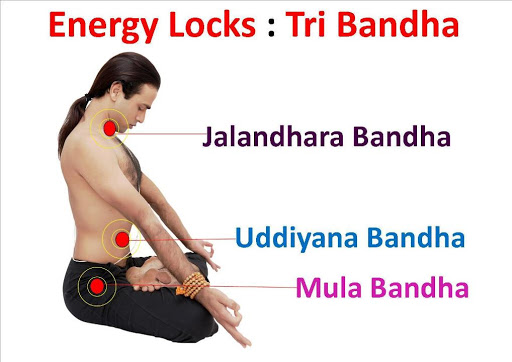
Apply Jalandhara, Uddiyana and Mula bandha one after the another in the same order as mentioned. There must be no pause in between, the bandhas must be applied back to back.
Retain the breath or locks for as long as it feels comfortable. Do not strain. Even 3 seconds are sufficient for a beginner.
To release the three locks, start with Mula Bandha, then Uddiyana Bandha and in the end Jalandhara Bandha.
Take a slow inhalation after bringing the head into an upright position. One round completes here.
Relax the whole body taking easy breaths. Let the eyes remain closed. Once the breath comes back to its normal rhythm, you are ready to practice again.
Practice 2 times initially. As you begin to feel more efficient in your practice, gradually add one more round till you reach 5 rounds.
Benefits of Bandhas
- Maintains cardiovascular health.
- Activates all the organs of the area, where Bandha is applied.
- Gives relief from a variety of headaches, mood disorders, and sleep disorders.
- Strengthens the immune system and metabolism and Stimulates all glands of the endocrine system
- Helps in better digestion, respiration, and extraction of waste from the body.
- Makes us more concentrated and alert and Calms the brain and strengthens our emotions
- Helps in Kundalini awakening by stimulating Mooladhara (root), Manipura (heart), and Vishuddhi (throat) Chakra.
- Strengthens the autonomic nervous system 2 and parasympathetic nervous system 3.
- It helps to purify the body and mind.
Sequence of Bandha
When we talk about the bandha, one thing where we stuck commonly is the sequence of bandha. In other words, which bandha should we practice first?
Maha bandha is practiced by performing the first three bandhas simultaneously, beginning with jalandhara bandha, uddiyana bandha, and ending with mula bandha. These bandhas are released in the reverse order, with mula bandha first, Uddiyana bandha, and jalandhara bandha last.
Contradictions
- You must not practice Maha Bandha if you suffer from any of these conditions: heart disorder, high or low blood pressure, hernia, stroke, intestinal or stomach ulcer, in case you are recovering from a visceral ailment.
- Maha Bandha must be avoided by pregnant women as well as during menstruation.
Vrishasana (Bull Pose) – वृषासन
Vrishasana is the sitting follow asana. ‘Vrusha’ means a bull. An aspirant performs this asana resembles the image of manliness. He is believed to be a ‘man-bull’ and so this asana is called vrushasana. Physical flaccidity in a young body is a sign of old age. It indicates physical weakness. This asana helps to preserve youth.
Bull Pose is like one form of the foundation position of Gomukhasana, but not the Gomukhasana. It seems like the Dhyana-Virasana (Horse-meditation Pose). But this is a bit different in the leg and hand positions. I noticed that many people are confused about Vrishasana (Bull Pose) and Vrikshasana (Tree Pose).
“Yaamyagulphe paadamoole vaamabhaage padetaram;
Vipareetam sprished bhoomim-vrishasana-midam bhavet”-Ghe. Sa. 38;
याम्यगुल्फे पादमूले वामभागे पदेतर। विपरीतम स्प्रिशेद भूमिम-वृषासन-मिदम भवेत।। घे.स. । ३८। –
Place the anus on the right foot. The upturned left foot touches the ground on the right side with the left heel to the left side of the anus. The top of the feet should remain on the floor. This is called Vrishasana.
Procedure for Bull Pose
- Sit with the legs stretched out in front of the body.
- Bend the right leg at the knee and place the right heel under the anus and sit on right foot.
- Place the left knee on the right knee in such a way that the left heel touches the right thigh or left foot close to buttock.
- Sit erect and place the palm of the right hand on the knee.
- Then place the palm of the left hand on it. And the weight of the body can be adjusted on top of the right foot.
- Breathe in the normal way.
- Direct your sight and attention to the navel.
Precautions
This asana requires extremely flexible ankles and feet and is not suitable for the generation practitioners.
Advantages of Vrishasana (Bull Pose)
- Mooladhaara chakra is automatically stimulated and increasing the energy levels.
- It awakens Kundalini Shakti, which enters the mouth of the Sushumna.
- Stimulates blood circulation, making the body energetic and the mind peaceful.
- It makes the respiratory system function in a proper order.
- It cures diseases such as waste of semen, gas-trouble, nocturnal discharges, indigestion, lumbago, insomnia, cardiac trouble, asthma and dysentery.
- Strengthens all the muscles of the body.
- Vrishasana provides a nice opening in the groin.
Jalandhara Bandha
Jalandhara is a Sanskrit word derived from the roots ‘jalan’ meaning “net,” and dhara, meaning “flow” or ‘stream. Jalandhara Bandha is performed by bringing the chin down towards the chest; therefore, it is also called the “chin lock.” Practicing this bandha improves the function of the thyroid and parathyroid glands, supports the cardiovascular and respiratory systems, as well as activates the Vishuddhi chakra. Jalandhar bandha is also known as ‘Chin Lock’ or ‘Throat Lock’. This bandha locks the prana in the throat region.
Once the Kundalini energy passes through the Abdomen, it flows toward the head through the throat. So, to clear its path in the throat region, we lock Prana in the throat region. This stimulates the Vishuddhi Chakra with Jalandhara Bandha. Therefore, the Bandha practice is completed with Jalandhara Bandha. It is the action of simultaneously lowering the chin and lifting the sternum.
Methods of Jalandhara Bandha (Throat Lock)
a) Sit in a comfortable sitting position, either padmasana or siddhasana, or any other comfortable meditation position.
b) Extend your spine and lift your sternum slightly up.
c) Begin the inhalation slowly and deeply with the head upright, and retain the breath inside.
d) As you near the end of the inhalation with short retention, gently lower your chin down and draw simultaneously the top of the sternum upward. Straighten the arms and lock them firmly into position.
e) Hold during the retention. The chin rests comfortably on the sternum.
f) Exhale and raise your head slowly to a neutral position.
Variation:
In different means of kriya Yoga a more simple and subtle form of jalandhara bandha is practiced where the head is simply bent forward so that the chin presses the neck. It is commonly used while practicing the mudras and pranayama.
Breathing:
We can perform with abhyantara (internal) and bahyantara (external) kumbhaka (Retention).
Sequence:
This bandha is literally formed with Mudras, bandhas, pranayamas. It should be practiced after asanas and pranayamas and before pranayama. Pranayama with bandha is called Uchcha Pranayama (Higher/advance).
Benefits of Jalandhara Bandha (Throat Lock)
The jalandhara bandha compresses the carotid sinuses, which are located on the carotid arteries. The practice of Jalandhara bandha connects the head with the heart and thoracic and throat cavity, and opens up the throat chakra. The bandha presses the ida and pingala channels and allows the prana to pass through the shushumna. The jalandhara bandha regulates the flow of blood and prana (energy) to the heart, head, and the endocrine glands in the neck. This practice produces mental relaxation and relieves stress, anxiety, and anger. It develops one-pointedness.
Cautions of Jalandhara Bandha (Throat Lock)
Those with stiff necks should keep their head as far down as possible or roll a piece of cloth and place it on the top of the collar bones. Hold jalandhara bandha by lifting the chest rather than by pressing down with the chin. This releases tension in the throat and breathing becomes relaxed. Work on lengthening the back of your neck, releasing your shoulders, and opening your chest. Never force your chin to your sternum. Jalandhara bandha is the action of simultaneously lowering the chin and lifting the sternum.
Uddiyana Bandha (Upward Abdominal Lock)
Uddiyana is a Sanskrit word meaning “to rise.” In this bandha, energy moves upward more forcefully than it does in Mula Bandha. Uddiyana bandha stimulates the abdominal muscles, involuntary muscles, and internal organs as they are pulled in, while the chest lifts upward and inward. Though it is highly recommended for those struggling with constipation, indigestion, loss of appetite, and dysfunction of internal organs, the uddiyana bandha can boost the practitioner’s metabolism and promote healthy function of the vital organs, the adrenal gland, thereby relieving stress and tension. It also energizes the heart chakra (anahata), promoting kindness and compassion.
Uddiyana bandha is an abdominal lifting lock that locks the Prana in the abdominal region. In this bandha, we draw our navel part (abdomen) in and upward. After Mula Bandha, one should practice the Uddiyana Bandha.
The Kundalini energy flows in an upward direction. It flows from the root of the spine to the head. Once we set kundalini energy free to flow through the spine, it reaches the abdomen.
To clear the obstacles in the way of Kundalini energy in the abdomen region, we lock prana at this part. This stimulates the Manipura Chakra. This process is done by practicing Uddiyana Bandha. That’s why Mula Bandha is followed by Uddiyana Bandha.
Uddiyana means flying upward. It is practiced by contracting the navel in and up towards the spine.
Steps of Mula Bandha
Sit straight on the mat in Siddhasana or any comfortable meditation poses, pressing well the perineum with the left heel.
Keep your back straight, your neck erect and your head pointing forwards.
Take a deep breath.
Now breathe out slowly. As you breathe out, first tighten the muscles around your anus and then your pelvic floor muscle and your sphincter muscles.
Intensify the contraction as you exhale completely.
Now, bend forward gently and move forward your head and neck to the chest.
Contract your abdominal muscles fully and slowly lift the navel towards the spine in and up. Hold the Uddiyana bandha for 5 to 15 seconds.
Then slowly release your abdominal muscles and inhale normally.
Perform 3 to 10 rounds with one or more breaths between each round.
Advantages of UDDIYANA BANDHA
- This bandha moves the energy up the central channel from the earth, water, and fire centers into the heart chakra which element is air.
- It tones the abdomen, strengthens the diaphragm, and increases the gastric fire.
- It improves the powers of digestion, assimilation and elimination, and purifies the digestive tract of toxins.
- Strengthens the abdominal muscles and diaphragm.
- It opens up blockages in the manipura chakra, as it massages the solar plexus, as well as the heart and lungs.
- Makes us feel and look younger, refreshed and energetic.
- Helps to stimulate mainly the Manipura Chakra (Heart Chakra), affects the Svadhisthan and Muladhara also.
- It prevents accumulated tensions, toxins, or stagnation from developing or accumulating in the navel region, stimulating and lifting the energy of the lower belly (apana vayu), to unite it with the energies localized in the navel (samana vayu) and heart (prana vayu).
- Enhances higher awareness within us.
Cautions
- Women who are menstruating or pregnant should not practice uddiyana bandha.
- People suffering from stomach or intestinal ulcers, hernia, Lumbar spondylosis, high blood pressure, heart disease, and glaucoma.