
How Can Reiki Help People with Digestive Disorders?
Most of the Digestive Disorders of the digestive system are related to the food that we eat. A controlled diet, at many times, can help in reducing the discomfiture caused by certain foods. The ailments of the digestive tract can be easily detected by some specialized tests. Some disorders of the digestive system also include abdominal pain, nausea, vomiting, bloating, and constipation.
How Can Reiki Help People with Digestive Disorders?
Regardless of the specifics of the disorder, participating in regular Reiki sessions may be beneficial in some cases. Reiki helps to provide an environment of stress reduction and relaxation, which in turn may be beneficial for the body to balance and help heal. The idea behind this type of modality is that the symptoms of discomfort and pain within the body, including for digestive disorders, may be related to disturbances in the individual’s energy pathways. Reiki is a non-invasive therapeutic technique intended to support the body’s resolution of these disturbances. It helps restore the normal flow of energy or ‘chi’ or ‘ki’ and to help potentially improve the client’s symptoms. A relaxed body with strong energy may very well better handle stressors than one whose energy is frazzled and scattered.
Key Points of Reiki on Managing Digestive Disorders
1. Working towards alleviation of pain or discomfort
Most of the people who have had Reiki treatments report fewer pain sensations after therapy. Because most digestive disorders cause pain, this may be beneficial for individuals with these conditions.
2. Lower stress levels
Studies have shown that people who participate in Reiki sessions report feeling less stressed than those who do not participate in this type of therapy. Because stress plays a role in the pathology of many digestive conditions, this effect of Reiki may help to lessen the symptoms of individuals with digestive problems indirectly.
3. More control over the condition
When a person participates in Reiki sessions, he or she is doing something proactive to improve his, her or their condition. This gives the individual a greater sense of control over the condition and life in general.
4. On the road to improved digestive function
Currently, very little scientific research on Reiki’s ability to improve digestive disorders has been completed. However, anecdotal reports from individuals who suffer from digestive disorders indicate that Reiki may be a supportive tool for dealing with pain and discomfort. Reiki can support conventional medicine in a healing or wellness plan.
Reiki is noninvasive and doesn’t pose any risk to the client. It also causes no side effects. Thus, Reiki can be used in conjunction with virtually any other treatment prescribed by a physician, including medication and other types of therapy.
Difference Between Yoga and Pilates
Introduction to Yoga and Pilates
Yoga and Pilates both use a mat for operation, but they are very different from one another. There are many cases where, people get confused about which one to choose as both can help you to achieve healthy physique you want, but before that there is something you must know about both yoga and pilates.
Yoga
Yoga is the realization of the union of body, mind, and soul. It is the science of self-realization throughout the body, mind, and soul. Yoga is not done; it is achieved. It is not physical activity, but is achieved from the performance of these activities. Yoga is the state of proper functioning by uniting hardware, software, and current together.
There are different forms of yoga, ranging from Hatha to Kundalini, Sivananda, Ashtanga Yoga, Vinyasa Yoga, and various others, you can choose any one of these as per your choice and preferences. Such yoga postures are a great way to de-stress yourself after a long day. Yoga is a great to help people dealing with addictions, boost flexibility and strengthen muscles.
Pilates
Pilates is a method of exercise that consists of low-impact flexibility and muscular strength and endurance movements. It focuses on proper postural alignment, core strength, and muscle balance. In the 1920s, Pilates was named for its creator, Joseph Pilates, who developed the exercises.
A Pilates routine generally includes exercises that promote core strength and stability, muscle control, and endurance, including exercises that stress proper posture and movement patterns and balanced flexibility and strength. It can also be helpful in training for sports or in physical rehabilitation.
HOW TO CHOOSE BETWEEN YOGA AND PILATES?
Both look very promising if you are willing to have a proper healthy body and features, but if you want to choose one, then we have given below some differences you must consider before choosing one between Pilates and yoga depending on your needs and requirements:
1. Know Your Motive
First of all, when you choose the first thing, that you should keep in mind is the motive of your initiation, you should keep in mind the reason, why you are doing the physical exercises like it may be for good stamina, losing weight, or other reasons. But if you want mental health, spiritual enlightenment, then with no doubt, yoga will help you for all those reasons. Hence, if you want everything all together, yoga will be very beneficial, and if you just want to work out only on your body, to get a toned body with great flexibility, Pilates will be the best option for you.
2. Know About What You Get
Yoga is known for improving the flexibility of the body, along with the flexibility of your joints. It helps achieve peace of mind. However, when we talk about Pilates, it just focuses on trying to relax your and strengthen your tense muscles.
3. Depression or anxiety issues
If you are suffering from depression or mental anxiety and looking for some mental peace, yoga is the most effective exercise to combat these problems than anything else. Yoga mainly focuses on both mind as well as body, and with the help of amazing breathing exercises. You will easily achieve relaxation and mental peace for sure.
CONCLUSION
So, if you are still confused, no problem. Yes, obviously it is quite hard to choose between them as yoga and Pilates are both good in their own way. Both Pilates and Yoga are very enjoyable ways to strengthen your muscles, get your body in better shape, relieve stress, and gain more flexibility.
YOGA TEACHER TRAINING’S MANUAL
Yoga, an ancient Art and Science of Health, Self, and Life, is the key to unlocking the hidden potency of human beings. It works for integrated health, happiness, and harmony in human life. Health is not only physical fitness, to those who have only physically fit means only 15 to 20% of their life works in daily work out, to those who have mental and emotional balance means 50 to 60% of their life works in daily work out and to those who have full of life force and will power means 100% of life works in daily work out. When people are healthy physically, mentally, emotionally, culturally, socially, spiritually, and also ecologically can only gain integrated or wholesome health and then be able to update into happiness. By being happier, they can expand their consciousness.
Yoga plays an important role in human health and life. So the yoga training of teachers in yoga, both in theoretical and practical aspects, is considered very necessary for developing the skills and energy required in the Yoga Teacher Training course. A model of course schedules for the Teachers’ Training Programme proposed by the experts is as follows:
The Training components include knowledge of Yoga and other related subjects to develop a broader perspective of teaching yoga for the overall development of the wholesome personality of students. Accordingly, the course standards have been prepared to provide the knowledge of fundamentals of Yoga and other allied sciences to develop required skills and perception in Teacher-trainees.
It has two sections: Theory and practice. The theory section deals with
- The introduction, Foundations of Yoga
- Paatanjal Yoga Darshan & Ashtanga Yoga
- History & Philosophy of Yoga
- Hatha Pradipika and Hatha Yoga
- Gheranda Samhita & Sapta Sadhana
- Bhagavat Geetaa & Chaturthavidh Yoga
- Yoga, Human Anatomy & Physiology and Yoga & Human Health
- Yogic Food & Lifestyle, Values & Attitude of Yogic Life, Personality Development
- Methodology of Yoga Teaching, etc.
The practical session deals with: Yoga Teacher Training’s Manual
Yogic Practices like Prathana (Prayer), Mantra (Mixture of Sound Energy), Shatakarma (Six Cleansing Acts), Sukshma Vyayama (Subtle Acts), Surya Namaskara Chakra (Sun- salutation Cycle), Yogasana (Posture), Bandha (Lock), Mudra (Gesture), Pranayama (Breath Control), Yoga Nidra (Yogic Sleep), Relaxation techniques, Dharana (Concentration gravity), Dhyana (meditation), Traditional Hatha Yoga, Ashtanga Yoga (Classical), Karma Yoga (Yoga of Action), Bhakti Yoga (Yoga of Devotion), Jnana Yoga (Yoga of Knowledge), Kundalini Yoga (Yoga of Spiritual Power);
Corporate Yoga, Clinical Yoga, Children Yoga, Acrobatic Yoga, Ashtanga Vinyasa (Modern Yoga), Yin Yoga ( Traditional Yoga with new Brand or Trade),
Practicum (Teaching Practices) & Communication skills, Business skills, Chances & challenges, and Evaluation,
Reiki and Meditation
Even though Reiki and meditation brings peace, calmness, and relief, each have its own specialties and ways :
What is Reiki?
Reiki is a Japanese technique for stress reduction and relaxation that also promotes healing. It is administered by “laying on hands” and is based on the idea that an unseen “life force energy” flows through us and is what causes us to be alive. If one’s “life force energy” is low, then we are more likely to get sick or feel stress. And if it is high, we are more capable of being happy and healthy.
What is Meditation?
Meditation is a state of consciousness possessing very specific and unique attributes. To enter into this almost forgotten quiet space within is the most natural thing you can do to experience inner peace and calm. It dissolves stress and boosts your immune system. You feel mentally focused and refreshed. It slows down the ageing process and improves the quality of your entire being.
Meditation is revealing itself to be one of the greatest breakthroughs in healing and personal growth. There is more and more scientific evidence that proves that meditative practices should be at the very heart of our healthcare system.
Reiki and Meditation: The Bottom Line
Because there are no laws limiting how good you’re allowed to feel, you can certainly use both methods to benefit your body, mind, and soul. Reiki and meditation can serve as ideal complements to each other, working together to produce an overall sense of well-being and peace.
Tips To Care for Singing Bowl
Here, we present an interesting article on Tips to care for Singing Bowl. Worried about how to handle the singing bowl that you bought at a very nice price? So follow this guide written by our group of sound healers who teach singing bowl training and sound healing training in Nepal. We at Himalayan Yoga Academy are very happy to help you in any way regarding the singing bowl, as we are considered one of the best schools for singing bowl training in Nepal.
Various tips To Care for Singing Bowl (Dwani Paatro)
Handling
In Numismatics, you are taught to always hold a coin by the rim to avoid leaving any residue on the face. With singing bowls, the rim is the most important part. The way I handle singing bowls is to try to only touch the outer side, lifting them with two hands and then transferring to one if I’m going to ring it in hand. Try not to grab a singing bowl with one hand, fingers inside, and thumb out.
Mishandling
While singing bowls are made out of tough metal, they also have a vulnerable side to them. Falling onto a hard surface can make cracks in brittle metal. Cracks aren’t always fatal, but often, they mean the end of the sound. If you suffer this misfortune, sorry, there is no way to repair a crack that you can hear.
Cleaning
Certainly, you want to wipe your singing bowls out from time to time with a soft cloth to keep dust from building up. A singing bowl with caked dust in it will lose some of its sonic sparkles. These days, “dust” can include chemicals that will react with the metal. A clean cloth is best, really. If the original patina is important to you anything stronger than cloth can have an effect. On bright bowls, I use white vinegar to take out fingerprints.
Singing bowls are composed of a complex mix of metals and they have been cleaned, mostly by rubbing them out with cloth or more caustic elements such as sand and mud, by their former owners. These singing bowls are tough as well as delicate and due to recent cleaning, some will likely tarnish over time. If you decide to remove the tarnish, commercially available metal cleaners are just fine. If your singing bowls get really grungy somehow, start with a dry coarse woven cloth and that may do the trick. Scouring powder will scratch smoothly finished singing bowls and some bowls already have scratch marks from past treatment. Be careful to get any cleaning substance residues off the bowl.
Aggressive Cleaning
More strenuous and harsher cleaning options are also available to you with the caveat that the sound you hear is based on the metal in the singing bowl, and removing any of it can have an effect. Sometimes, rims are compromised by build-up that makes contact with a stick rough. In that case, you can try steel wool, especially the new cheap Chinese imports that are not as hard as the old stainless steel ones. The tarnish and stain of many years of use are not always pleasing to people. If you want to take a bowl down to base metal, anything from steel wool, copper, or steel beads and chemical brass cleaners will do the trick. The base metal, with its high copper and tin content, will shine up wonderfully.
You can wreck a singing bowl by spraying Coke on it and letting it dry out. The metals in the singing bowl will react to the ingredients of the soda and begin a process that will deeply pit the bowl. If your singing bowls get wet, dry them promptly. I do not advise leaving water in your singing bowls for any period of time. If you play your singing bowls with water in them best to use distilled water and be sure to dry them off so you avoid water stains.
Storage: Tips To Care your Singing Bowl
Be careful of moisture and ocean air. I may just be superstitious, but I never store or transport singing bowls on their sides.
It is pretty basic but you don’t want singing bowls to rub on each other in transport and you want to protect the sides from shock. Cardboard boxes are fine but you want to protect the finish of a singing bowl, too. One of the reasons I provide cover clothes is to make this a no-brainer. You’ll find it is sufficient to wrap every other singing bowl in a nest. Be careful nesting singing bowls with sides that curve in or inner lips. Leave some space as it is easier to get bowls to fit in each other than to come apart.
Part 2 What is Yoga?
Part 2 What is Yoga? . As Yoga Darshana of Maharshi Patanjali; Yoga is defined as “Yogashchittavrittinirodha” PYS 1.2; the cessation of modified thoughts in chitta is yoga. This is only one authorized definition of Yoga in this entire text called Patanjali Yoga Sutra. This sutra is often taken to mean that yoga is concerned with stilling disturbed thoughts.
As Bhagavad Geeta “Yogah Samadhihi” -Yoga is Samadhi, or Samadhi is Yoga, but people think very differently as the training for the body. It is the training for wisdom to make equanimity of knowledge or wisdom. Sama + Dhi means Sama stands for equanimity and Dhi stands for wisdom, i.e. equanimity of wisdom.
“Buddhi-yukto jahaatiha Ubhe sukrita-duskrite
Tasmaad yogaaya yujyasva yogah karmashu
kaushalam” B.G. 2.50
A person who is engaged in devotional service rids himself of both good and bad results and karmas, even in this life. Therefore strive for yoga, which is the art of all actions.
Yoga Definition as Bhagavad Geeta
Yoga-sthah kuru karmaani sangam tyaktvaa dhananjaya
siddhy-asiddhyoh samo bhootvaa samatvam yoga uchyate” B.G. 2.48
Perform your duty equipoise, ‘O’ Arjuna abandoning all attachments to success or failure. Such equanimity is called Yoga.
The equanimity that enables us to accept all circumstances of life with serenity and sorrows is to praiseworthy that Shree Krishna calls it Yoga or the union of with the supreme power. This equipoise comes from implementing the knowledge of the previous views. When we understand that effort is in our hands, not the results, we then concern ourselves only with doing our duty. The results are for the pleasure of supreme power, and so we dedicate them to him.
Yoga Definition as Spiritual Science
Yoga is the journey of self; throughout the self; to the self. It is the science of self; the physical aspect is only the foundation of the body for the being of life; for the purity of being. The journey of self runs by the self throughout life and ultimately goals to explore the self purposed to the expansion of consciousness.
Yoga Definition as an Integral Science
Yoga is an inner engineering science that discovers and designs our inner engineering by self-witness. Engineering starts from the outer world to the inner world journey and makes you recognize yourself.
What is Yoga?
Current Overview of Yoga
What is Yoga? Everybody knows what yoga is. Yoga is being done in health clubs, beauty parlors, stadiums, movie shooting studios, Gym halls, Aerobics Chambers, Zumba halls, theaters, etc. Celebrities cum all stars are doing nowadays to maintain fitness and keep them thin & slim. They think that yoga is a great role and is very important in the glamour zone as well. Now, let’s talk and find out what they are doing that tells us whether it is yoga or not.
First Angle
Physical jerks at the Gym Play? The more they are smooth, easy, and balanced; they may perform true yoga practices. But many of what now they approach, are just the aerobics series, and physical training using yoga postures as their form, and because of the quick extreme stretching with bouncing ‘ballistic’ movements they are not yoga, is just the Yogasana postures. The fundamental ethics of physical training is “No pain No Gain” but it is not yoga.
Second Angle with something
Yoga has been proven to be a beneficial stress–relieving system and can be used by anyone right in the middle of a stressful situation, close to but only a small part of it. The Yoga classes at modern yoga studios, of which are tens of thousands throughout the world. So far, as they are taught by experienced yoga teachers who have been there using simple techniques suited to the fitness, flexibility, and experience of the student, they may do a small amount of what we try to accomplish from Yoga.
Third Angle with a different ideology
Sometimes, somewhere the people/yogins in deep meditation in a cave and camp are also an image people usually have. However, most yogins are deeply involved in the world for the benefit of the world and the people in it and certainly have little time for sitting in caves. These people think meditation is supper, is everything. Some people think yoga & meditation or meditation & yoga are different science or different practices for different purposes. In fact what it is.
People have many ideas of what yoga is, but rarely do they come anywhere near the width and depth of yoga. The object of this article is to express the right image of the extent of yoga and to explain how we can use it in our lives to realize our highest potential and dimensions. It makes us acknowledge about the true sense of yoga science, its true understanding, and its daily applications.
Meaning of Yoga
Yoga means the state of oneness achieved by uniting, yoking, harmonizing, equalizing, and connecting.
Definition of Yoga
There are many definitions of yoga given in different sacred texts and also some are practically applied conditionally and unconditionally. Yoga is more about meditation. Throughout the meditation, we reach Yoga. Meditation is the final tool or the final key for yoga. So we can’t say yoga and meditation, but we can say yoga asana and meditation or meditation and Yoga or Samadhi as well at least.
At some point in yoga studios, I heard and read as well that they are saying yoga and meditation and also say that “ We teach both yoga and meditation” in our center. That is wrong. The right thing is to say that we teach just “Yoga” and not need to say that we teach yoga and meditation because all the things are means of Yoga, which is not different from yoga. Yoga is mastery over the mind and is more about meditation.
Yoga is generally defined as the realization of the union of body, mind, and soul. It is the science of self-realization throughout the body, mind, and soul. Yoga is not done; it is achieved. It is not physical activity that is achieved from the performance of these activities. It is the state of proper functioning by uniting hardware, software, and current together.
Yoga is defined as the “Management of Life”. It has three aspects: body management by physical yoga (Hatha Yoga), Mind management by concentration and meditation (Raja Yoga), and power management by energy recharge (Prana Yoga). It is also known as “A Way of Living”. We learn how to be healthy, how to be happy, and how to be conscious. How is the day, for Night; how is the night, for the day?
Holistic Impact of Yoga
In this modern era, we have all the material comforts due to advancements in technology; this rapid progress and technological development have changed the lifestyle of the people, which in turn seems to pose many challenges. Today, one’s lifestyle has been changed in all aspects, viz physical, mental, emotional & social. Mankind suffered from infectious & contagious diseases before the 19th century. So here we have Yoga as a solution for the management of chronic and lifestyle-related issues. It works for prevention, promotion, cure, rehabilitation, and rejuvenation. Learn More about the Holistic Impact of Yoga
1. Stress reduction
Stress is the very first reason why you should start doing Yoga. It helps cure those stressors inside your body and calms your body with care. When your body is in a calm state, you respond better and you’ll be happier.
2. Enhanced fitness
With those effective Yoga poses, your body balance will improve and so does your strength and range of motion. This means reduced fumbling at your workplace and containing yourself in a better way.
3. Disease Management
You will realize in the long run that investing in yoga is the best thing you have done. Yoga can save you from fatal diseases like cancer and other chronic illness by revitalizing and making the defense mechanism strong and can keep your blood pressure in check. Daily Yoga also ensures you sleep better at night and give the rest and relaxation as needed.
4. Heart Heath promotion
Studies show that yoga may help improve heart health and reduce several risk factors for heart disease.
One study found that participants over 40 years of age who practiced yoga for five years had lower blood pressure and pulse rate than those who didn’t.
So, Yoga Asanas play a great role in maintaining the blood pressure of the people. Hence maintains the overall cardiac health of the individual.
5. Could Reduce Chronic Pain
Chronic pain is a persistent problem that affects millions of people and has a range of possible causes, from injuries to arthritis. There is a growing body of research demonstrating that practicing yoga could help reduce many types of chronic pain. In one study, 42 individuals with carpal tunnel syndrome either received a wrist splint or did yoga for eight weeks. At the end of the study, yoga was found to be more effective in reducing pain and improving grip strength than wrist splinting.
A Yoga Teacher Blog
Here is a yoga teacher blog. Being a professional yoga teacher and practitioner gave wings to my passion and dedication. I could feel a sense of dignity in the work. I did and made a path that I chose; from then, I have never thought to look back or take a twist. My life has become a full-on yogic path, and I feel oneness. Trekking is full of adventures and memories, yet yoga treks are more of it. Yoga trekking as a yoga teacher is more exciting. 6-8 hours of walking to mountain trails was extremely fun, and I felt it more intense to walk with my guest. I had to be in full-on energy to send better vibes on the tough roads of the mountains. Further about Ghorepani Poon Hill Trek Blog.
Poon hill is a magnetic and magnificent place and a must-go place to see the beauty of “Brahmamuhurta” at the dawn of the day and the intense beauty of sunrise from an altitude of 3210 m. The Annapurna range is worth watching from here. And the early yoga practice here in touch with the purest form of nature is intense and progressive. The mind simply gets meditative, and in asana practice, body and mind perfectly coordinate and blend with nature; a sense of stillness simply happens.
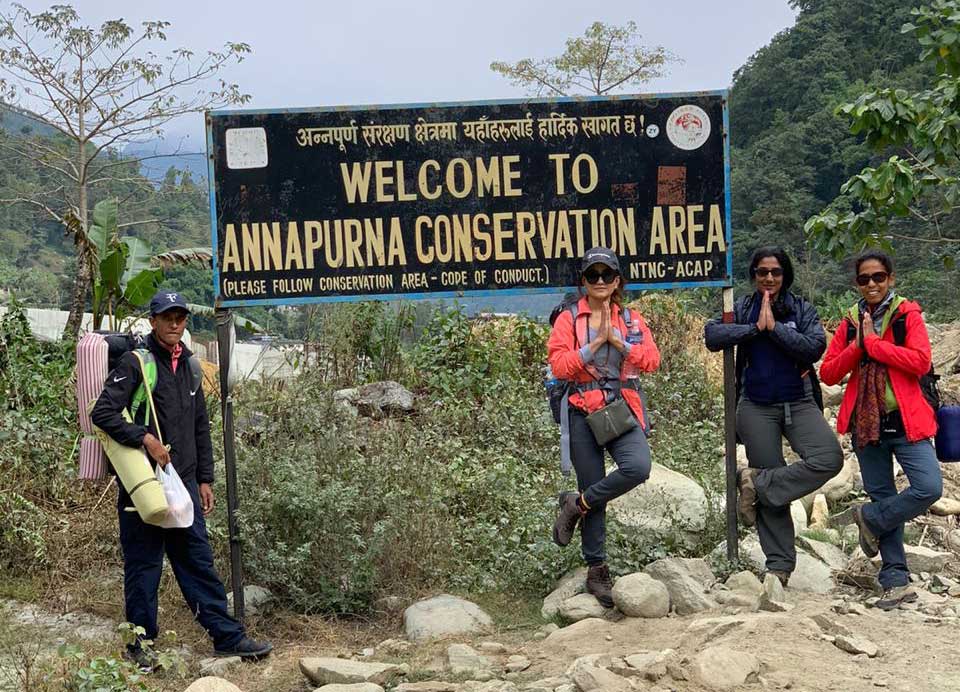
Our trekking began from Nayapul and then lasted 6 days. We covered Hile, Ulleri, Ghorepani, Poon hill sunrise, Tadapani, Ghandruk finally Pokhara where we stayed in Visitors Inn. Around 136 km of walking, the longest yoga trek I have been to, and there were a few challenges and lots of fun to keep in my memory pocket. Being a yoga teacher, what I learned was intense cold temperatures and an average walk of 6 hours, early morning or in the evening, facilitating yoga guests involving them in yoga sessions; especially in winter might be tough. The only thing that works in that situation is your passion and dedication to teaching yoga in the cold of the Mountains and Himalayas; wake up, take a cold shower and wake your yoga children up, pamper them with love, and drag them to yoga sessions. This was how I managed yoga sessions during a tiresome trek, long and steep walks, and ups and downs.
Yoga was my fuel. As a yoga teacher, it was a great learning experience for me, and I would love to have more of it. Yoga sessions were part of my job, and I would be dedicated to it for I had consciously decided to be one. I say it again: no looking back, even if I freeze, because after fun sessions whole day feels warmer, and even a cold shower becomes your buddy. The yoga Nindra session in the evening at our 1 day-stay guest home was fun, It would release restlessness and physical pain, meditation-fueled enthusiasm, and feeling of self within us.
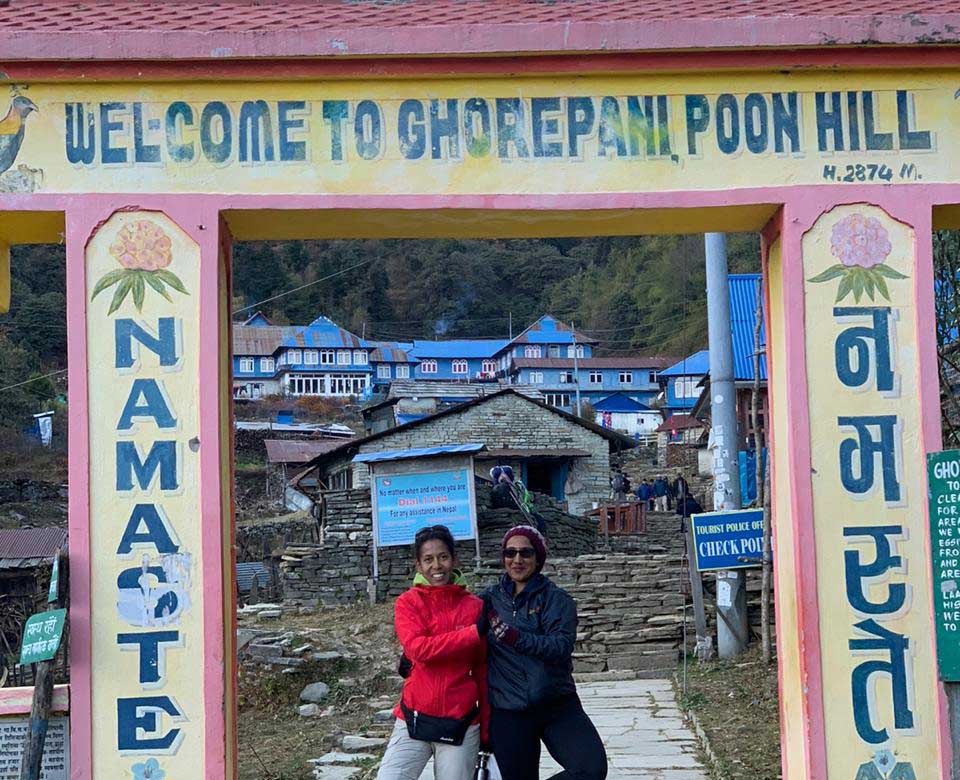
Ghorepani 2874 m is simply magical. I would like to be lost in this kind of place for a month, like a “lost in the mountains” kind of vibe. The mountains were so near to my eyes, it felt like I wanted to introduce myself to them and ask for their introduction. They seem overwhelmingly beautiful; maybe I was too emotional or whatnot because I openly say I am one of ‘them’. Annapurna (8091 m), Fishtail (6993 m), Dhaulagiri range, the hills, pine forest, sky, eagles, spring, grasses, rocks everything seemed beautiful and beautiful humans too. “Snow View Lodge and Restaurant” This place is so memorable to us.
3rd day of our walk, the tough uphill trek, well, the pain released as we had wonderful hot shower service, and also their apple pie, americano, and vegetable soup is simply awesome. The taste was marvelous, I could only say so because the moment and weather, and mountains brought the taste to it.
Day 4 Tadapani, a Chill place to perform yoga sessions, a very meditative place. If someone misses the sunrise from Poon Hill (3210 m), they can see the same canvas of mountains and sunrise, so chill and if overslept at Ghorepani you will still catch it on Mattapan.
Ghandruk was downhill and an easy walk, the tea garden was eye-catching, and food was always full of love everywhere. We were in lots of fun because mission poon hill felt easily accomplished, yoga and meditation and walk and treks and pains and funs started and we were beautifully ending it at Pokhara.
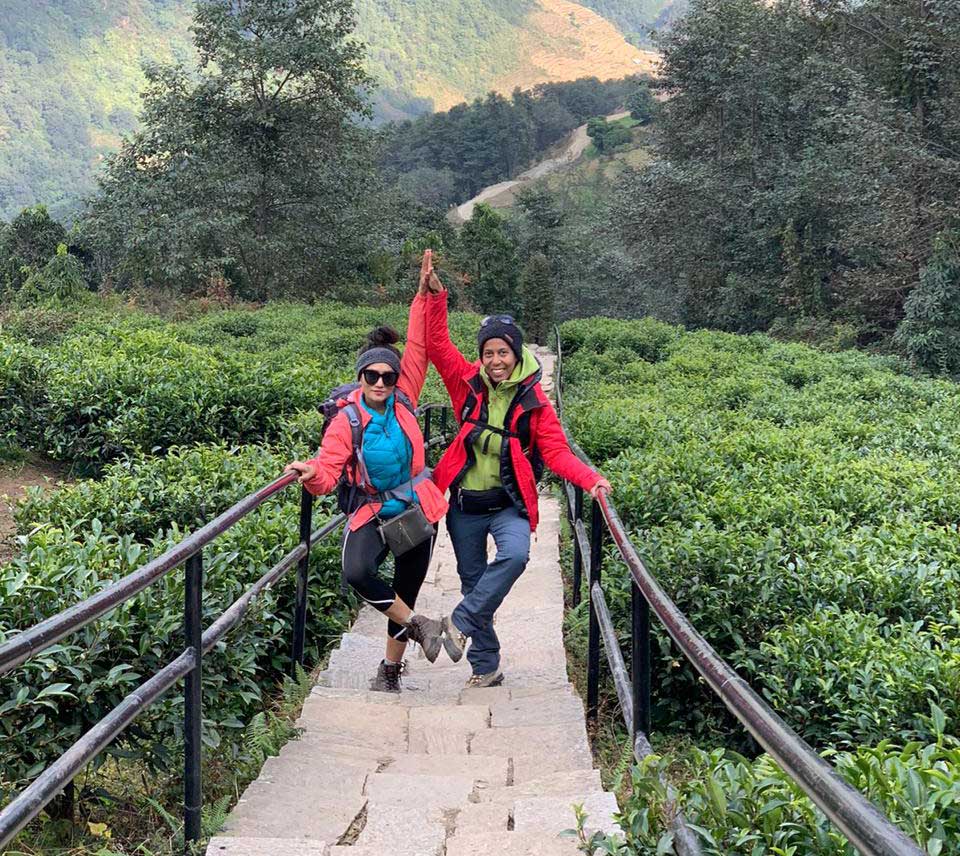
Day 6 Pokhara, back to the hotel. Cleaning up some left tiredness but as far as I feel we were cool, me, our guide, guest everyone. Less tiring than yoga nidra, meditation, and asana, make a great friend when you are trekking; they recharge us spiritually, mentally, and physically to stick on the trekking journey with positive and tireless enthusiasm. “The journey begins and the journey ends, some continue for the next second, some for the next minute, the next hour, the next day, maybe the next life eventually every journey ends only to begin again; being conscious about the journey as a whole is one big realization about self”.
Integrate Reiki Healing into Your Yoga Practice
Reiki is an ancient Japanese healing technique that involves the transfer of “life force energy,” or prana, by laying the hands on specific parts of the body. Reiki masters have successfully unlocked their free flow of prana. They can transfer the ability to use Reiki to students through a process known as “attunement”. Let’s learn how to integrate Reiki Healing into Your Yoga Practice.
Once your own prana is unlocked and you have the ability to use Reiki, you can use it on others or yourself. Focusing the life force energy on specific body parts may help heal injuries and promote overall good health and well-being.
Yoga and Life Force Energy
Yoga, too, has a strong focus on the flow of prana throughout the body. To unlock and free up your life force energy by moving into and holding various poses. Each time you successfully hold a pose while breathing deeply, you’re effectively dissolving the blockages that prevent your prana flow.
Various poses can unlock your prana in various ways. Forward bends, for instance, can unblock prana to soothe, calm, and ground you. While backbends prompt prana that provides a revitalizing boost.
Reiki Healing and Yoga: A Potent Combination
You have the basics on how both Reiki and yoga help awaken and unblock your life force energy. Now, you can just imagine the results when you put the two together. Using Reiki on targeted areas while holding and breathing through yoga poses that target those same areas has the power to create a potent surge of prana. It can veritably catapult your mind, body, and spirit to a more enlightened and invigorating plane.
She found Reiki so beneficial to her yoga practice that she says Reiki has become her yoga practice. She views each pose as a pure expression of life force energy. Reiki and yoga work together to ensure that energy remains strong and readily available during her yoga practice as well as her daily life.