
27 Jul 2026 HYN Himalayan Yoga Academy
Breathing is the first movement of life—and one of the last things most people learn to observe consciously. In our fast-paced world, breath has become automatic, unnoticed, and undervalued. Yet, across the globe, a quiet revolution is taking place. Yoga teachers, meditators, therapists, and travellers are increasingly turning to Nepal to rediscover the ancient science of pranayama in its most authentic form.
This guide explores traditional pranayama courses in Nepal and why learning breath here goes far beyond the modern breathwork trends that flood social media and wellness apps. Whether you’re a seasoned yoga teacher, a curious practitioner, or simply someone seeking a more grounded approach to wellness, this article will help you understand what genuine pranayama education entails—and how to choose a program that honours this sacred tradition.
Pranayama Is More Than a Breathing Technique
In classical yoga philosophy, the term pranayama carries profound meaning. Prana refers to vital energy or life force—the subtle current that animates all living beings. Ayama is commonly translated as extension, regulation, or expansion. Together, they describe a practice far more comprehensive than simply taking a deep breath on command.
True pranayama encompasses:
- The quality of inhalation and exhalation
- The pauses that exist between them
- The condition of the physical body
- The steadiness of attention and awareness
- The ethical intention behind the practice
This holistic framework is precisely why serious students choose a traditional pranayama course in Nepal rather than relying on short online demonstrations or weekend workshops. Here, breath is not reduced to a technique—it is understood as a doorway to self-awareness, nervous system regulation, and inner transformation.
Why Study Breathwork in Nepal?
Nepal is internationally renowned for the Himalayas, ancient pilgrimage landscapes, monasteries, temples, and living traditions of yoga, Ayurveda, and meditation. Yet, the value of studying here is not merely that altitude or scenery automatically creates spiritual progress. The true gift is the opportunity to step outside ordinary routines and enter a residential rhythm where practice, meals, study, rest, and community all support the same intention.
Kathmandu offers access to accomplished teachers, rich cultural heritage, and international travel connections, all while providing quieter residential areas near forested hills. It is a place where tradition lives—not in museums or history books, but in the daily lives of practitioners who have preserved these teachings for generations.
The Himalayan Yoga Academy Approach
Himalayan Yoga Academy (HYA) offers a comprehensive 12-day, 100-hour residential Pranayama Teacher Training in Kathmandu. This program is carefully designed around:
- Progressive practice that builds competence systematically
- Classical yogic theory rooted in traditional texts and oral teachings
- Breathing anatomy and physiology with practical applications
- Nervous-system awareness and its relationship to breath
- Bandhas and mudras as integral components of practice
- Teaching methodology with supervised class design and feedback
- Contraindications and safety protocols for responsible instruction
Students choose between shared and private accommodation, enjoy sattvic meals designed to support practice, and receive airport support to ensure a smooth arrival. The published course framework includes more than eighteen pranayama techniques, exploration of the five pranas, Ida, Pingala, and Sushumna, bandhas, mudras, stages of kumbhaka, breathing anatomy, nervous-system education, and professional ethics.
The program is intentionally kept small, allowing teachers to observe individuals rather than treating the group as one identical breathing body. This personalised attention ensures that each student receives the guidance, adjustments, and encouragement they need.
What Students Should Learn
A complete pranayama course should balance personal practice with teaching competence. Key learning areas include:
1. Foundational Practices
- Natural breath observation and awareness
- Diaphragmatic and rib-cage awareness
- Classical breathing techniques
- Ratio development and rhythm
2. Advanced Dimensions
- Cleansing practices (kriyas)
- Bandhas (energy locks) and mudras (gestures)
- The subtle-body model (chakras, nadis, prana vayus)
- Respiratory anatomy and physiology
- Autonomic nervous system regulation
3. Teaching Competence
- Class sequencing and structuring
- Verbal cueing and instruction
- Hands-on adjustments when appropriate
- Professional ethics and boundaries
- Recognising when to refer students to healthcare professionals
What a Responsible Training Does Not Promise
In an age of wellness hype and exaggerated claims, ethical programs stand apart by what they don’t promise.
No responsible training should claim that one technique will cure anxiety, hypertension, trauma, asthma, or other medical conditions. While research into slow breathing and mind-body practices is indeed developing, results depend on the method, the participant, and the context.
A strong training:
- Presents evidence carefully and accurately
- Distinguishes traditional explanations from biomedical claims
- Avoids turning every sensation into proof of healing or awakening
- Encourages students to work within their scope of competence
Safety, Contraindications, and Individual Capacity
Pranayama must be taught with humility and care. Dizziness, tingling, agitation, breath hunger, chest discomfort, or panic are not badges of progress. They are reasons to stop, return to natural breathing, and reassess the method.
Important Safety Considerations
People who are:
- Pregnant
- Recovering from surgery
- Living with cardiovascular conditions
- Managing respiratory disorders
- Experiencing neurological conditions
- Navigating significant mental health challenges
…should seek individualised medical advice and disclose relevant information to their teacher before beginning practice.
Educational breath practice can support self-awareness and relaxation, but it is not a substitute for diagnosis or medical treatment. Ethical teachers understand this distinction and honour it in every class.
Broader Training Pathways
For students who want a broader teaching qualification, this specialist pranayama study integrates seamlessly with HYA’s comprehensive training pathways:
Yoga Teacher Training
The 200-hour Yoga Teacher Training provides a broader foundation in asana, philosophy, anatomy, and methodology—ideal for those new to teaching.
Meditation Teacher Training
Develops guiding skills, silence, and concentration for those who wish to deepen inner observation.
Sound Healing Training
Explores Nada Yoga, singing bowls, and the relationship between vibration, listening, and relaxation.
Ayurveda Programs
Introduce traditional approaches to daily routine and constitutional understanding.
For travellers who want wellness and cultural immersion without an intensive certification schedule, HYA offers yoga retreats in Kathmandu, Nagarkot, and other stunning Nepal settings.
How to Use This Article in Your Learning or Booking Decision
When comparing options for a traditional pranayama course in Nepal, we encourage you to examine:
- The actual timetable and daily schedule
- Teacher biographies and their lineage or training background
- Class size and student-to-teacher ratio
- Accommodation quality and food offerings
- Assessment methods and certification requirements
- Cancellation policy and terms
- Support before arrival (visa assistance, airport pick-up, etc.)
Questions to Ask Before Enrolling
- Are advanced practices optional or mandatory?
- How is health information handled and kept confidential?
- Does the course teach modifications for different body types and conditions?
- What ongoing support is available after the course?
Himalayan Yoga Academy publishes its 12-day course structure, fees, and upcoming dates on its main course page. However, prospective students should confirm current availability directly before arranging flights—dates and availability can change.
Conclusion
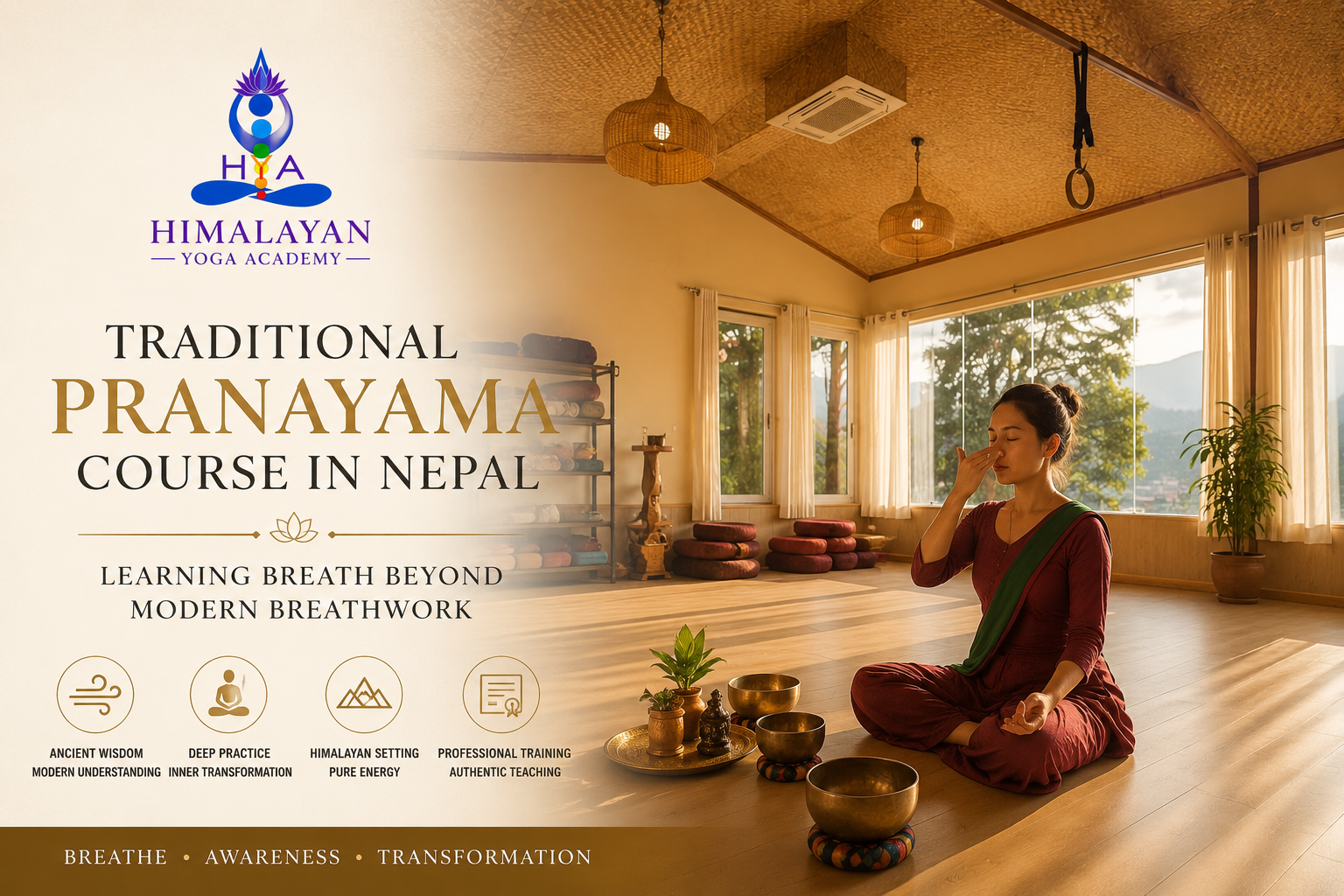
Traditional Pranayama Course in Nepal: Learning Breath Beyond Modern Breathwork is ultimately about developing a respectful, informed, and sustainable relationship with breathing.
The best outcome is not the longest retention or the most dramatic sensation. It is:
- Greater sensitivity to your own breath and body
- Steadier practice that integrates into daily life
- The ability to teach within appropriate limits and ethical boundaries
- A deeper connection to the ancient tradition that honours breath as sacred
For students seeking genuine pranayama education, Himalayan Yoga Academy offers a residential pathway that connects classical pranayama, anatomy, meditation, and teaching practice with Nepalese hospitality and the wider experience of yoga in Nepal.
Those who are not ready for certification can begin through an HYA yoga retreat, while qualified teachers and serious practitioners can use the 100-hour training as a focused step within a longer professional journey.
Whether you come for a week or a month, for certification or simply for depth, Nepal welcomes you. The mountains stand as silent witnesses to centuries of breath practice. Your own breath is waiting—ready to be noticed, understood, and honoured.
Namaste.