
19 Apr 2020 HYN Himalayan Yoga Academy
Yoga is the union of the inner self and the cosmic intelligence. Yoga is for getting good health, happiness, and harmony. It is a completely experimental science that uncovers inner peace, inner purity, inner rest, and inner relaxation, then links to groom entire potency. Yoga is the complete science of being. Dhyana (Meditation) is the final key in yoga Practice. Physical practice, or Asanas, is one of the major pillars of the whole yogic mission. Ashtanga Vinyasa Yoga is the complete Asana series for intense physical fitness; it is strongly grounded for Yoga sadhana. It combines some of the means of Yoga like Prayer, Asana, Breath, Bandha, and Focus (drishti) for optimum merits.
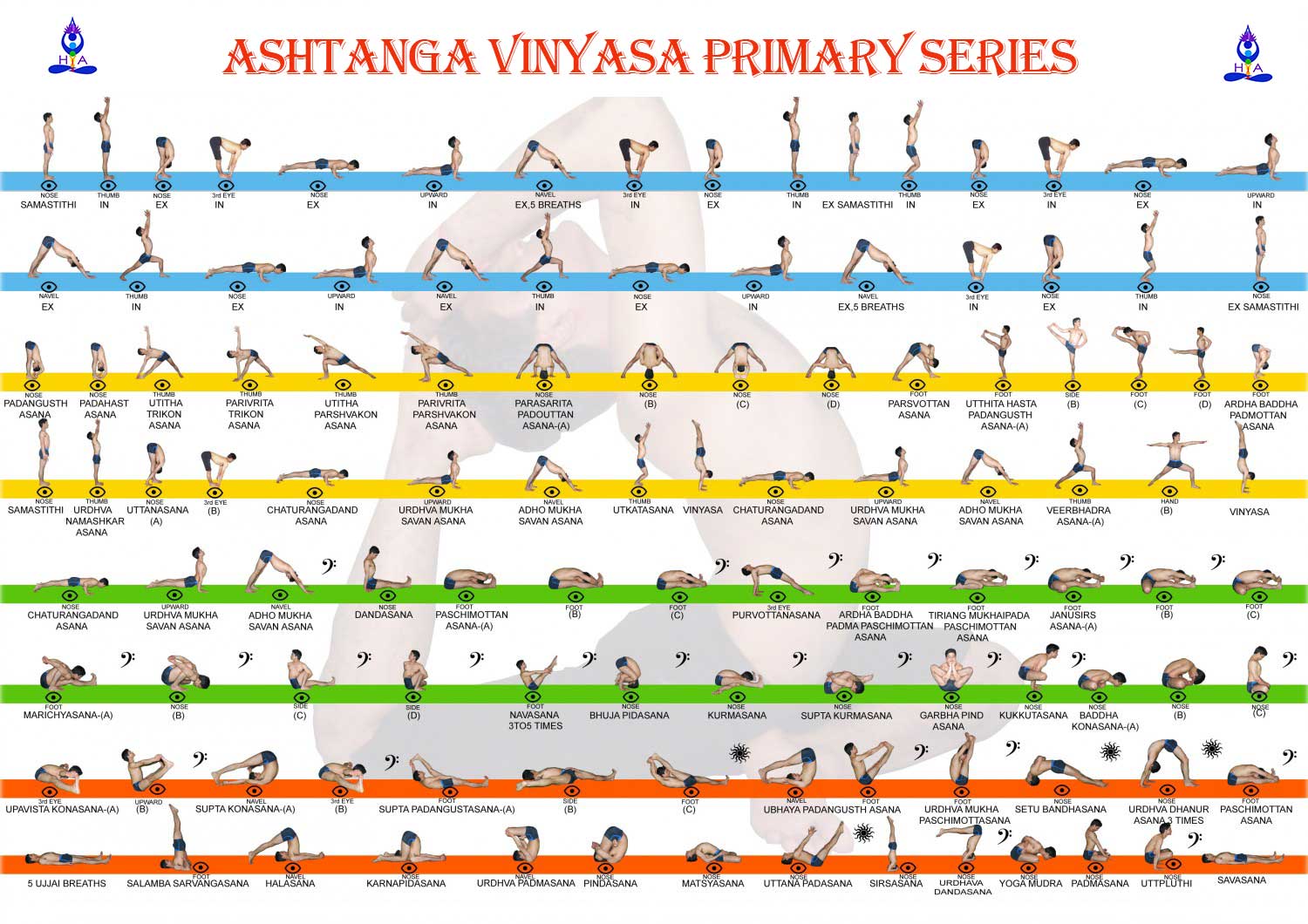
Ashtanga Vinyasa is the combination of yoga asanas (poses) and is the teaching style of asanas by Shri K. Pattabhi Jois. The term ‘Ashtanga’ means eight limbs of yoga (i.e., yama, niyama, asana, pranayama, pratyahar, dharana, dhyana, and Samadhi) as a complete pattern of Yoga Sadhana mentioned in Patanjala Yoga Darshana. But here, Ashtanga Vinyasa Primary Series means merely a sequence of asanas for regular practice in his style. Vinyasa here means careful linkage of breath with
- movement of body and
- static position of the body
- keeping awareness on body, breath and thoughts.
Ashtanga Vinyasa Primary Series includes
- Opening Prayer
- Surya Namaskara A (9 steps)
- Surya Namaskara B (17 steps)
- Standing Asanas
- Sitting Asanas
- Lying Asanas
- Savasana
- Closing Prayer
There are 71 asanas sequenced in the primary series. The powerful vinyasa flow to link one asana with the other is the distinction of this technique. Vinyasa flow strengthens arms, hands, torso, and core. The continuous vinyasa-flow after each asana keeps making the body warm, which helps to go extreme level of asana due to better flexibility. This also helps the body to do counter-stretch. Ujjayi breath and Drishti (gaze), along with asana, are an inseparable part of Pattabhi’s technique. The breathing sound produced through the throat during the asana is called Ujjayi breath.
Ujjayi breath helps
- to give abundance oxygen during the practice, thus recharges and invigorates the body
- clear the blockage of nadis and purify them
- to make a perfect oscillation of the inner-ventral blood pressure. The internal organs get massaged with this oscillation, leaving them healthier and stronger
You cannot separate the throat breath (almost like the Ujjayi breath) during the holding moment of asana.
- Ujjayi reduces the anxiety and the stress keeping mind in the present.
- Increases mindfulness and consciousness.
- Deepens the breath and helps in formal practice of pranayama.
- Relaxes the muscles and goes deeper into the asana.
- Activates parasympathetic nervous system. This results peaceful and tranquil mind.
- Creates inward attention and helps to feel the body more and more.
- It gives effect to the subtle body and helpful to awaken Kundalini.
There are six sequences of Ashtanga Vinyasa. After 1-2 years regular practice of Ashtanga vinyasa, you will be prepared for the intermediate series. The series is very effective for making body energetic, strong and flexible. It makes a great change in you if practiced regularly with dedication.
Want to practice or train Asthanga yoga teacher in Nepal. Here we provide training in Asthanga Vinyasa Yoga, Yin Yoga, Hatha Yoga, and many more. We specialize in 200-hour yoga teacher training, 200-hour yoga teacher training, and 300-hour yoga teacher training in Nepal.
By : Swami Yog Subodh
To Learn Asthanga Vinyasa Yoga and Become Yoga Teacher
Join this Ashtanga Vinyasa Yoga Teacher Training Course with Us